Qbotica

Category: Uncategorized

  • qBotica Earns Fourth Consecutive Inc. 5000 Ranking: Proving AI-First Automation is the New Growth Model

    qBotica Earns Fourth Consecutive Inc. 5000 Ranking: Proving AI-First Automation is the New Growth Model

    qBotica Earns Fourth Consecutive Inc. 5000 Ranking: Proving AI-First Automation is the New Growth Model

    PR Newswire

    August 14, 2025 2 min read

    #1,663 in the U.S., #55 in Arizona – Delivering Measurable Outcomes Across Banking, Healthcare, Manufacturing, Retail, Transportation & Logistics, and Government

    PHOENIX, Aug. 13, 2025 /PRNewswire/ — qBotica, the AI company behind some of the most impactful enterprise automation programs in the world, has secured its fourth straight appearance on the Inc. 5000 list of America’s fastest-growing private companies — ranking #1,663 nationally and #55 in Arizona.

    The Inc. 5000 list represents a unique look at the most successful companies within America’s independent business sector—those achieving significant growth through innovation, dedication, and a customer-first approach.

    “Four years on the Inc. 5000 tells me one thing — when you put client outcomes first, everything else follows,” said Mahesh Vinayagam, CEO and Founder of qBotica. “Our Agentic AI and Automation-as-a-Service approach takes the pressure off software adoption and utilization, so results happen faster. It’s about giving enterprises the power to move quickly, scale confidently, and win bigger.”

    Founded in Phoenix, Arizona, with additional operations in India and serving clients across North America, Europe, and Asia, qBotica has become a trusted partner to Fortune 500 companies and industry leaders in banking, insurance, healthcare, manufacturing, retail, and government.

    The company’s portfolio includes:

    qBotica (a UiPath Diamond Partner and strategic partner to Kognitos) uses the best-in-class automation platforms and its own methodologies to achieve faster results, lower operational costs, and digital transformation at scale.

    Going forward, qBotica will extend its AI powered automation capabilities to new markets and further develop its platform-inclusive solution to enable more organizations to speed up the process of digital transformation and future-proof operations.

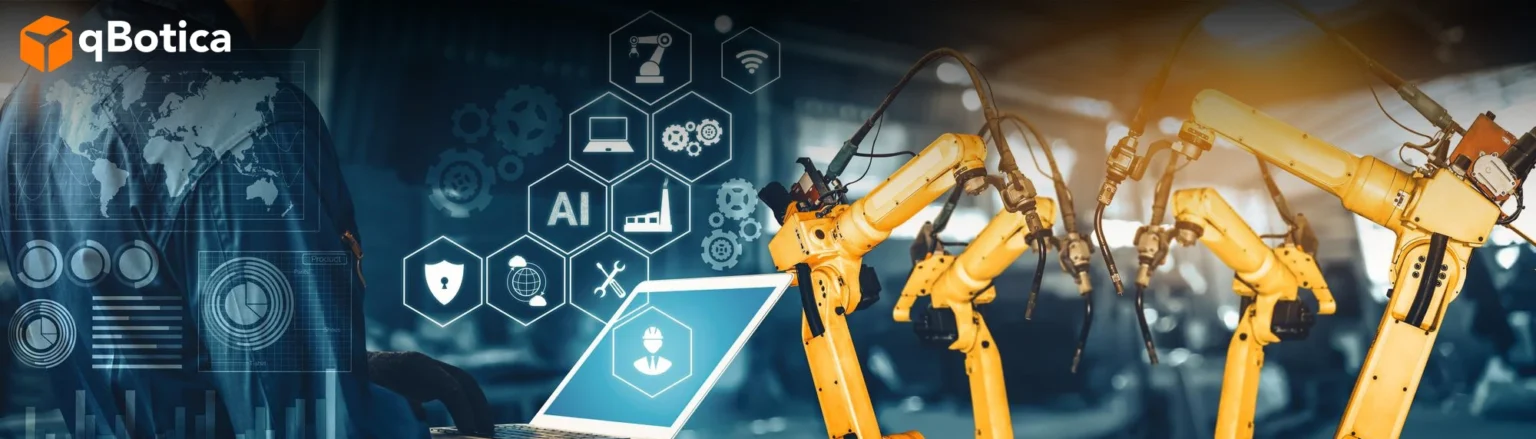
  • Revolutionize the Power of Digital Transformation in Manufacturing

    Revolutionize the Power of Digital Transformation in Manufacturing

    Harnessing the Power of Digital Transformation to Revolutionize Manufacturing

    Digital transformation in manufacturing is essential to achieving considerable gains in operations on the competitive manufacturing market in the states of the USA. McKinsey notes that the impact of digital transformation in manufacturing is the ability to increase throughput by between 10 percent and 30 percent, improve the cost of quality by between 10 percent and 20 percent and decrease machine downtime by up to 50 percent. Even with these transformative advantages, a PwC study indicates a mere one-third of manufacturers have moved beyond the planning stage, failing to fully grasp the growth potential that penetration to digitalization can bring. qBotica has made it to the list of Deloitte Technology Fast 500 which speaks volumes about how digital-first strategies are becoming the future of manufacturing.

    At qBotica, we are experts in transforming manufacturing enterprises through this pivotal process. We are one of the most-established providers of Intelligent Automation as a Service; we are creating full-service automation environments specific to the US manufacturing market needs. As a UIPath Diamond Partner we have established ourselves as a company with expertise and focus on the provision of high quality RPA solutions. When you work with us, you will have the best-in-class automation technologies to work with and you will be on your way to start to think inside the Bots initiating the efficiencies and innovativeness in your operations.

    Our goal will be much more than simply a service provider- we will be your resolute guide in reaching digital excellence. As Certified UIPath Platinum Partner we have extensive experience in RPA and we can offer you the best level of knowledge in the field and technical support. Our bespoken hyperautomation solutions will simplify your manufacturing systems to increase productivity and cut costs. qBotica helps you to achieve full potential whether you are just starting your digital transformation journey in manufacturing or you want to optimize the existing systems.


    How Robotic Process Automation Can Simplify the Transition to Digital Transformation in Manufacturing

    The digitalization of the manufacturing sphere in the USA is gaining pace because more and more companies want to make processes more efficient, minimize expenses, and stay ahead of their competitors. Digitalization, with the adoption of robotic process automation (RPA), is part of this movement. How embracing digital manufacturing can help your organization and how our experience in RPA can ease your transition:

    Heightened Operational efficiency
    Digital manufacturing incorporates cutting edge technologies such as IoT, AI, and data analytics to enhance the streamlining of operations. This causes optimized production processes, shorter time-to-market and lower operational costs.
    Increased Data Use
    Through digital manufacturing, businesses will be able to use real-time information in order to make informed decisions, anticipate the requirement of maintenance and enhance the quality manufacturing.
    Cost Cutting
    Automation and digital products significantly cut down on manual involvement, human error, and the process cost, resulting in huge cost savings in the production cost.
    Flexibility and Adaptability
    Digital manufacturing allows manufacturers the flexibility to be able to swiftly adjust to shifting market needs and consumer demands. This flexibility is important in remaining competitive in a very dynamic industry.
    Optimized Business Processes
    RPA frees your business team of mundane and time-consuming tasks to help them engage in more strategic business operations. This enhances work output and makes the routine processes to be performed very quickly and accurately.
    Fluidic Integration
    Our RPA integrates and fits in very well with your current systems, and that means, regardless of the proficiency in the systems there will be no exceptions to the process scheduled to shift to digital manufacturing. With this integration, the data consistency and continuity of operations are ensured which carry on with your operations.
    Increased Accuracy & Reliability
    Automation of processes using RPA minimises human errors, and makes your manufacturing processes highly reliable. This creates better quality of products and consistency, updating the general performance of operation.
    Scalability
    RPA products are deemed to be scalable, meaning that you would be able to increase automation functions as business continues to flourish. This adaptability caters to the changing needs of manufacturing and it facilitates in dealing with the rise in production volumes appropriately


    Current State of Digital Transformation in Manufacturing Industry

    The concept of digital transformation is transforming the manufacturing sector changing the way the companies operate, produce, and deliver products extensively. More and more manufacturers are looking into digital solutions as technology advances to remain competitive and up to date with rapidly changing business environments. The following is a quick overview of where digital transformation stands today in the manufacturing industry:

    Widespread Adoption of Advanced Technologies

    Producers are adopting various expensive technologies in order to improve their businesses. The most important technologies are:

    • Internet of Things (IoT): Devices which are connected to the IoT are utilized to monitor and control equipment and production processes in real-time can also give valuable data that can be used in predictive maintenance and creating efficiency in operation.
    • Artificial Intelligence (AI) and Machine Learning: AI and machine learning algorithms can be used to analyze large amounts of data to optimize production processes, improve quality control, and use predictive maintenance.
    • Robotic Process Automation (RPA): RPA of manual and monotonous work is saving time and minimizing human mistakes in the production of goods.
    • Additive Manufacturing (3D Printing): 3D printing will also transform prototyping and production making complex parts and products in a relatively short time rapidly and at reduced cost.


    Emphasis on Data-Driven Decision Making

    At the centre of digital transformation is data. It is through big data analytics that manufacturers are gaining insight into every aspect of business. It is possible to collect and analyze data in real-time:

    • Enhanced decision making: with data-based insights, manufacturers can make better decisions, which allows them to optimize production plans, inventory and make more effective responses to changes in the marketplace.
    • Improved Quality Control: Sophisticated analytics detect patterns and possible problems in advance, and thus it allows proactive actions to help keep product quality high and defects minimal.


    Integration of Smart Manufacturing Systems

    Wise production systems are on the rise. The systems combine different technologies in the digital world to deliver more productive and nimble production settings:

    • Cyber-Physical Systems (CPS): CPS fuses physical machines with digital technologies, to form a network of systems that increase automation and control.
    • Digital Twins: Digital Twins- A digital twin is a virtual imitation of an actual asset to give the manufacturer the capacity to resemble, forecast, and boost execution on the fly.
    • Cloud Computing: Cloud-based solutions offer flexible and scalable services that allow storing data, analysing data and collaborating, which makes it effective in contributing to digital transformation across the supply chain.


    Problems and obstacles to adoption

    Despite myriad positive changes that digital transformation may have, a number of challenges exist:

    • Expense of Implementation: Initial investment cost on digital technologies and infrastructures may prove to be expensive thereby posing a threat to small-scale manufacturers.
    • Data Security: As the number of manufacturing activities adapted to be digital continues to increase, the concern of cyber-security threat and data breach emerges and therefore security should be on it.
    • Skill Gaps: The need to be skilled continues to rise and skilled people can manipulate and operate high performance digital technologies. Closing these skills gaps is the element of successful digital transformation.
    • Change Management: When shifting towards the digital processes, there should be a change in the attitude and the organizational culture. Manufacturers have to handle this change well in order to make it smooth. Incorporation of AI process.


    Future Directions

    With a vision towards the future, digitalization of the production process can be characterized as the movement that is likely to further develop, including trends:

    • Greater Adoption of Artificial Intelligence: Artificial intelligence will be more used to bolster production process optimization, improved predictive maintenance, and autonomous operational capability.
    • Increased Focus on Sustainability: The availability of digital technologies will enable sustainable manufacturing operations as it will optimise the use of resources and enhance waste minimisation.
    • Improved Collaboration: Supply chain collaboration across the entire supply chain is expected to improve as digital tools also increase collaboration, aiding in more connected and responsive manufacturing ecosystems.


    Focus on Customer-Centric Innovation

    Digitization The necessity to transform and evolve into a digital world has encouraged manufacturers to focus more on customer-centric innovation. This involves:

    • Personalization: Use of digital tools to provide personal-level products and solutions which match the specific requirements of the customer, which enhances customer satisfaction and loyalty.
    • Better Customer Response: Use of digital platforms to improve the customer response cycles and response to customers to ensure services and products are matching to the market.
    • Agile Development: Safe-guard digital technologies have the potential of accelerating product development cycles, and to be more responsive to the dynamics taking place in the market and the demands of customers.


    How qBotica is contributing to automation in manufacturing

    By providing manufacturers with smart automation to optimize document-intensive business processes, streamlining supply chain procedures and improving quality control, Botica can add significant value to any manufacturing business. By incorporating AI, IDP, and RPA we save manual work, save money, and maintain high levels of efficiency, and manufacturers can take the time to get innovative, shorten production cycles, and a bigger emphasis on perfecting excellence at scale.

  • Medical AI Companies That Deliver Autonomous Workflow Agents

    Medical AI Companies That Deliver Autonomous Workflow Agents

    What Makes a Medical AI Company Truly Enterprise-Ready

    Not all AI vendors are enterprise-ready in today’s dynamically growing healthcare environment. Proper preparedness means more than providing generic tools like diagnostic apps or medical chatbots. The true challenge is whether healthcare ai companies can transition experimental GenAI solutions to more robust and deployable agents that can fit inside clinical and administrative workflows. To scale to the enterprise level, innovation is not sufficient: To use an enterprise-level innovation takes more than innovative technology…it must be trustworthy, compliant and demonstrably valuable to healthcare enterprises and their organizations.

    Medical AI companies have to prove their effectiveness in varied settings, such as hospital environments in addition to the insurance systems. This would include not only single-use cases but also a complete framework, which would be linked to current EHRs, billing systems and care management systems. The best thing about the main health-related artificial intelligence corporations is their capacity to create an infrastructure, which is scalable and which contributes to the idea of interoperability with adherence to the healthcare regulations that are rather strict, like HIPAA, GDPR, and local patient data conventions. Without such a premise, even the most sophisticated algorithms can find themselves facing the peril of becoming solitary pilots who never get into production.

    The breakthrough innovation of next-generation healthcare ai platforms is they can provide compliance and transparency and automation. It should be possible to explain decisions, audit them, and align them to the best practices in clinical terms. In the case of enterprise clients, the feeling of trust is established when AI systems, unlike replacement, enhance human judgment. Meanwhile, the most successful AI health companies will need to present robust governance models, sustained monitoring and outcome tracking to guarantee regular ROI on health systems.

    Some of the main characteristics of an enterprise-ready artificial intelligence healthcare companies:

    • Scalable deployment from pilots to enterprise-wide rollouts
    • Seamless integration with EHRs, billing, and existing workflows
    • Strict adherence to compliance and data privacy regulations
    • Transparent, explainable, and auditable decision-making
    • Continuous monitoring, governance, and ROI tracking


    Where Most Medical AI Platforms Fall Short

    As the hype around healthcare AI vendors persists, not all platforms are able to reach the level of enterprise readiness that the healthcare organizations require. Many solutions found on the market are limited in scope and target a single healthcare task, e.g., image detection or a chatbot-like patient engagement. These tools might exhibit solid performance in isolated pilots, but they may tend to be broad, connected and governed to scale around the complexities of the healthcare ecosystem.

    One typical pitfall is a lack of deep integration. Companies using ai in healthcare are unable to integrate smoothly with EHRs, claims systems, or billing infrastructure. In the absence of such connectivity, even accurate insights are unlikely to lead to an operational or clinical impact. Enterprise-scale deployments require more than data ingestion, interoperability integration to the entire healthcare IT stack is becoming a necessity. It is here that single-purpose models with lightweight functionality fail- since they won within silos, not within a workflow of care.

    The other key gap is compliance. Enterprise healthcare is about not only the accuracy of AI but about systems that are designed with HIPAA, GDPR, audit logging, PHI access controls that are baked in. Most platforms believe in compliance as an afterthought and not as a prime architecture principle. This exposes organizations to regulatory risk and chilling adoption even though its technical characteristics are interesting.

    Lastly, a majority of the solutions limit to suggestion or reporting, but not really automation of the workflow. It has become increasingly common to have enterprise clients seek to move AI beyond just insight to action as a means of close claims, prioritization, or live scheduling. Medical AI cannot effectively support healthcare systems without automation and therefore will be relegated to pilot functionality and results.

    Common Shortcomings of Medical AI Platforms:

    • Narrow focus on one function (image detection, chatbot, etc.)
    • Lack of connectivity with EHR, claims, or billing systems
    • Weak or missing compliance features (HIPAA, audit logs, PHI control)
    • Limited to reporting/suggestions, with no automation into workflows


    What Sets qBotica Apart as a Healthcare AI Partner

    The majority of medical AI companies have an issue of being stuck in single-use pilots, whereas qBotica has been engineered to provide enterprise-level automation at scale across the healthcare environment. qBotica brings together the strengths of the UiPath-driven back-end automation infrastructure and a cognitive, self-expressing front-end agent powered by GenAI to enable the most effective possible hybrid approach to process orchestration: AI-enabled front-end intelligence at conversational levels. The healthcare organizations that are enabled by this dual layer means, do not only get to see insights, but they also see results that are actionable, trackable, and fully compliant.

    qBotica is strong in that it has the ability to work at strategic touch points through the patient and provider journey. Automate intake and eligibility verification to benefits management, prior authorization, discharge coordination, qBotica offers automation where it counts. Work flows are also configurable to enable organizations to fit automation to specific operational requirements without necessarily losing flexibility with changing processes. Having human-in-the-loop review in place provides an additional level of control over making sensitive decisions in a transparent way, and audit-ready logs can help to demonstrate compliance with HIPAA, GDPR, and other regulatory policies.

    This is unlike other commonly used healthcare AI platforms that end at reporting, our qBotica automation is designed to be end-to-end. That translates to health payers and providers attaining quicker ones, less administrative load, and easier patient experiences. With process automation combined with genre-specific GenAI, qBotica enables personnel to devote time to patient care and reduce redundant work and risk of non-compliance.


    Key Healthcare Use Cases for AI Agents

    Patient Intake & Eligibility

    AI agents will accelerate one of healthcare processes that take the most time-patient intake and insurance eligibility. Scanned insurance documents become summarized and validated without a manual input instead of errors being flagged only afterwards. It is then fed into payer and provider systems via structured data cross-injected with high accuracy and velocity. This streamlines administrative costs, and it also enhances the patient onboarding experiences.

    Real-use case: Eligibility & Benefits Bot
    qBotica bot automates eligibility and benefits verifications to ensure coverage in mere minutes and relieve staff of the tedious verification process to cause quicker intake and streamlined patient experiences.


    Prior Authorization Automation

    AI agents make the historically time-consuming and inaccurate process of prior authorization much faster. New requests are automatically received and diagnosis/ procedure codes are extracted and compared against payer rules. Automated decision making uses criteria to auto-approving or redirecting to a human reviewer, eliminating the admin and performance bottlenecks that come with delays. This would make compliance possible with a minimum of denials, due to improper or incomplete submissions.

    Real Use Case: Prior Auth & Denial Management Agent
    The agent reduces workloads through the simplification of prior authorizations, and the denials inquiry process, which increase turnaround times and assure providers can receive approvals efficiently and safeguard their revenue cycles.


    Claims Processing & Reconciliation

    Workflows under this category benefit immensely with AI agents that electronically match procedures and diagnosis codes to ensure that they fit with payer requirements. They summarize EOBs into tabular forms which are easy to review with the help of which the staff can immediately check payment information and outstanding balances. Abnormal situations like underpayments, duplication or code mismatches are highlighted within minutes of them occurring to be addressed. These agents fill in the accuracy gap between clinical documentation and financial processes by communicating directly with EMRs and payer portals, minimizing current revenue leakage and stimulating claim remittance. Automation-based claims management brings efficiency and financial accurateness to the healthcare teams.


    Discharge & Follow-Up Agents

    Using AI agents, the process of discharge is revolutionized as the instructions issued by physicians are summarized to form brief directions that patients can understand. They produce reminders of medication, follow-ups and lifestyle change in a timely manner to keep patients busy in their recovery. In addition to communicating with patients, these agents auto-plan care coordination activities, including making follow-up appointments, ordering home health care, or sending notifications to care teams, inside hospital systems. This decreases manual hands offs, reduces risks of readmission, and enhances continuity of care. Automating discharge and follow-up workflows achieves healthcare providers safer transitions, empowered patients, and frees clinical staff to engage in value-added interactions.


    How Agentic AI Improves Patient + Admin Outcomes

    The healthcare systems are continuously under pressure to enhance patient experiences and cut down on administrative overheads. The AI tools that have been available traditionally may have provided incremental value but agentic AI is reinventing the game. Compared to the static models, agentic AI solutions can operate autonomously: accessing, verifying, and transferring data between systems. The difference is quantifiable in the impact on patients and administration teams.

    Among the most obvious benefits is intake. Agentic AI allows authorizing document validation and eligibility checks to be automated, leading to as much as a 5x increase in speed over manual processes. This helps the patients in terms of lower wait times, reduced duplication of forms and increased assurance of their insurance information being correct. Admin personnel in turn will not spend time chasing errors but more time fixing exceptions that really require human judgment.

    Other long-standing sources of pain, prior authorization and insurance validation, are also transformed. The volume of manual work in this area can be decreased by 60-80% via agentic AI that automatically extracts diagnosis and procedure coding, payer rules checking and case routing. This drastically decreases delays and minimizes denials and patients have timely access to care. In the case of healthcare organizations, the outcome is a quicker turnaround of the revenue cycle and reduced reimbursement losses.

    Most importantly, agentic AI responds to the human aspect of administration. Claims, intake, and prior authorization activities all accumulate to cause staff fatigue and burnout. Shifting AI to repetitive processes in an organization allows organizations not only to become efficient but also to establish working environments that are more sustainable. The personnel have more time to put towards activities that are more valuable, and patients can get a smoother and more responsive care experience.

    That is why enterprise-ready automation is in higher demand among medical AI startups than one-time solutions. Equally, AI medical device companies are looking at agentic AI to promote interoperability and real world outcomes. These advances in technology can be described as a watershed in the use of technology that compliments healthcare provision.

    At a Glance: Outcomes

    • 5x faster patient intake and eligibility completion
    • 60–80% reduction in manual prior auth and insurance validation
    • Lower staff burnout, higher patient satisfaction


    Why Hospitals and Health Plans Choose qBotica

    In assessing AI partners, healthcare organizations require more than a point solution, they require capabilities that are enterprise-ready and deliver a quantifiable impact. A vast majority of market vendors provide fewer providers with the ability to abstract away the challenges of compliance, integration, and workflow automation that health systems experience each day. Thus defining the qBotica as one of the top healthcare ai companies, which provide a platform that can be scaled on both the provider and the payer sides.

    This is in contrast to other vendors where there is no need to build up workflow agents. This results in long development times like typical vendors do before an agency is fully adopted. The platform also supports interoperability of clinical and administrative systems because of seamless EHR, API, and HL7 integration. Audit born logs and built-in HIPAA compliance safeguard sensitive patient data and have regulatory compliances. Above all, qBotica is not only automation: Automation + GenAI offers not only the execution of the processes but also intelligent front-end interaction, a task that the best healthcare AI companies fail to provide regularly.

    Criteria Typical Medical AI Vendor qBotica
    Prebuilt Workflow Agents
    EHR / API / HL7 Integration ⚠️
    HIPAA Compliance ⚠️
    Audit Trail & Logs
    Automation + GenAI Combo

    qBotica is one of the leading providers of ai technology in health care which helps not only to hasten the process of intaking patients, improving their prior authorization, streamlining in claims management, and coordinating discharging of the patients smoother. qBotica has repeatedly been identified as one of the top artificial intelligence healthcare companies in the field of artificial intelligence in healthcare, where inevitable innovations have taken on reliability in its definition.


    Ready to Deploy Medical AI That Works Like a Team Member?

    Healthcare doesn’t just need tools—it needs intelligent partners that integrate seamlessly into daily operations. qBotica AI agents are set to work as real team members, using automation and GenAI to make a tangible difference in key areas of the intake, prior authorization, claims and discharge processes. Our solutions are compliant, audit-able, and easily interoperable, allowing providers and payers to expand more rapidly, enhancing administrative benefit.

    • Book a Live Demo of Our Healthcare Agents
    • Download the Healthcare AI Agent Framework
    • Explore Our Full Healthcare Use Case Library
  • Why Leading Healthcare Technology Companies Are Betting on AI Agents

    Why Leading Healthcare Technology Companies Are Betting on AI Agents

    The New Wave of Healthcare Tech: From Data to Decisions

    Top healthcare technology companies have traditionally been propelled by requirements to digitize records, provide compliance, and produce reports for regulatory and operational reasons. In legacy IT applications such as electronic health records (EHRs) or hospital management software, they somehow succeeded in making digital warehouses of patient and institutional data. However, such programs proved very often to leave providers with disintegrated information, a factor that influenced one to put effort in interpreting reports and taking a meaningful action. What was achieved was more bureaucracy rather than better decision-making, significant absence of impact on real world their information gathering efforts.

    Today’s top healthcare technology companies are shifting beyond digitization to solutions that genuinely facilitate smarter care delivery. As automation, generative AI, and a seamless platform-to-platform experience is becoming more in the spotlight, payers and hospitals are reducing the friction between insight and action. This transformation is being driven by AI agents, which act as effective intermediaries that go beyond studying data to tracking workflows, signaling events and recommending evidence-based subsequent actions. This revolution takes healthcare technology out of an inactive reporting tool and changes it into an active decision making partner. By bridging the gap between action and data, AI agents enable clinicians, administrators, and patients to attain improved outcomes with more efficiency.


    Where Most Healthcare IT Vendors Fall Short

    No real process automation

    The majority of healthcare IT businesses including the top healthcare technology companies are specialized in dashboards, analysis and visualization, but they do not go to the end of processing automation. Such tools can bring data into better focus, but clinicians and administrators will frequently need to determine what the results are saying and what actions need to be taken on their own. This is to make a system that informs you, but not so much. Not having robotized decision-making delays key processes and increases expenses in those areas where speed matters, such as in hospitals or when settling insurance claims. When dashboards lack AI-driven agents that can analyze and execute, dashboards merely appear as screens accessing data and not engines of real change.


    Long deployment cycles, custom code

    The second significant weakness in even some of the top healthcare IT companies is the use of protracted and complicated deployment. Solutions tend to be highly customized and proprietary and to need deep integration work prior to being operational within existing work flows. Although this can speed up the value, it is a time-to-value delay and a high burden change management across both clinical and administrative teams. These disruptive rollouts are strenuous to deal with by hospitals and payers which are already strained in terms of resources to manage. Rather than help to empower the staff, these tools introduce complications and opposition. To the contrary, contemporary AI-centered platforms are focused on plug-and-adapt implementation, characterized by minimal interference and allowing to scale up faster with quantifiable outcomes.


    No audit or compliance intelligence

    Little or no audit and compliance intelligence built into most healthcare IT solutions is a severe failure and a weak point. This gap is quite dangerous in the environment where HIPAA rules and protected health information (PHI) are involved. Vendors could possibly offer reporting functionality, however hardly any systems actively monitor, flag or ensure real-time compliance. In absence of intelligent oversight, organizations are exposed to risks of data breaches to regulatory penalties that are expensive to deal with. Compliance turns into a hand-written and error-prone procedure instead of an automation. With AI-powered tools, this is shifting as automated compliance measures are built into the workflow process establishing the highest security and integrity without being a drag on the activities.


    What Sets qBotica Apart in the Healthtech Landscape

    By contrast to the traditional IT companies for healthcare, which rely on dashboards and partial digitization, qBotica software being one of the top healthcare IT companies, is designed to provide a fully automated process. qBotica brings together a UiPath proven automation stack with Generative AI and proprietary agentic workflows so healthcare organizations can bridge the gap between insight and action. This practice converts the traditional reporting system to an automated, dynamic decision-making system which achieves actual results.

    qBotica solutions are HIPAA-ready and can guarantee patient data security and confidentiality in every step. This is especially important in the PHI-drive ecosystem whereby most legacy tools lack the ability to in-corporate audit intelligence. qBotica is one of the most progressive healthcare automation vendors, which can be implemented into a payer, provider and medtech ecosystems without the need to install long-term deployments using custom code. Rather than the proliferation of silos, it choreographs functions across systems to achieve quicker, more trusted results.

    The difference between qBotica and other IT companies for healthcare is the way it can be more than a vendor: qBotica is a transformation partner. qBotica gives organizations the power to quicken decision-making, lessen compliance risk and enhance efficiency by positioning itself as a new-generation leader among healthcare automation vendors, to raise the bar in the healthtech industry.


    Real AI Agent Use Cases in Healthcare

    Intake & Eligibility Automation

    Among the most effective where to apply AI agent in healthcare is the smoothening of patient reception and validity checks. Conventionally, employees have to process information in documents manually, confirm insurance benefits and key information into payer or provider databases- a process that is time consuming and prone to errors. In the end-to-end automated workflow that AI agents support, data extraction occurs in forms, eligibility checks against payer databases and auto-population in the respective fields in various systems. This is not only faster to onboard patients but also minimises burden related to administration and claim denials. The providers will also be able to spend more time attending to care delivery than they would spend on paperwork since the accuracy and compliance is taken care of at the very beginning.


    Prior Authorization & Denials

    One of the most time consuming and complicated processes in healthcare is prior authorization, as it usually results in care delays and administrative disappointment. This workflow can be vastly sped up by AI agents that issue the needed documentation, makes queries to insurers, and escalates cases when necessary. Instead of personnel going after clearances or redoing half-baked submittals, the AI agent guarantees truthfulness of data as well as compliance. This reduces the likelihood of denials, minimizes rework, and accelerates approval rates. Automation of prior authorization has allowed providers to reduce turnaround times, make their patients more satisfied, and focus funds on direct care activities.


    Claims & Billing

    Revenue cycle problems occur in claims management and billing, which are areas where exceeding efficiency affects the revenue cycle. By automatically summarizing Explanation of Benefits (EOBs), detecting anomalies and raising red flags due to inconsistencies that could result in denials or disruption to payments, AI agents can streamline this process. In addition to merely reporting, including manual cleansing, they interact with the clearinghouses and internal billing systems to reconcile claims and update status, as well as initiate corrective action. This is an active process that minimizes losses on revenue collection, speeds reimbursements and increases adherence to payer requirements. Healthcare organizations can save huge administrative overheads by automating these mundane but critical processes and can be more accurate and timely by having more accurate and timely financial results.


    Discharge & Coordination

    The discharge planning frequently entails numerous contacts such as care directions, medication directions, later visits, and the liaisons with external providers. AI agents simplify this process by automatically creating patient-specific discharge plans and action plans which are well-structured in accordance to patient records and care plans as well. They also auto-schedule follow up visits, therapy or lab tests, which means that care is seamlessly continued without the need of coordination by hand. The AI agents crosscheck data in systems and, therefore, minimize errors, decrease readmissions, and enhance the patient adherence to the recovery plans. This level of automation will not only aid the providers, but gives patients clear, timely directions to assist in transitioning helpful as they leave the hospital.


    How Healthcare CIOs Are Choosing Tech Partners Today

    CIOs in the healthcare sector are under increasing pressure to produce comparative, outcome-based results within a short time and have to work with minimum budgets and strict compliance standards. Consequently, the requirements of choosing technology partners have changed. CIOs are ditching gaudy platforms with infinite capabilities and focusing more clearly on time to value, i.e., solutions that can be up and running quickly, that do not require tens of thousands of hours to integrate with legacy systems, and whose value can be demonstrated within a matter of weeks instead of years.

    Also evident is the preference to modular and low-code solutions which are less reliant upon custom development and can therefore be easier to adopt across teams. Together with explainable AI, such tools will enable stakeholders to be educated in decision-making logic, essential to patient-care and regulatory contexts. Just as important is the promise of auditable and secure, particularly in ecosystems subject to HIPAA and other international compliance regulations. CIOs require partners not only to provide automation but also the accountability in all the processes.

    Key priorities for CIOs today:

    • Time to Value: Quick deployment with measurable ROI
    • Modular & Low-Code: Flexible adoption without heavy coding
    • Explainable AI: Transparency in decision-making logic
    • Auditability & Security: Compliance built into workflows
    • Strong Support: Long-term partnership with scalability


    Let’s Build an AI-Driven Healthcare Operation Together.

    Traditional IT tools are no longer enough to meet the speed, compliance, and outcome demands of modern healthcare. Healthcare sector if qBotica performs as the top healthcare technology companies and goes beyond dashboards and static platforms to deliver HIPAA-ready AI agents that automate intake, eligibility, prior authorization, billing, and more. By integrating UiPath, GenAI, and proprietary agentic workflows, we provide an opportunity to payers, providers and medtech organizations to accelerate time to value and deliver significant levels of impact. Want to see how?

    • Schedule a Demo of Our Healthcare Agents
    • Download Our Healthcare Automation Use Case Deck
    • Explore Our Healthcare Outcomes Tracker


  • Best AI for Business: Beyond Tools to Intelligent Enterprise Solutions

    Best AI for Business: Beyond Tools to Intelligent Enterprise Solutions

    What Does “Best AI for Business” Really Mean in 2025? Why “AI tool lists” are not enough anymore

    In 2025, simply searching for the best AI tools for business won’t take you far. The challenge is that as more and more AI apps enter the market in the thousands, business leaders are learning that the value of individual tools is relatively useless and will not actually add much value to business workflows; instead, it is the integration, orchestration, and alignment of those tools among themselves and real business processes where the true value emerges. For startups there are some of the best ai for small business.

    The two most common types of lists of Top 10 AI technologies are made up of surface-level features or short-term use cases. But what truly differentiates the best AI software for business is its ability to plug into your CRM, ERP, ITSM, and data platforms—and deliver automated, explainable results at scale.

    Inevitably, enterprises require more than smart tools. They should have systems that know compliance, that scale safely and that are transparent. Startups and established enterprises need to set their sights on orchestration, auditability, and lifelong learning. That’s why selecting the best AI tools for small businesses in 2025 is more about fit, governance, and strategic alignment than flashy features.

    What to look for:

    • Being included in enterprise stacks (cloud, CRM, RPA) that are Native
    • Human-in-the-loop control HITL Audit logs
    • Performance monitoring, and model management
    • Versioning and feedback loop Fishbones
    • Localization localization and compliance preparedness Data privacy

    Ultimately, the best AI software for business is not a standalone app—it’s an ecosystem of intelligent components working in sync. The 2025 success stories of businesses using AI are those who do not just think about tools but develop AI-infrastructure that can grow.

    Well, the question you have to ask before you select something is, does this tool communicate with all the other stuff I have? And as my business develops, will it evolve too? These questions lead to the understanding of best AI tools for small businesses 2025.


    Comparing Popular AI Apps vs Enterprise Solutions

    Popular Tools (ChatGPT, Jasper, Copy.ai, Zapier AI)

    Tools in the fast-paced world of AI have normalized and become few with some outstanding features that make them more accommodative and easy to use. An example of the best ai chat for business is ChatGPT developed by OpenAI and which has become extremely useful in assisting business in all aspects such as customer service, content creations, and internal knowledge search. It has advanced language creation services and is being embedded in business processes in industries.

    Another popular AI writing assistant is Jasper that is most commonly used by marketers and content departments. Jasper is known to have an intuitive interface and brand voice training and is commonly used in the generation of high-quality blog posts, advertisements, emails, and web site content in a quick and very consistent manner.

    Short-form content is also abundantly created using Copy.ai. It is also good at writing product descriptions, social media captions and advertisements. It can be used by even non-technical users because of its pre-packaged templates that give fast usable results. It is one of the best ai for businesses.

    The use of Zapier AI introduces automation into the equation Since Zapier works with any app in its library, businesses are ready to create their own smart workflows at scale by injecting AI logic into their no-code workflow builder, e.g. automatically summarize emails, send leads to the right teammates, draft responses, and more. This helps in making the best ai for business plans.

    As impressive as the best AI tools for businesses are in isolation, they can be so much more when implemented strategically on an integrated basis to bring efficiency, personalization, and scale to any business. The impact of these AI tools also depends on entering the best AI prompts for business.


    Financial Operations

    While going through the best AI books for business, you will find that the banking environment is so highly regulated that compliance is paramount and expensive. Generative AI can transform financial institutions to manage their regulatory needs with a Compliance Bot. Based on the AI, such a solution can compile terabytes-worth policy papers automatically, verify internal reporting against up-to-date regulations, and highlight possible compliance risks on the fly.

    As compared to manually performed audits, which may be sluggish and prone to errors, the constant operation of this bot searches the updates and contrasts the modifications in various documentation. It connects to the internal banking systems and operations and provides a smooth analysis process where gaps or mismatches are issued to the compliance teams early enough. Summaries and regulatory briefings can also be generated by the bot that will take hours of work by human resource and jumpstart decision-making.

    The Compliance Bot can find meaning in complex rules and regulations with the use of natural language processing and contextual reasoning abilities and provide guidance rather than raw information. This also records all the actions and decisions for complete auditability and transparency making it the best AI for small businesses.

    Result: Quicker compliance checks, lower operational expenses, decreased amount of penalties, and higher trust of the stakeholders.

    Be it anti-money laundering (AML) compliance, Know Your Customer (KYC), or other data privacy laws such as GDPR, GenAI-powered Compliance Bot assists banks in remaining at the forefront of regulatory needs and increasing efficiency and accuracy as well.


    Business Planning & Decision Support

    One problem with the current business environment is that companies require intelligence rather than templates. Generative AI (GenAI) proposes an innovative mind shift with the capacity to compose entire business plans with market models, financial assumptions, competitive analysis, and GTM strategies within minutes. It saves a lot of time, manual investigations, and supports the uniformity of formatting and reasoning. This is why many professionals now consider it the best AI for business plan generation.

    GenAI is not limited to merely generating a static document. It also checks the validity of prices set, compares product set-ups to market data and it can even assist with scoring vendors to optimize procurement. These are smart recommendations based on not only internal data but also on the insights of the general public, so that all of the recommendations are intelligent and up to date.

    GenAI is also great when it comes to writing. Whether it’s executive summaries, investor decks, or stakeholder reports, it structures content clearly, aligns tone with audience needs, and shortens revision cycles—earning it a reputation as the best AI for business writing today.

    It is flexible and can therefore be used in both start-ups and enterprises. Whether refining an existing business strategy or creating one from scratch, teams are turning to GenAI as the best AI for business plan development and the best AI for business writing across functions.


    Marketing Automation

    By 2025, organizations are leaving behind many tent templates and instead seeking Generative AI to enable them to develop dynamic and intelligent business planning. The excellent AI of our time in the business plan creation parallels not only text formatting but also strategic thinking incorporated into the text. GenAI is capable of writing full business plans, which may include models of revenue, conditions of operations, market sizing, and go to market plans. It knows your industry, it connects with your information and puts the plan in a form that looks clear and it can be presented to investors.

    Want a gap check on prices, product set ups, or vendor evaluations? GenAI will be able to do that too. It looks at the past, and market feedback to assist groups in calibrating pricing frameworks, analysing product market fit and even propose vendor scoring systems. This is the deepest understanding, and hence only choose the best ai tools for business productivity when it comes to business writing, and not only planning.

    These tools accommodate changes in your strategy whereas the static templates do not. GenAI makes iterations extremely fast so that your plans can be synchronized with changes in the business. Be it a startup or an enterprise, having the best AI agents for small business available will give you a competitive advantage over speed and accuracy as well.

    Whether it be pitch decks or even executive summaries, the best ai apps for business makes the entire process more intelligent, quicker, and more precise – converting raw thoughts into lucid, assertive plans.


    Best AI Platforms by Category (2025 Outlook)

    Businesses are increasingly looking beyond the superficial appeal of AI to implement purpose-built technologies that generate tangible value within the enterprise. Enterprises are choosing the best AI platform for business. AI in 2025 is characterized by an apparent divide between platforms that have gained mindshare, such as ChatGPT and Jasper, and enterprise-level leaders, such as specialized stacks built by qBotica, as they can create extensive operational benefits.

    The likes of ChatGPT, Claude and Perplexity are at the forefront of the mind in the Chat category, when it comes to general use and research. However, businesses are shifting towards the best AI platform for business such as the qBotica GenAI Agent + LLM stack, which introduces governance, auditability, and workflow orchestration on top of large language models.

    When it comes to Productivity, the consumer-oriented applications such as Copy.ai, Notion AI work to ensure that people are writing quickly and working smart. Nonetheless, writing assistance is not enough without automation of enterprises. They require the best AI tools for business analyst. This is the part where the RPA + GenAI automation of such leaders as qBotica kicks in, making it possible to handle tasks with intelligence, process documents, and do cross-platform integrations on a larger scale.

    LivePlan AI or Jasper are some of the best AI tools for small business when it comes to drawing pitch decks and forecasts regarding Business Planning. However, on the enterprise level, qBotica Decision Agents introduce contextual decisioning, pricing logic, and multi-model strategy verification, which is supported by LLMs with business logic fine-tuned.

    Intercom Fin and Zendesk AI are utilized by Customer Service to offer effective initial AI-powered ticket management and chat interfaces. However, qBotica Service AI Stack is taking this further with the integration of GenAI and backend systems (CRMs, ITSMs, ERPs) so that in real time, any issue can be triaged, escalated, summarized, and resolved with full enterprise-grade compliance and SLAs.

    Category Popular Picks Enterprise Leaders
    Chat ChatGPT, Claude, Perplexity qBotica GenAI Agent + LLM stack
    Productivity Copy.ai, Notion AI RPA + GenAI automation
    Business Planning LivePlan AI, Jasper qBotica Decision Agents
    Customer Service Intercom Fin, Zendesk AI qBotica Service AI Stack

    But in 2025, the discussion of the best AI tool for business gives way to the discussion of the best AI systems to do the job. Although the popular tools are great to experiment with, the enterprise solutions featuring integration, governance, and automation are changing what it means to be productive and deliver satisfying customer outcomes.


    How qBotica Delivers the “Best AI for Business”

    Generic tools for AI do not suffice in the modern business world which is fast paced. Companies need best AI agents for small businesses that go beyond chat to drive real operational outcomes. Custom GenAI workflows are now executing enterprise operations with smart automation, orchestration, and human in the loop-feedback implemented.

    The main turning point of this development is to combine LLMs and Agentic automation with the capacity of enterprise systems such as UiPath, Azure, AWS. This will enable organizations to design domain-specific and secure GenAI workflows that will automate processes such as ticket and document triage, document summarizing, onboarding, KYC and forecasting. Unlike generic tools, these flows are workflow-first and compliance-orientated, that is how decisions can be proven to be traceable and auditable.

    It is a significant leap because of the loop of continuous feedback. The best ai for small business marketing learn by every task they have done. They educate using the edge cases, escalation rules, and offer adaptation to business logic evolution. This is particularly vital for teams choosing the best AI agents for small business, where flexibility and precision must coexist.

    Choosing the best AI platforms for business is no longer about the most popular brand—it’s about interoperability, security, and vertical adaptability. The ability to connect the AI platform as a plug-and-play solution with CRMs, ERPs, ITSMs, and legacy systems enables businesses to roll out the benefits of AI across the departments.

    qBotica’s approach centers on this exact philosophy: GenAI that is tailor-fit, not bolt-on. Their AI agents combine LLM intelligence with structured workflow logic—ensuring every action has business context and every interaction creates enterprise value.

    At the end of it all, companies, whether large or small, should focus on platforms that are not merely generative but act. The best ai tools for business development today is one that orchestrates, learns, and aligns with your exact operational blueprint.

    CTA Block: Stop Chasing Tools. Start Using AI That Works.

    The actual power of AI is not in pursuing the shiniest tools, but in the actual implementation of smart systems that are solving actual business issues. qBotica guides business to out-maneuver the hype with GenAI plans focused on outcomes, to scale, security and ROI.

    Even the best AI courses for business leaders tell us that regardless of the automation, agentic AI, or LLM integration that you are starting to look at, our team will assist you in finding the application that makes a big difference. Whether it is back-office efficiency or bringing another experience to your customers, we develop our AI-powered solutions to live within your ecosystem, not just at its edges. Still looking for the best ai to use for business?

    • Sign up a GenAI Strategy Call with qBotica
    • Get your 2025 Enterprise AI Use Case Playbook!
    • Check Out Our AI Use Case Library

    Find out what the difference is when AI is created to match your processes. We are at the stage to stop experimenting and take GenAI that works.


  • Banking & Financial Document Automation- Accuracy, Compliance, and Speed with Intelligent Document Processing

    Banking & Financial Document Automation- Accuracy, Compliance, and Speed with Intelligent Document Processing

    What Is Banking & Financial Document Automation?

    Banking financial document automation is the use of AI to extract, categorize, and validate financial documents so that institutions can process large quantities of information rapidly, precisely and correctly. With the use of these core technological components of Optical Character Recognition (OCR), Natural Language Processing (NLP), Machine Learning, and Intelligent Document Processing (IDP) platforms, organizations are automating what were considerable manual workflows. This is essential in the case of banks, investments, and financial services where the adherence to regulations requires handing information in a very tight-knit, trackable, and timely manner.

    Specifically, the document automation for financial services industries mitigate operational risks and minimize processing prices, as well as meet the AML, KYC, and other compliance regulations. Automated monitoring of loan agreements, investment contracts, and transaction records can present the user with immediate classification of the data as it is offered, anomalous or not, and may also validate the data against external sources. Document automation for finance helps scale-up with no compromise on quality in the case of a growing institution. With the current tightening of compliance around the world, the automation of financial documents in the banking sector not only offers the benefits of document processing speed, but also the sequestration of data governance in an environment of secure, auditable and efficient financial operations enabled through intelligent automation.


    Pain Points Solved

    Document processing that is done manually poses bottlenecks at the various financial institutions which slows the transfer of vital information. The processes of banks and investment firms include numerous loans applications, contracts, and statements, which are to be reviewed, confirmed, and archived. In the absence of banking financial document automation, these activities can usually take days rather than minutes and have a direct influence on customer satisfaction. The issues of high error rates during financial data capture also add to the problem because keystroke errors or even omissions could cost companies in rework and regulatory noncompliance.

    Compliance risks are also a feature in the financial world, and there needs to be a high degree of accuracy and traceability in relation to AML and KYC as well as to audit requirements. With manual work-flows, it is more challenging to maintain such standards on a regular basis whereas with document automation, financial services data is validated and recorded properly in real-time. It also slows down fraud detection procedures as long as it has been carried out manually where automation of financial documents with the help of AI can identify suspect activity or anomalies in real-time.

    Fragmented document control adds to inefficiencies, because employees would have to go through several applications to search or update the records. This division slows down customer onboarding and loan narrowing, which are processes where quickness is the key to winning the competition. The Finance document automation helps to integrate information across machines and make the decisions that are made quicker and records retrieved easily.

    It is almost certain that the operational expenses will be high using labor-intensive processes since it involves large teams to address workloads that could have been efficiently executed automatically. Besides, at peak times, e.g. quarter-end reconciliations, or tax season, scalability will continue to be a problem unless automation of banking financial documents is possible.

    With the usage of AI-driven solutions, the institutions will have an opportunity to eradicate delays, reduce errors, enhance the compliance rate, and make a better job at fraud detection. Banking as an industry is all about accuracy, speed and being trustworthy, so in an industry where processes are critical, financial document automation of documents in the form of PDF conversions provide advantage in allowing operational efficiency as well as flexibility in meeting regulatory deadlines.


    qBotica’s Platform-Inclusive Approach to Financial Document Automation

    Multi-Platform Expertise

    Experienced with financial document automation of banking financial documents with top IDP automation solutions, such as UiPath, ABBYY, Hyperscience and Automation Anywhere. The fields of expertise include document automation of financial service providers, and document automation of the finance area to automate workflows of extraction, classification and validation. Proficient in designing automated processes that are compliant and secure and can thus cut down on the processing time, minimize error rates and ensure better scalability. Proficient in deploying AI, OCR, NLP and ML technologies to automate the financial document processing processes in the banking sector and the most complex, large-volume financial transactions.


    Document Types We Handle

    Has a background in the financial document automation of the banking industry to process loan application documents, mortgage documentation, account opening applications, compliance documents, KYC packets and investment disclosures. Experienced in financial services document automation, and document automation of finance to give accuracy, compliance and speed. I use AI, OCR, NLP, and IDP platforms to build workflows that minimize human lines of effort, identify errors as early as possible, and scale. Successful track record in the increase of the efficiency of the operation through end-to-end banking financial document automation solutions.


    Seamless Integration

    Specialist in automating banking financial documents and the banking CRM, banking core financial systems, robotic process automation workflows, and cloud infrastructure to achieve end to end business-wide automation. Both are competent in document automation of financial services, as well as document automation of the finance to enable single data flow and compliance ready reporting. Expertise at using OCRs, NLP and AI-powered IDP solutions to provide accuracy, security and scale, to help institutions optimize their processes and realize the full benefit of banking financial document automation investment.


    Compliance-Ready Processing

    Areas of expertise include automation of bank financial documents complying with the KYC/AML, GDPR, PCI-DSS, and other high security standards of the industry. Experienced in document automation of financial services, and says document automation in the finance sector to achieve compliance, auditable, secure document handling. Using state of the art OCR, NLP and AI powered IDP platforms, I develop solutions that ensure that an enterprise becomes compliant with minimal risks and create lean operational work flows that are both fast and precise that are regulation ready. The services of expertise guarantee global and regional financial governance compatibility to the banking financial document automation.


    Key Capabilities for Financial Services

    Automated Data Capture

    Familiar with the financial document automation of banking financial documents that retrieve structured and unstructured data in a variety of banking financial documents such as contracts, statements, loan files, compliance reports. Experienced in document automation in financial tender, financial document automation as well as document automation in finance through AI, OCR, NLP, and IDP platforms. The solutions provide proper categorization, verification and incorporation into business applications, minimizing errors and the need for manual work. Knowledge of providing a reliable, safe banking financial document automation workflow at scale, to high-volume, compliance-intensive financial operations.


    Intelligent Document Classification

    Specialist in banking financial document automation to auto-sort loan files, contracts, statements and regulatory forms, at speed and accuracy. Experience in document automation of financial services, document automation of finances, financial document automation using deep learning technology through classification, optical character recognition, and natural language processing. The solutions give compliance, reduce manual intervention and integrate with the financial systems. Expert at delivering scalable, secure banking financial document automation workflows to increase the level of operational efficiency that addresses the strict industry rules of compliance and complex, high volume document processing.


    AI-Powered Validation

    It is specialized in banking financial document automation to spot the anomalies and lack of signatures, as well as gaps in compliance within critical financial documents right away. Experienced with document automation in financial services, and document automation in finance involving AI, OCR, NLP and machine learning models to build real-time validation features. Solutions provide regulatory compliance, a decrease in frauds and simplification of review frequencies. The ability to rollout secure, scalable and banking financial document automation processes that improve accuracy, compliance readiness, and speed of operations in high volume Finance DRWs.


    Workflow Orchestration

    It is specialized in banking financial document automation to spot the anomalies and lack of signatures, as well as gaps in compliance within critical financial documents right away. Experienced with document automation in financial services, and document automation in finance involving AI, OCR, NLP and machine learning models to build real-time validation features. Solutions provide regulatory compliance, a decrease in frauds and simplification of review frequencies.


    Benefits of Intelligent Document Processing in Banking & Finance

    Automation in banking financial documents can reshape the loan transaction cycle as turnaround time can be cut short by up to 70 percent and the loans institution may serve more cases without compromising on the quality. Automation of data extraction, classification and validation greatly increases the accuracy, and removes costly reworking, ensuring clean, reliable data is fed into core systems.

    Compliance to audits can be enhanced using document automation for financial services and all documents can be traced, timestamped, and safely archived. This reduces the risk of compliance and provides highly restrictive regulations such as KYC, AML, GDPR, and PCI-DSS. Financial document automation also uses automated anomaly detection, which improves in-time fraud prevention and can identify irregularities and missing data before they develop into serious problems.

    Financial document automation also fast-tracks customer onboarding and does not involve the lag in the progress of onboarding due to manual checks and decentralized document handling. We provide a faster decision and improve the customer satisfaction level as well as the operational efficiency in financial institutions through the use of AI, OCR, NLP, and IDP platforms. Finally, automation of financial documents in banks provides speed, compliance, and trust which are the pillars of success in the currently competitive financial services industry.


    Cross-Industry Applications (Link to Related Pages)

    Automation in banking financial documents can reshape the loan transaction cycle as turnaround time can be cut short by up to 70 percent and the loans institution may serve more cases without compromising on the quality. Automation of data extraction, classification and validation greatly increases the accuracy, and removes costly reworking, ensuring clean, reliable data is fed into core systems.

    Compliance to audits can be enhanced using document automation of financial services and all documents can be traced, timestamped, and safely archived. This reduces the risk of compliance and provides highly restrictive regulations such as KYC, AML, GDPR, and PCI-DSS. Financial document automation also uses automated anomaly detection, which improves in-time fraud prevention and can identify irregularities and missing data before they develop into serious problems.

    Financial document automation also fast-tracks customer onboarding and does not involve the lag in the progress of onboarding due to manual checks and decentralized document handling. We provide a faster decision and improve the customer satisfaction level as well as the operational efficiency in financial institutions through the use of AI, OCR, NLP, and IDP platforms. Finally, automation of financial documents in banks provides speed, compliance, and trust which are the pillars of success in the currently competitive financial services industry.


    Why qBotica Is a Trusted Partner for Financial Document Automation

    The demonstrated experience in the financial document automation can be measured in the regulated financial industry structure resulting in accurate, compliant, and operationally efficient processes within the required modes. In document automation of financial services, organizations receive an end-to-end automation ability of document- capture, classification, data extraction, validation, compliance checks and archival of the document in a secure location.

    Through the implementation of both document automation for finance best practices and document automation in finance best practices, workflows are restructured to ensure stringent KYC, AML, GDPR and PCI-DSS regulations are met. This minimizes hand operation, lowers any chance of error, and increases the speed in the quickest processes.

    The solutions are scaled, and capable of supporting retail banks, investment firms, and fintechs, as they scale. No need to sacrifice quality or compliance to meet high demands when institutions use AI, OCR, NLP and enhanced IDP platforms. Finally, by automating financial documents, banking will be able to make faster decisions, enhance customer experiences, and respond to the changes in regulations and business needs.


    Automate Your Financial Document Workflows Today

    • Arrange a Free IDP Consultation-Find out how automating your financial documents to achieve a bank can alter your work processes.
    • Get Financial Document Automation Guide – Document automation financial services best practices.
    • Talk to a Banking Automation Specialist – Get perspective on document automation in finance and scale-ready solutions that are compliance ready.
  • Robotic Process Automation Services Built for Enterprise Impact

    Robotic Process Automation Services Built for Enterprise Impact

    What Is Robotic Process Automation (RPA) and Why It Matters Now

    Robotic Process Automation (RPA) involves software-based bots to emulate human behaviors in accomplishing meticulous processes in doing recursive, guideline-based procedures within virtual systems. In contrast to other conventional software, RPA does not need the strong system integration into business processes, it communicates with solutions in applications as a human being does, via user interfaces. RPA originated as you may expect, with fairly uncomplicated task bots programmed to execute a simple, high-volume task, like data entry or report-making. Over the years, the above capabilities evolved to attend, unattended and hybrid formats, and so, robotic process automation services became an important capability that ensured efficiency in an operation.

    Robotic Process Automation (RPA) is the term that defines exploiting the idea of creating software that achieves the feature of imitating the behavior of a human being in performing the operations of monotonous and rule-based undertakings in digital environments through the use of software bots. RPA is highly superficial in terms of system integrations unlike traditional software, it is not integrated at the deep level and instead, it communicates with applications as a human would through the user interface. The history of RPA can be traced to beginning with basic so-called task bots used to automate and accelerate simple, repetitive tasks, like data entry, or report generation. These capabilities have grown over time to cover attended, unattended and hybrid services with RPA automation services proving to be an essential facilitator of operational efficiency.

    Single automation is moving towards AI-enabled orchestration in the market. Contemporary RPA builds with natural language processing, predictive analytics and decision engines, so it is not that the bots simply do things; they decide what to do next as well. This development makes RPA an enterprise workflow orchestrator in the middle- connecting systems to each other and figuring out what to do with the information and to do so without human operators currently. RPA automation services are also rising to a more strategic level as organizations adopt this shift, blending into more than cost savings, with innovations, agility, and customer experience enhancement added to the mix. That is why this shift makes RPA a vital connection between human knowledge and smart autonomous enterprise functions.


    Core RPA Services We Deliver


    Process Discovery & Mining

    Process discovery and mining use advanced analytics to determine those workflows that are ready to be automated in an organization. Through system logs, transaction information, and interactions involving all possible individuals, businesses get an opportunity to identify inefficiencies, bottlenecks, and repetitive tasks that are best automated. These insights form the foundation for deploying robotic process automation services effectively, ensuring maximum ROI. Contemporary instruments visualize end-to-end processes, emphasize the differences, and suggest priorities in terms of complexity and impact. Such an analytical method not only speeds up automation processes but also minimizes the risks of implementation. With robotic automation services supported by precise process intelligence, organizations can transition from guesswork to targeted, high-value automation at scale.


    Bot Development & Deployment

    The ease of creation and deployment of bots facilitates the process of automation implementation as low-level forms of development allow small iterative builds with eventual incorporation into current enterprise technology stacks. It is a faster-time-to-value strategy that does not require many coding skills. Through robotics automation services, companies are able to plan, and test as well as execute bots that are aligned to the specific workflows in a precise and scalable manner. Automation can also integrate easily with the processes that are already in existence since it seamlessly integrates with current ERP, CRM, and legacy systems. Robotic process automation services provide the businesses with agility, avoid manual tasks, and other efficiencies. This results in a sustainable automation ecosystem which can be modified according to further organizational requirements, and technological innovations.


    Managed RPA Operations

    Controlled RPA activities also ensure a 24/7 operational capability and stability of the robotization initiatives concerning round the clock monitoring of bots, proactive updates and optimum scalability. The approach will facilitate minimum downtime interval, faster rectification of the incidents, and optimization of resources. Organizational institutions that consider robotic automation services can concentrate on core business interests, and experts to deal with the complexity of the operation. Maintenance of bots involves good health checks, performance tuning as well as upgrading versions. In the case of robotic process automation services, companies are exposed to an automation environment that is scalable and resilient in response to changing loads. With the help of extension, it ensures continued value delivery and long-term success without negatively affecting compliance or operational stability.


    RPA with AI/ML Capabilities

    Adding AI/ML to RPA redefines automation as more than just following rules, as it becomes smart, adaptive systems. Combining the robotic process automation services with the high level of machine learning models, the companies add the possibility of solving complex tasks of decision making, predictive analysis, and ensuring real-time exception processing to their bots. Through this synergy, automation does not merely repeat itself in simple cases, but can be applied to dynamic ones, such as in fraud detection, sentiment analysis or demand forecasting. The AI/ML-based capabilities of robotic process automation services enable the business to attain greater accuracy, meet compliance and resolvability needs and drive an intelligent workflow that constantly learns, adapts and offers high values as business operates through varying environments.


    RPA Consulting & Strategy

    Effective automation starts with a well-defined roadmap, and robotic automation services play a central role in this transformation. RPA consulting and strategy entities encompass end to end direction, including process mapping, feasibility study, to developing a framework of scalable automation. Businesses may also use the insights of experts so as to link automation initiatives with strategic objectives; in this way, the success will be measurable. These robotic process automation services also focus on ROI measurement, helping organizations quantify the impact of automation on cost savings, productivity, and compliance. When companies adopt the proper consulting methodology, they can make confident transitions in the pilot processes to enterprise-wide intelligent automation programmes.


    Industry-Specific RPA Solutions

    Healthcare Automation

    A leading RPA services company would be able to automate prior authorization, processing of claims and eligibility checks and adhere to HIPAA compliance. robotic process automation services enable seamless payer and EHR integrations that can help streamline administrative processes through the reduction of delays and the enhancement of patient care.

    Real Estate & Mortgage Automation

    Robotic process automation services streamline loan origination processes and title searches as well as compliance monitoring. This saves time and costs of human error in exchange of property.

    Energy & Utilities Automation

    Whether it is meter-to-cash, outage reporting, regulatory submissions, RPA services increase the speed, accuracy, and compliance of operations thereby maximizing customer satisfaction and operational efficiency.

    Banking Automation

    Automation of KYC/AML, fraud detection and credit authorizations are solutions of RPA services company to automate compliance with faster customer onboarding and decision making.

    Insurance Automation

    RPA services allow policy renewals, automation of claims, and underwriting, saving much time to do these processes manually and increasing the number of customers responded to.

    Manufacturing Automation

    Through the robotic process automation services, the manufacturers are able to monitor the supply chains, confirm the quality control of their products and orders and handle the orders in real time avoiding delays in production.

    Contact Center Automation

    AI-assisted routing, real-time transcription, and ticket triage run on robotic process automation services, increasing the speed of resolution and customer experience.

    Supply Chain & Transportation Automation

    Shipment tracking, customs clearance, and vendor payments are tackled by robotic process automation services, facilitating the logistics.

    Finance Automation

    An RPA services company can automate the approval of invoices, cost control, and reconciliation, which helps in providing faster financial close cycles with greater accuracy.


    Benefits of qBotica’s RPA Services

    Organizations adopting robotic process automation consulting services often experience transformative results, including a 60–80% reduction in manual processing time. These solutions enable employees to concentrate on more strategic and value-intensive tasks as most of the workloads will be automated- high volume and duplicate work. Not only does it produce efficiency in operations but there is also observable attunement in employee satisfaction and productivity.

    Another key advantage of robotic process automation services is improved accuracy and compliance tracking. Automated workflows decrease the chances of producing erroneous results by people, make sure the procedures are run parallel to the regulatory requirements and preserve comprehensive audit records to be accountable. Such accuracy is particularly important within the industries related to healthcare, finance, and insurance where compliance cannot be reached without massive fines.

    Another characteristic of RPA adoption is faster cycle times especially among the mission-critical processes such as claims processing, loan approvals and supply chain operations. Also, processes that previously consumed several days, or weeks, can now be accomplished in a matter of minutes, or hours, resulting in a huge increase in customer satisfaction and competitive benefit.

    Finally, the scalability of robotic process automation consulting services ensures organizations are equipped for growth and change. Since it is simple to scale, RPA platforms also easily adapt to emerging business demands, integrate with new systems and increase the scope of coverage, essentially a long-term investment in agility and resiliency.


    Why Choose qBotica Over Other RPA Providers

    When it comes to robotic process automation consulting services, qBotica stands out by offering a level of expertise and customization that generic providers simply cannot match. Whereas most vendors apply the standard appliances, qBotica has industry-specific frameworks that are configured to respond to the peculiarities of every industry. This accelerates the adoption, improves compliance and makes ROI more meaningful.

    In contrast to generic providers who find integrating AI + RPA very difficult, qBotica integrates advanced automation techniques with artificial intelligence to facilitate smarter decision-making, predictive intelligence and exception control. This leads to better adaptable, powerful and futureproof automation systems. Furthermore, qBotica can provide compliance ready builds so that all the solutions are within the regulation industry and audit requirements are met eliminating all risk and enhancing operation trust.

    qBotica increases the speed at which automation is implemented by using rapid deployment models without sacrificing quality. Going to market much faster and seeing the value, making a process much more efficient, and minimizing costs sooner, gives businesses a competitive advantage. In addition, qBotica has a global delivery capacity and therefore maintains high-quality services across geographies that enhance seamless scalability as organizations expand or enter other markets.

    Feature Generic Providers qBotica
    Industry-Specific Frameworks ⚠️
    AI + RPA Integration ⚠️
    Compliance-Ready Builds ⚠️
    Rapid Deployment Models ⚠️
    Global Delivery Capability ⚠️

    Choosing qBotica means partnering with a leader in robotic process automation consulting services—one that prioritizes innovation, compliance, speed, and global reach to help businesses thrive in the evolving automation landscape.


    How Our RPA Engagement Works

    We measure out our delivery of effective automation solutions into four definite phases that guarantee maximum value on each engagement.

    Discovery
    We start with discovery by mapping your existing processes, detecting the processes that can be repetitive and need to be defined by rules and also identifying gaps which can be used to introduce automation driven efficiencies. This deep dive can enable us to set priorities on the process with the most potential ROI and are aligned with your goals in business.
    Design
    In the design phase we develop an elaborate automation blueprint of what the architecture and the integrations will look like, what security measures will be in place, and how exceptions will be handled. This makes the solution to be of your specific environment and can simply be adopted.
    Deploy
    Whether you want to implement bots into an existing workflow or a set of new technologies, we deploy the most effective tools and methodology to integrate bots into your tech stack with the least interruptions. Our integrated team of engineering, solution and support enables fast time-to-value through a repeatable and stable process.
    Optimize
    Once the bots are put into use, we will continually monitor its performance, acquire analytics, and fine-tune workflows to ensure speed, accuracy, and scale. Over time, after perfecting automation, we make sure that your investment continues bringing long-term benefits.

    This managed, end-to-end approach to work provides companies with the potential of RPA to be fully unleashed- productivity, cost reduction, and an intelligent means of sustainable, scalable growth.


    Automate Smarter, Deliver Faster, Scale Confidently.

    Experience intelligent automation that can maximize your business in your business industry. Our experienced team integrates strong process expertise and best robotic process automation consulting services to make operations easy, precise and fasten up growth. No matter whether you are new to the world of automation or need to expand the solutions already in place, we have the strategy, tools, and support to deliver the results measurably.

    • Book a Free RPA Consultation
    • Download Our Industry Automation Playbooks
    • See Client Success Stories in Action

    It is time to start transforming now- efficiency is a click away.

  • AI Business Use Cases That Move Beyond Insight to Action

    AI Business Use Cases That Move Beyond Insight to Action

    The Evolution of AI Business Use Cases

    The revolution visible with traditional AI to surrogate AI is a huge jump in terms of how companies approach technology. Under the customary models, the artificial intelligence was mainly involved in analyzing information to help predict the future and suggest measures to be undertaken, which were to go through the human personnel side. Although this was a strong method, it tended to induce bottlenecks since decisions had to be manually followed up.

    With agentic AI, this changes, such that we shift beyond dashboards and insights to a closed-loop: Predict, Decide, Execute. It implies that the AI can not only provide interpretations of the complex data but also can automatically decide things and move mountains, converting the potential of statistical intelligence into efficient action. To give an example, when it comes to artificial intelligence application cases like supply chain optimization, the system is able to identify faults, select alternative sources, and auto initiate purchase orders. With ai ml use cases such as customer care, Agentic AI can give a sentiment analysis, select the appropriate strategy of resolving the situation, and implement the custom responses immediately.

    The shift also broadens the artificial intelligence use cases, like organisations being able to automate complex, cross-department workflows or automated financial reconciliation, IT incident resolution, without human involvement. By removing the time lag between intuitiveness and action, Agentic AI enables companies to work faster and at greater scale than ever before, generating real-time measurable efficiency, nimbleness and competitive advantage.


    Why Businesses Are Moving Toward AI Agents

    The rigid understanding does not scale operations as it ends by merely presenting data leaving teams to bridge the so-called last-mile of execution manual. The presence of this gap hinders the process of making decisions and causes operational bottlenecks. AI agents are designed to close this gap by autonomously turning analytical outputs into measurable business outcomes. They don’t simply offer recommendations, they go and do it to improve systems, initiate workflows, connect to customers and reduce the time gap between insight and action.

    Gen AI use cases are growing quickly in the current enterprise environment including a range from automating customer services to intelligent process orchestration. AI agents are capable of working across such scenarios, getting familiar with their previously achieved performance, and adjusting to the ever-evolving business needs. Using generative AI use cases, organizations can move out of a paradigm with playbooks or adopt an on-demand approach whereby AI agents will be able to either create content or strategies or process enhancements on the fly.

    Using AI agents, integrated to the enterprise systems will allow companies to scale decision-making and execution, without increasing headcounts. This is a circle where data is analysed, decisions are made and actions are taken- revealing new efficiencies. Out of all the potential Gen AI applications the greatest impact is dealt by those where generative AI enterprise use cases transform human-driven actions to AI-driven outcomes, transforming insights into the action, which is much needed in contemporary markets.


    High-Impact AI Use Cases by Function

    Customer Service & Support

    Generative AI agents are also transforming the way we do business by automating and streamlining labor-intensive workflows into smooth, efficient processes. GenAI agents would perform better at summarization, sorting, and responding quickly, thus finding solutions in a faster and more accurate way, in customer call centers and healthcare. E.g. when it comes to tickets, they route tickets + trigger actions no bottlenecks of humans. One of the most impactful enterprise AI use cases is qBotica’s Prior Authorization Agent, which automates healthcare prior authorization requests—reducing delays, minimizing manual errors, and improving patient outcomes. These solutions demonstrate how GenAI agents bridge execution gaps and unlock scalable, high-impact results in real-world operations.


    Finance & Compliance

    GenAI agents simplifying the work of analyzing complex documents are changing the legal and compliance workforce. They are good at document review, clause retrieval and anomaly finding, thus ensuring that important information is never dismissed. In addition to analysis, these agents auto generate audit logs and raise alerts to signal a real-time problematic compliance risk. The Contract Compliance Bot offered by qBotica is one of the best illustrations of the platform as it automates the process of contract monitoring, checks compliance with conditions, and signals deviations. It does not only save much time and money but also reinforces governance. With the use of AI-powered automation, the organizations will be able to keep a higher level of accuracy within legal limits and be in constant compliance in all areas without corresponding manual overhead.


    HR & Talent

    There is a shift in recruitment systems where organizations attract, assess and on board their talent using AI-powered recruitment agents. They can automate the parsing of resumes so that essential skills, qualifications, and experiences can be mined out more swiftly leading to short listing. The candidate scoring method potentially eliminates bias in the hiring process because with AI, it objectively ranks applicants using how suitable they are in the role. After the selection, these agents map individual onboarding experiences and customize the training, resources, and communications to suit the profile of a hire. This will guarantee results that incorporating new staff becomes smooth with increased engagement and productivity on the first day. Using both intelligent automation and human management, organizations will be able to speed up hiring processes, improve candidates’ experience and develop a scalable and data-powered talent acquisition and onboarding life cycle.


    IT & Internal Ops

    Due to the lack of overloading human agents, GenAI in service desk deflection enables organizations to effectively deal with typical IT and HR support questions without overwhelming human agents. It is possible to automate such tasks as password reset, user provisioning, and retrieving SOPs by relying on AI-based self-service capabilities, which may take as little time as possible. Using generative AI, the qBotica Service Desk Agent can interpret natural language requests, follow instructions, and initiate the automation of backend. This minimizes the number of tickets, shortens the resolution time and also helps the support staff to concentrate on the complex cases. It offers one continuous assistance that is accurate and always available because of the integration with existing systems- this effectively creates a proactive, cost and highly responsive support function by replacing the service desk.


    AI Use Cases by Industry

    Healthcare

    qBotica Healthcare Workflow Agents enable key processes in healthcare to be performed more precisely, using AI. They conduct insurance eligibility checks on-demand by linking up with payer databases to automatically check the coverage and the benefit. They also summarize patient history including extracting key details in the EHRs, lab results, and clinical notes into actionable overviews which providers can use. This alleviates burdened tasks, minimizes mistakes and speeds up decision making. These agents, by automating repetitive processes and by ensuring compliance, also allow the care teams to concentrate more on patient outcomes. This leads to a smoother and more effective patient-centric healthcare workflow-enhancing both the operations and overall quality of the given care delivery.


    BFSI

    qBotica KYC and Compliance Workflow Agents intelligent automation changes the process of onboarding and regulation. They manage KYC document extraction, reading and validating the ID, proof of address and financial statements through advanced OCR and AI models to validate its integrity and completeness of the data. Internally, real-time internal coverage capabilities provide anomaly, mismatching or suspicious patterns detection through integrated risk flagging capability that starts compliance processes into review. This saves on manual verification of processes, time during onboarding and enhances fraud detection. qBotica by integrating automation with AI-driven insights and regulatory alignment, helps financial institutions achieve compliance demands whilst fulfilling a fully secure, smooth and frictionless customer journey end to end.


    Public Sector

    qBotica Intelligent Workflow Agents can speed up form intake by automatically reading, verifying, and categorizing form data of any format, and ID validation delivers authenticity and fraud control using OCR, face comparisons, and other fraud messages. Native language translation facilitates easy cross border access and document classification provides an efficient method of sorting files according to their quick access and compliance. These capabilities highlight generative AI use cases by industry, from banking and insurance to healthcare and logistics. As one of the most versatile AI use cases by industry, this solution reduces processing time, boosts accuracy, and improves customer experience, empowering organizations to handle diverse, multilingual, and high-volume workflows with speed, precision, and security.


    What Makes AI Use Cases Actually Work in Production

    qBotica AI Agents can easily integrate into enterprise systems, which will enhance them to perfectly operate in current CRMs, ERPs and legacy tools, as operations will not be disrupted. This deep interoperability unlocks the best AI use cases, such as automating high-volume data processing, personalizing customer interactions, and enabling predictive decision-making. Human-in-loop design reflects the human-in-loop control where the human expert reviewing, approval, or optimization of AI outputs can happen on a real-time basis . So the platform is perfect to use in regulated industries where accuracy and compliance are not up to negotiation.

    Continuous monitoring, retraining, and traceability helps keep models relevant, bias-free, and explainable in line with a responsible adoption of AI. Organizations will be able to audit performance and fulfill compliance by recording all performance decisions and results. These capabilities fuel generative AI business use cases like automated contract review, multilingual customer support, and intelligent workflow orchestration.

    Applications that are installed either in finance, healthcare, manufacturing or in the operations of the public sectors produce the same level of measurable ROI. Its adaptability across domains reinforces why it’s considered among the top ai use cases in the market today. With its robust governance framework, it empowers enterprises to confidently expand their GenAI use cases, balancing automation efficiency with ethical, transparent, and human-centered design.


    Why qBotica’s Agent-Driven Use Cases Deliver Faster

    The UiPath automation framework used in qBotica is supplemented by a proprietary agentic layer of automation that brings an outstanding level of flexibility and scalability possibilities. The platform allows so-called full-cycle automation (data capture, intelligent decision-making, and action) through a combination of large language models (LLMs), clear business processes, and accurate triggers. A design like this makes sure that it is not only automated, but also modular so that carry-on workflows will be adaptive and respond to the dynamic inputs or unexpecteds.

    The role of pre-built templates and accelerators enables real business teams to accelerate the idea-to-production cycle at as little as a hundredth of the normal amount of time. These accelerators reduce complexity in development, enhance governance and align best practices whether in customer service, finance, HR, or healthcare operations. Its mobility services and enterprise tools are flexible and allow an easy integration with both the current and legacy systems which do not cause a disruption to current systems but do introduce new efficiencies. With inbuilt monitoring, retraining, and traceability qBotica ensures that not only all of the automations operate with reliability now but that the performance of many automations can improve over time. Under such a strategy, organizations do not merely get automation, but also a future-armed operational model with human supervision and AI intelligence cooperating in the most excellent coordination- one that stands out to achieve quick ROI and sustained strategic benefit.

    Explore AI Use Cases That Don’t Stop at Insight

    Unlock the future of intelligent automation with our proven agentic AI solutions.

    • View Our Full AI Agent Use Case Library to explore real-world implementations driving measurable impact.
    • Book a Use Case Discovery Session to identify the most strategic opportunities for your business and design workflows that deliver rapid ROI.
    • Download the 2025 Agentic AI Business Use Case Guide for a comprehensive look at practical applications across industries, technology stacks, and operational models.

    From concept to deployment, our team ensures your AI investments translate into scalable, sustainable outcomes that give you a competitive edge in today’s market. We set the best AI use cases examples among the top leaders.

  • AI Applications in the Healthcare Sector That Actually Work

    AI Applications in the Healthcare Sector That Actually Work

    Where Most AI in Healthcare Stops

    Predictive tools have potential in the AI application healthcare sector and they can provide many helpful insights, but so far these tools have AI led to provide actual impact. Such solutions are able to predict risks related to the patients, or to identify patterns but until operational workflows have been integrated, these capabilities have not been fulfilled. There is no action layer and thus the insights would hardly be translated into timely interventions; care teams will have to manually fill the gap.

    The AI in healthcare industry has evolved rapidly, but challenges around compliance, interoperability, and trust still persist. For Artificial Intelligence in Healthcare to deliver its full value, systems must not only predict but also trigger and coordinate actions across electronic health records, payer systems, and clinical decision platforms. Otherwise analytics remain un-integrated. and become reports rather than drivers of better results..

    In artificial intelligence in the medical field, trust is built through transparent algorithms, verifiable results, and strict adherence to privacy regulations. The use of AI in healthcare should focus on delivering actionable intelligence that complies with industry standards and integrates across platforms. As adoption grows, solving these workflow and trust barriers will be the key to realizing the promise of AI in healthcare for both providers and patients.


    AI Agent Use Cases in the Healthcare Sector

    Prior Authorization Processing

    In the AI application healthcare industry, advanced platforms have now introduced real time submission, elevation, and update of cases, therefore eradicating lapse between care procedures. These systems avoid the tedious and long process of the approval system by connecting directly to payer portals and electronic health records (EHR). AI in healthcare sector is becoming more concerned with the aspect of interoperability, so that artificial intelligence in healthcare can perform its role within current workflows rather than AI as a passive observer. At this degree of combination in the artificial intelligence in the medical domain, the implementation of AI in medicine moves from insight to execution, providing actual efficiency increases in the process of AI in medicine.


    Patient Intake & Verification

    In the AI application healthcare sector, new solutions can scan paperwork, process coverage, and transfer correct information into linked systems. This smooth movement saves work and time in making the decisions. The AI in healthcare sector is taking advantage of artificial intelligence in the healthcare sector within systems of artificial intelligence in medical practice, applying the AI in healthcare to achieve the automated confirmation enhances efficiency and thus AI improves the way healthcare operates.


    ClAI ms Reconciliation

    ClAI ms on the intelligent platforms in the AI application healthcare sector: Read Explanation of Benefits (EOBs), map medical codes and flag denials in an instant to be resolved in a timely manner. The AI in healthcare industry helps to utilize the concept of artificial intelligence in healthcare to simplify the process of revenue operations. In such a complex area as artificial intelligence in medicine, AI in healthcare does not even need an introduction; its use in denial detection minimizes waste of any revenue and drives follow-ups to a point that AI in healthcare is the most crucial part of financial and operational efficiency.


    Discharge Summary & Task Creation

    Within the healthcare domain in the AI application advanced natural language processing (NLP) now provides patient friendly automatic discharge instructions which are clear and have less post-care confusion. The follow-up appointments and reminders are also auto-generated in these systems and guide patients to keep their care plans. Artificial intelligence in healthcare is being used increasingly to help bridge the gap between clinical documentation and patient engagement.

    In artificial intelligence in medicine, such solutions are used to turn crude data of medical records into actionable, comprehensible advice. Automated discharge and follow-up using AI , a practice common in healthcare, have positive effects in improving compliance and lowering readmission rates. As the use of healthcare AI becomes a natural way to interact with EHRs and communication channels, care teams will be able to dedicate more time to more valuable interactions whereas patients will feel more supported and receive continuous support in a timely manner.


    AI Tools vs. AI Agents in Healthcare

    When considering the AI application healthcare sector, one should draw the line between the traditional AI tools and the advanced AI -based agents such as those developed by qBotica. Although they are both capable of providing predictive analytics, this is mostly where the similarities begin and end.

    The classic AI tools tend to concentrate on insights only. They are able to predict the risks of patients or find the trends but cannot provide actions in workflows. In contrast, qBotica’s AI agents combine artificial intelligence in healthcare with end-to-end automation, enabling seamless workflow execution. This implies that they are able to send forms, update records as well as align actions across systems without the need of manual work.

    Another distinguisher is the compliance with HIPAA. Most of the older solutions are working with partial protection ( non-HIPAA compliant ) but the qBotica AI agents are compliant. They also incorporate human-in-the-loop support—vital in the artificial intelligence in medical field where oversight and trust are essential.

    Perhaps, what is most important is that these agents communicate directly with EHR and payer systems. This use of AI in healthcare ensures data flows securely and efficiently, turning insights into measurable outcomes.

    The AI in healthcare industry is shifting toward intelligent agents that act, not just analyze—making AI in healthcare more impactful for both providers and patients.

    Capabilities Traditional AI Tools qBotica AI Agents
    Predictive Analytics
    Workflow Automation
    HIPAA Compliance
    Human-in-the-loop Support
    EHR & Payer Integration


    Benefits Delivered with Agentic AI

    In the healthcare sector of the AI application field, the activity of the healthcare companies is revolutionized by highly sophisticated AI agents that have deprived manual tasks by 60-80 per cent in no time. Processes time previously consumed by staff uncounted hours on tasks like data entry, form submitting and status updating are now automated end to end allowing care teams to focus on patient interaction as well as important decision making.

    The solutions have a special effect on prior authorization and billing processes. Slowdowns in these spheres have been a sore spot in the healthcare market, so far resulting in delayed treatments and unsatisfied patients. Automating them with the use of artificial intelligence in healthcare leads to approvals and reimbursements taking significantly less time thus creating fewer bottlenecks and more generally increasing patient throughput.

    Silos in the system have been one of the primary obstacles to effective care delivery in the past. In artificial intelligence in the medical sphere, integrated AI agents allow sharing data to flow effectively between payer portals, EHR systems and communication channels with no breaches in information security. This application of AI in healthcare will reduce the redundancy in data entry and guarantee care teams access to actionable data in real-time.

    All the actions made by such AI agents can be traced down the line, are secure, and HIPAA-compliant. This fosters trust, which is a very crucial characteristic of implementing AI in healthcare solutions. Administrators feel more secure when the integrity of the processes is guaranteed but without violating strict regulatory requirements.

    Finally, the healthcare sector of the application of artificial intelligence is going beyond the tools that merely anticipate and record. These agentic systems perform a range of activities, bridge the gaps in operations, and give healthcare specialists back the precious time that can be used to better the patient outcomes and minimize burnout rates.


    Why the Future of Healthcare AI Is Agentic

    The AI application healthcare sector is heading firmly into the future of agentic systems-AI that analyzes as well as acts. Conventional instruments in the AI healthcare sector have concentrated on creating forecasts or reports that human teams would deal with execution. Agentic AI does that differently.

    These systems can automatically submit forms, make updates to EHRs, perform prior authorizations, and send communications with payer portals simply by connecting artificial intelligence in healthcare to the workflow. This transformation will free staff from administrative bottlenecks and more time devoted to the patient.

    The application of AI in healthcare is transitioning beyond ad hoc insights to being fully choreographed, secure and compliant operations. When AI in healthcare can serve as a real-time collaborator, able to cause actions, confirm outcomes, escalate cases as they require, the potential of healthcare AI can be palpable, quantifiable, and life-changing, to both provider and patient.

    Turn AI from Insight to Action in Healthcare.

    • Request A Demo of Our AI AgentsChoose AI solutions that complement human intelligence, removing customers from critical-path bottlenecks and reducing medication errors with agentic workflows that are superior to conventional tools in the AI in healthcare industry.See how our AI agents complement human expertise to reduce errors and accelerate care delivery
    • Download Our Healthcare Automation BlueprintDiscover real-world examples in artificial intelligence in healthcare applications, including the artificial intelligence in the medical field to payer operations.Learn how enterprise teams use our workflows to optimize their processes and outcomes with AI in healthcare.
  • AI Powered Assistants: From Scheduling Bots to Enterprise- Grade Agents

    AI Powered Assistants: From Scheduling Bots to Enterprise- Grade Agents

    What is an AI Powered Assistant in 2025?

    The shift in use of AI from intelligent assistant software (ia assistant) like reminders to using it as an entity of implementing business on a large scale can be seen as a point of change in emphasis. Early tools acted as passive notifiers, but modern artificial assistant is capable of managing workflows, integrating with core systems, and making context-driven decisions. Consumer AI tools have a lot of distance ahead before they can be compared to enterprise-level assistants due to scale, security, and coordination.

    Automated personal assistant, such as simple scheduling apps or personal chatbots, are more convenient-oriented, and as such, they do not have the same compliance control, multisystem integrations, and government regulation that regulated industries require. By contrast, enterprise AI assistant combine large language models with robotic process automation, CRM/ERP integrations, and analytics to deliver measurable business outcomes.

    The real breakthrough comes with GenAI + agentic orchestration—where AI helpers don’t just respond to commands but proactively triggers workflows, escalates exceptions, and loops in human decision-makers when needed. As an illustration, rather than only reminding a manager about a bill that is late, the AI application assistant might create an automatic payment reminder, verify the terms of the contract, and point out inconsistencies.

    The use of enterprise use is gaining traction owing to the fact that these capabilities have been directly translated to operational efficiencies, cost savings and increased compliance. With built-in feedback loops, this artificial assistant continuously improves through monitored usage, while ensuring transparency and audit readiness.

    In the near future, the difference between a consumer artificial intelligence helper and an enterprise AI assistant will be as stark as the difference between a personal smartphone and a corporate-grade ERP system—both powerful, but designed for entirely different purposes.

    Key Benefits of Enterprise AI Assistants:

    • End-to-end automation, not just task reminders.
    • Integration with ERP, CRM, ITSM, and industry systems.
    • Compliance-ready with audit logs and governance controls.
    • Scalable, secure, and domain-tuned for industry needs.

    This understanding of the difference between a consumer ai helper ai and an enterprise AI assistant shift means organizations can finally move beyond “smart” to truly strategic AI.


    Use Case Categories for AI Assistants

    Personal Productivity Assistants

    Modern AI productivity tools now allow scheduling, maintaining the reminders, triaging the inbox, and preparing meetings to be performed more efficiently.

    Plugins such as reclaim, motion and Notion AI offer more than just a calendar or time management tools, and can instead parlay machine learning to prioritize tasks, indicate the best meeting times and, maybe even auto-adjust schedules with a priorities switch. They have the ability to filter and respond to new emails, mark the urgent emails, and build succinct meeting briefs by extracting information from notes, documents and earlier chat conversations. To those with busy schedules, there are smart assistants in the form of tools that not only cut down the time saved but also keep such users attentive to not losing out on the key jobs and deadlines amidst the daily grind.


    AI Assistants for Business Teams

    The AI personal assistant for business might compose individual follow-up emails, automate information entering of CRM and assess the quality of leads to be converted. The AI is applied by operations teams in quick document summarization, intelligent request routing, and automated repetitive task processes.

    In marketing, AI can re-use content across media, look after campaign schedules and tune messages targeting different groups. Through these combined abilities, companies may be able to improve their response rates, lessen manual processing, and perform quality processes across functions. Whether closing deals, streamlining operations or implementing marketing strategies, AI facilitated tools guarantee that teams can focus on high value activities even though mundane processes are completed automatically in the background.


    AI Assistants for Websites and Support

    An AI assistant for website interactions can do far more than answer basic FAQs—it can escalate complex issues to the right human agent, summarize user requests for context, and route tickets to the correct department instantly.

    When connected to CRM, ITSM, or ticketing tools, this AI assistant for business ensures no customer query gets lost and that every handoff is smooth and informed. It participates in real time acquiring of crucial details, thereby decreasing manual entry of data and enhancing accurate first response. Faster resolution, increased customer satisfaction, support model, which is scalable on a round-the-clock basis, without any compromise on service quality, favours businesses.


    From Assistant to Agent: What qBotica Enables

    generative AI assistant combined with Robotic Process Automation (RPA) and event triggers transforms AI from a passive responder into an execution-ready business partner. And it is not separated by chat-bots which only answer questions- it is separated by assistants which behave. When a request comes in, the generative ai assistant can understand intent, pull relevant data, and trigger workflows across systems like UiPath, Salesforce, and Freshdesk without human intervention.

    The assistant can do the repetition of the tasks, including record updates, transaction processing, approvals by using the RPA to be compliant and accurate. Event triggers keep workflows on time, every time it is required, customer inquiry, a system alert, or a scheduled workflow.

    An ai powered virtual assistant in this setup works seamlessly across departments. In terms of sales, it is able to auto-create proposals and send them to CRM. It has the capability to escalate issues, summarise tickets, and mark closed resolved cases. It has capabilities to monitor SLAs, initiate follow-ups and track completion during operations.

    Since the ai based virtual assistant connects to multiple platforms, it eliminates silos and speeds up execution. It doesn’t simply make you know what must happen–it makes it happen, and keeps a record of every step in case you have to trace what went on. Such combination of GenAI reasoning, automation, and orchestration provide a faster turnaround, being more accurate, and is business oriented at scale.


    qBotica’s Enterprise AI Assistants in Action

    Customer Support Agent

    The Prior Authorization Bot makes one of the most labor-intensive processes in health care more efficient. Upon receipt of a request made by a patient (through the portal, email or by call transcript), the bot immediately summarises the request based on the natural language processing by extracting: procedures codes, provider information and dates associated with the coverage. It then confirms eligibility and entitlements according to the rules of the payers, pointing out the lack of documentation.

    Lastly, it forwards the case to the right department or it initiates automation of submission in case the requirements have been met. It saves time to review the documents manually and delays the approvals and patient satisfaction as well compliance with the payer rules and preserves complete audit trails of any communication.


    Healthcare Intake Assistant

    The Eligibility & Benefits Bot extracts the structured data in the scanned insurance cards, enrollment forms and eligibility documents. It reads important data like member ID, plan type, date of coverage, and co-pay information. It is capable of scanning in low quality scans rather than using OCR and NLP. The data is then verified in real time against payer systems, in order to validate the active coverage as well as benefit limits. The bot can mark any deviations, order additional information or automatically update EHR and CRM records. It saves time of entering data manually, admits patients faster, and has up-to-date and accurate coverage information for billing and healthcare coordination.


    Compliance Assistant in BFSI

    Document Summary & Risk Flagging Bot uses language understanding powered by the LLM and reads a long contract, policies and compliance document. It also summarises it using concise and well-structured summaries. It pinpoints major clauses, obligations, deadlines and exceptions, allowing them to be read quicker by legal/compliance teams.

    The bot identifies risky or non-compliant clauses by having a predefined set of risk libraries and regulatory benchmarks and finding risk vulnerable clauses at the clause level. These highlighted sections that are to be manually reviewed are flagged and make the process more accurate with less time wasted scanning through the document. This reduces the time to vet contracts, enhances compliance and results in an auditable trail of risk evaluations to support enterprise governance.


    How AI Assistants Integrate into the Enterprise Stack

    The combination of Large Language Models (LLM) and enterprise systems such as ERP, CRM, and ITSM platforms allow turning AI into a true layer of execution. With AI assistant software, organizations can automate complex workflows that span multiple systems without requiring manual intervention. It begins with a user prompt, which could be either typed, spoken or an API-inspired trigger, and is coupled with relevant business context retrieved in the connected system. It is routed through a Generative AI engine that deduces the intent, business logic and passes it to the correct agent/automation.

    For instance, a customer chat service request may be routed to an ITSM automation and this request may end up being resolved due to a LLM summary of the request and enriched with CRM data. A request sent through a Web site in the sales environment may be received, classified, marked, and piped to the ERP to generate a quote–all without human intervention.

    Artificial intelligence assistant software in this setup is designed for resilience and trust. All interactions can contain fallback logic, i.e., where, depending upon the degree of automation confidence, the system sends to a human reviewer. This type of human-in-the-loop, results in high automation throughput, and the critical decisions are validated. The results received through such reviews are fed back into the loops of model training and accuracy increases with time.

    Such a framework makes AI assistant software not just a conversational helper but a system-aware decision-maker, capable of orchestrating ERP workflows, CRM updates, ITSM ticket resolutions, and cross-platform business actions. With artificial intelligence assistant software , enterprises move beyond siloed automations to a fully integrated ecosystem—where prompts turn into tangible business results, safely and at scale. This will decrease the time delay, lessen blunders, and guarantee that AI will bring quantifiable results in activities in all departments.


    Features to Look for in a Business-Grade AI Assistant

    Considering the case of an AI digital assistant to use in business, one should remember about the difference between consumer and enterprise-ready platforms. Where consumer tools might work best in simple personalization, they can fall short in depth and control at the mission-critical level. An AI work assistant at true business grade extends beyond questions, it performs tasks, it federates and operates under governance.

    The major capabilities are:

    • Workflow Automation: Automates multi-step processes across departments.
    • Audit & Monitoring: Tracks every action in calendar and to-do-list reminders, but a business-oriented type will have to manage tasks such as contract reviews, claim processing, and even compliance audits. An AI work assistant can not only perform the tasks quicker but also lawfully and within policy with the use of audit trails and domain tuning.
    • Domain Tuning: Trains the assistant on industry-specific terminology and workflows.
    • Multi-System Orchestration: Connects seamlessly to CRMs, ERPs, ITSMs, and other core tools.

    What we end up with is a platform that turns a basic AI digital assistant into a strategic business partnering for compliance and performance oversight.

    Feature Consumer Tools Enterprise AI Assistant
    Personalization
    Workflow Automation
    Audit & Monitoring
    Domain Tuning
    Multi-System Orchestration

    A consumer AI life assistant product can deliver measurable outcomes, reduce manual workload and allow teams to get on with higher-value work.


    Top Business Benefits

    Reducing the burden of low-value tasks is one of the core advantages of modern best AI virtual assistants. Automation of mundane tasks like data entry, request routing and scheduling of meetings helps the organization to rely less on its employees so that they can engage in more value-added tasks. Such a change not only enhances productivity in an organization but also directly contributes to the adherence of SLA since promises and commitments made to the customers and the stakeholders are achievable within given time frames.

    An AI powered personal assistant can be integrated into existing workflows without the need for a full application rebuild, making deployment faster and more cost-effective. Such an AI virtual assistant is based on natural language processing (NLP) and smart triggers to request, verify data and provide correct answers on a real-time basis.

    Efficiency is not the only thing that is beneficial. Response times and accuracy will be improved, customer experiences will be improved, escalation will be less, and trust in the system will be stronger. In the case of enterprises, these assistants could be integrated with the CRM, ERP and ITSM to power cross-platform automation so that no step is left behind.

    By combining automation, contextual awareness, and orchestration capabilities, today’s best AI assistant for work evolved from simple chatbots into execution-ready agents. When designed well, an ai personal assistant doesn’t just support teams—it becomes an active contributor to business growth, compliance, and operational excellence.

    Want Assistants That Don’t Just Answer—They Act?

    Stop settling for AI that only responds. With qBotica’s GenAI Assistant Stack, you get execution-ready agents that integrate with your systems, automate workflows, and deliver measurable results.

    Turn conversations into outcomes—faster, smarter, and with full control.