Qbotica

Category: Uncategorized

  • The Future of Application Testing: How UiPath Test Cloud and qBotica are Transforming Enterprise Quality Engineering

    Executive Teaser: The New Evolution of Enterprise Testing

    Businesses are now in a period where testing cannot merely prove anything, it must keep on guaranteeing. uiPathTest Cloud used on qBotica, is assisting organisations to align automation, artificial intelligence and performance validation in a single intelligent testing ecosystem. This change is transforming enterprise quality engineering in the following way.

    Lifecycle testing in UiPath Test Cloud: creating, testing, monitoring, and optimizing continuous -all through AI and automation.

    Executive Summary

    In the current digital economy, companies are supposed to provide perfect software more than ever quicker. However, most testing processes are still limited by fixed infrastructure, decoupled tools and manual integration that create bottlenecks into the contemporary release pipelines.

    UiPath Test Cloud

    It is a product of the UiPath Automation Cloud, which reimagines this model by integrating testing into an ecosystem along with an AI-driven ecosystem. It integrates the fields of design, execution, monitoring and performance validation into a single service-quality can become more proactive, rather than reactive, and it is driven by data.

    Companies that have already adopted this model record their observable gains: the accelerated development process, the increased level of automation, and a drastic decrease of the costs of testing and the work done manually. Through the proven enablement experience of qBotica, organizations are accelerating the scale of UiPath Test Cloud into testing business capability that is both strategic and generates faster delivery, compliance, and innovation.

    Combined, UiPath and qBotica are assisting companies in modernizing the test practice, both accelerating timetable to market, enhancing compliance, and facilitating unending innovation on an enterprise-wide scale.

    A Unified Testing Lifecycle

    In essence UiPath Test Cloud takes all testing processes, design, execution and insight, and places them all within one controlled environment. Instead of creating an assortment of structures, the groups can write coded or low-code tests in UiPath Studio or Studio Web with the help of a unified repository of objects that ensures reliability of selectors across the applications.

    Data about tests is centrally stored with UiPath Data Service, which helps teams to parameterize input values or create synthetic datasets with AI to cover more and be repeatable. Tests run on there are elasticantly run in the cloud on an expansive collection of surroundings, such as Web, API, Desktop, Mobile, SAP, Citrix, and Mainframe systems.

    As the results are fed into UiPath Test Manager, real time analytics and SLA dashboards can show the progress, performance and defect links. And since Test Cloud can be directly integrated with the tools like GitHub, Jenkins, and Azure DevOps, testing is a natural continuation of the CI/CDpipeline- it can automatically scale and overcome the limitations of a traditional testing environment.

    This orchestration eliminates tool sprawl, makes governance straightforward and results in a single source of truth of enterprise quality.

    A Cloud-Native Framework: Built to Scale

    UiPath Test Cloud is designed with an elasticity architecture, performance, and scalability to an enterprise. Cloud robots can be used to execute tests which can be dynamically scaled to match the workload demand eliminating the manual infrastructure provisioning. It has over 190 integrations with enterprise technologies, such as SAP, Oracle, Salesforce, Mainframe, and Citrix allowing a team to test all layers of its technology stack within a single platform.

    The AI is used in the process of the lifecycle: Autopilot proposes the choice, comments the test logic, and even assists in refactoring existing scripts. The Change Impact Analysis works automatically to identify high-risk areas when an update is made with the priorities of what to test first. Teams may also perform load, endurance and stress testing with up to 2,000 virtual users – on the same automation assets that drive functional testing.

    These capabilities create a secure, auditable and enterprise ready testing fabric which is a combination of functional preciseness and performance assurance.

    The Rise of Agentic Testing

    Testing is changing not into the traditional automation but into an agentic age, where AI is working autonomously with humans to design, execute, and refine the tests. The AI agents known as agentic testing can be used in combination with traditional test automation as independent agents.

    With Autopilot for Testers, teams can write tests using natural language, where AI can write code, find and use reusable parts and speed up the writing process. The Autonomous Agents will constantly search applications, identify UI or data changes and automatically recover broken tests without human intervention. And with Assisted Manual Execution, the automated process is represented by repetitive manual testing actions, yet by keeping the human oversight and evidence tracking.

    This change makes the process of testing not a mechanical one, but a smart system, which learns, evolves, and becomes better. Companies that have used this model have attained up to 90% automation coverage, 61% faster test creations and an almost 50% reduction in manual work-quality engineering has become a self-improving ecosystem.

    Incorporating Performance as a Core Function.

    Traditional performance testing has been a siloed field, which tends to rely on special tools and infrastructure. UiPath Test Cloud eradicates such a division by injecting performance validation right into the testing cycle.

    The same test assets that are used to verify functionality can now be used to simulate real-world workloads by teams. Multi-channel performance situations, where web, API and desktop processes are combined, may be run in the same interface, with resultant combined metrics of response time, throughput, and resource usage.

    This integration will make sure that the functional accuracy and system resilience are both measured in the same manner bridging the gap between QA and performance engineering. It also gets rid of tools that are duplicate and saves on operational overhead as well as time to insight.

    Measuring the Business Impact.

    The AI-powered, consolidated testing platform has business implications that can be evaluated on the financial and operational levels:

    • 529% ROI over three years
    • $4 million average per organization/annual benefit.
    • 61 percent faster test creation and authoring.
    • 50% decrease in hand testing tracks.
    • The cycles of release are six times higher.
    • 70% shorter processing times
    • 40% fewer escaped defects
    • 96% lessening of automation downtime.
    • 25 percent increase in total IT productivity.

    These findings indicate that the concept of modern testing is no longer a cost center- it is a strategic facilitator of reliability, compliance as well as customer confidence.

    Powering Each Persona in the Testing Ecosystem

    To the Executives and Business Leaders:

    The UiPath Test Cloud provides release pipeline transparency that assists leaders to observe reliability, performance and compliance real time. This visibility improves governance and sets the results of the testing in direct correlation to business KPIs.

    For Enterprise Architects:

    A unified, multi-cloud, and hybrid cloud system eases integration in a standardized framework. Having more than sixty native ALM and DevOps integrations, architects are able to create testing as a shared enterprise service across teams and geographies.

    For Developers:

    The developers are able to create, execute, and test the tests as part of their local CI/CD processes. Self-healing automation reduces maintenance, decreases the tension in the code changes and test preparation.

    As a QA Leader or Test Manager:

    Test Cloud offers centralized regression, data-driven, and performance testing orchestration as well as sophisticated analytics revealing the risk and coverage priorities.

    For Testers and Analysts:

    Low-code development, AI-assisted development, and evidence management in a central location enable testers, instead of performing regular testing, to perform validation that will be of higher value.

    Practical Change in the World of Industry

    In any industry, businesses are achieving quantifiable improvements faster, better, and larger with UiPath Test Cloud.

    A technology organization with operations worldwide was able to save 50% on manual testing and save tens of millions in money every year by integrating the test execution. One insurance company also increased processing by 70%, and a large financial institution consolidated testing on mobile, SaaS and desktop (legacy) applications to achieve regular scalability.

    In the energy market, a single firm achieved 90% coverage of automation and 75% components re-use, which saved it an excess of 80% costs in regression testing.

    These are just some of the ways in which implementing a single testing framework can contribute directly to the speed of operations, risk reduction and software reliability- enabled by such partners as qBotica which assists customers in scaling automation and testing maturity world-wide.

    Standing Apart: Cohesive Competitive Advantage

    In contrast to disjointed on-premises toolchains, UiPath Test Cloud provides a single, cloud-first architecture that scales to the elasticity level balancing security and governance criteria.

    It is compatible with more than 190 technologies, has inbuilt CI/CD connectivity and uses AI-driven self- healing to be stable in frequent releases.

    Data are centrally processed, either by direct integration or by AI-based generation and are traceable and adhere to enterprise requirements, including 21 CFR Part 11.

    All the elements are role-based and auditable, which provides organizations with certainty in the governance and regulatory conformity.

    With UiPath Test Cloud, organisations can test multiple functions, data and performance testing in a single roof, thereby eliminating redundancy and minimising maintenance costs, enabling organisations to focus more on innovating and less on infrastructure.

    From Validation to Continuous Intelligence

    Continuous intelligence is the future of testing a model in which systems do not just validate, but also learn and optimise on-demand. UiPath Test Cloud provides it through developing a continuous feedback loop linking testing to operations, data, and AI-enabled decisions.

    Organizations are also able to unify a disjointed tool set to a single platform, use AI to perform predictive analysis and test optimization, and perform scaling of testing dynamically to support business demand. This change reinvents quality assurance as a persistent layer of intelligence (which strengthens reliability, expands agility and accelerates digital change throughout the enterprise).

    With the adoption of this new wave of agentic AI-guided testing by organizations, the unified ability of UiPath Test Cloud and the enterprise enabling capabilities of qBotica can assist companies in transforming testing into an engine of digital excellence, rather than the reactionary endeavor.

    With UiPath Test Cloud, the future of enterprise quality engineering will be the unification of automation, intelligence, and scale to provide ongoing assurance to current digital ecosystems.


    To learn how UiPath Test Cloud and qBotica can help your organization accelerate digital quality transformation, visit UiPath Test Cloud Documentation or explore more on the UiPath Official Website.
  • Common Use Cases of Generative AI

    Common Use Cases of Generative AI

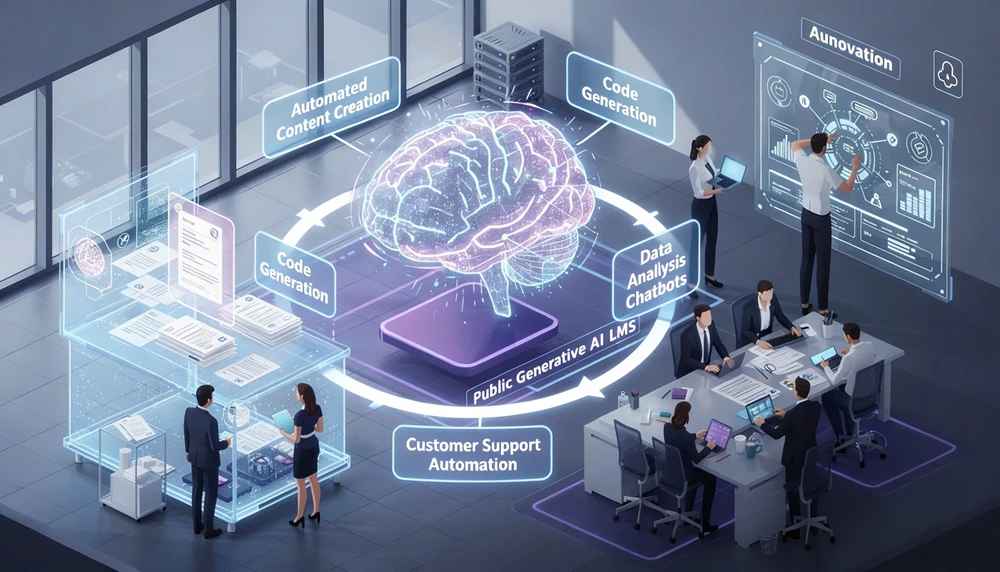
    Generative AI has transformed various businesses by automating manual administration, increasing efficiency, and simplifying business processes. Taking advantage of the skills of generative AI, human resources are released to work on strategic and innovative initiatives that lead to productivity and innovation in their companies. Public Generative AI technologies such as Large Language Models (LLMs) and their various use cases will be reviewed and examined in the following sections.

    Healthcare

    Generative AI is a key force in the healthcare industry, where it can be used to automate routine and time-intensive activities. It improves efficiency and precision in its operations, enabling medical workers to focus on enhancing patient care and outcomes. Personalized generation of patient care, prescriptions, clinical recommendations, and administration of administrative issues such as scheduling appointments for patients are improved. These are the main improvements which contribute a lot to the telemedicine industry, therefore creating the potential of visiting a doctor in the comfort of your own home. Generative AI models such as Generative Adversarial Networks (GANs) and Variational Autoencoders (VAEs) collaborate with each other to process medical images, identify medical abnormalities, and contribute to the research and development of novel medicines in the future.

    Insurance

    Likewise, the insurance sector uses Generative AI to process claims and automate the process by extracting data provided in forms, verifying claims, and helping in fraud prevention. The usage of Natural Language Processing (NLP) tasks, referred to as Optical Character Recognition (OCR) or Document AI, are both used to read, comprehend, and automate data entry processes. Insurance fraud can be identified through the adoption of pattern recognition on insurance claim information through Large Language Model (LLM) algorithms. Also, LLM-based chatbots aid in customer service, increasing the quality of customer service through the reception of customer requests and to handle policy requests to an extent automatically until the supervision of a human being is necessary.

    Finance and Accounting

    Generative AI is useful in the field of finance to process market trends and propose a portfolio with increased investment policies. Analytics of future trends, pricing of assets, and Generative AI models enable economic indicators by learning using previous financial data in order to determine intricate patterns and associations in the data. Portfolio management models can replicate a number of effects on portfolio performance, economic climates, market situations, and events. At that point, financial professionals are able to develop and refine their investment strategies to maximize risk-adjusted returns, improve portfolio management, and make better investment decisions consequently taking into account the following factors: risk tolerance, anticipated returns, and investment horizons.

    Generative AI possesses the resources to automate tiresome and dull jobs in the accounting industry like: data entry, account reconciliation, and financial report generation. Special AI deep learning functions that are used in transformer models are designed to automate accounting data entry and account audit functions through the extraction of information in different documents offered, loading databases, and resolving inconsistencies to minimize created output errors related to manual input. Preparation of financial statements including balance sheets, income statements, etc., and cash flow statements can also be automated and made more efficient, through financial analysis and templates of financial experts.

    Workflow Automation

    Workflow Automation helps organizations in different sectors to automate and streamline processes. Part of the tremendous advantages is to increase productivity, boost user experiences, and operations of generative AI. Email automation will automate routine administrative functions such as the scheduling of appointments, information processing, businesses, and management. This frees up human resources to work on more strategic issues for the organization. Workflow bottlenecks are discovered, and recommendations are offered to improve general functions of an organization and utilize resources in the best way possible, thereby enhancing productivity. In order to enhance user experience, user tastes and past data are considered to give customized customer suggestions that can be made to improve the overall user experience with a platform of an organization. Thanks to large language models, customers can also interact with chatbots to seek their help by troubleshooting problems and to answer questions that could be raised by the customer.

    Human Resources

    Integration of generative AI in Human Resource Management (HRM) software has changed how the management of employee benefits can be streamlined to take on the time-consuming processes and improve operational efficiency on activities that are based on the handling of paperwork manually, disjointed systems, and disjointed communication into one. Generation of HR documents can be automated with the help of Optical Character Recognition (OCR) and Document AI technology such as employee contracts and on-boarding letters by filling in the proper templates with the proper data and merging the pertinent information about employees with payroll, benefits, and time-tracking systems into the HR database. Chatbots based on generative AI dedicated to HRM systems offer consolidated communication channels with real-time response to employee queries that give uniform answers by responding to questions on company policies, employees’ training processes, and employee perks. Workflow automation is commonly used to assist in quickening HR responsibilities such as approval procedures and leave requests for employees within an organization.

    The ability of generative AI in these industries is only bound to grow as it develops, promoting creativity and productivity.

    -Pradeep Arumugam

  • Agent AI vs Agentic AI: Understanding the Distinction Between AI Terminology and Concepts

    Agent AI vs Agentic AI: Understanding the Distinction Between AI Terminology and Concepts

    Artificial intelligence terminology is also growing larger by larger bounds, causing confusion among business leaders, solution designers and people using AI in enterprises. One emerging topic of discussion is agent ai vs agentic ai, which is increasingly important as organizations explore intelligent automation strategies and AI transformation initiatives. The controversy of agentic ai vs generative ai is one of the most indeterminate aspects currently, especially as companies consider automation plans and AI transformation models. The two terms can be heard interchangeably, however, they have a lot of differences in terms of meanings, applications, strategic implications and technical structures. Such distinctions are important particularly to businesses that consider autonomous systems, intelligent automation and cognitive decision making frameworks.

    This article offers a practical and industry consistent agentic ai definition and definition of ai agents vs agentic ai, both in terms of conceptual models and practical implementation. It further brings out the situation and stance of qBotica in providing enterprise autonomous AI agents solutions.

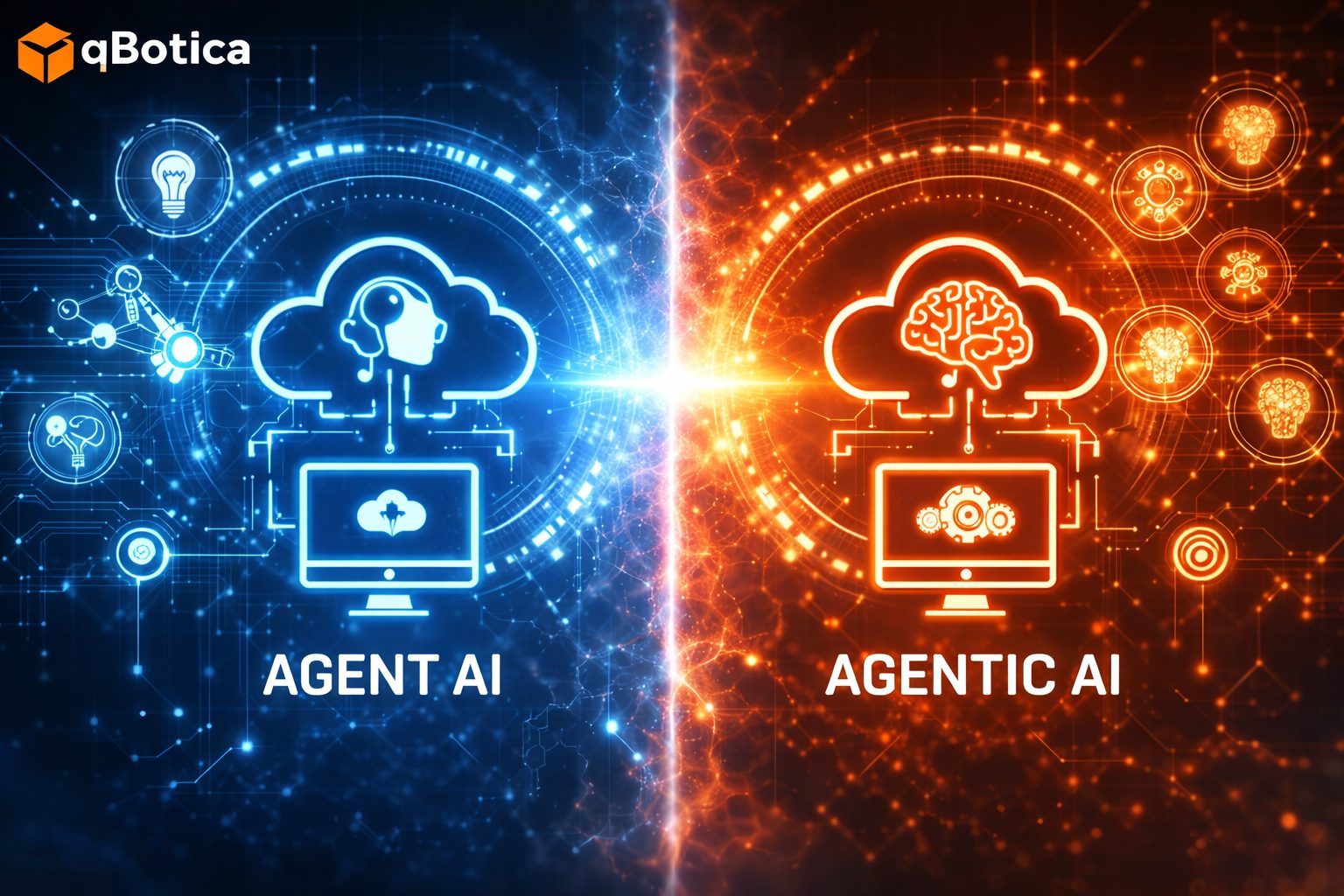
    Agent AI vs Agentic AI

    Agent AI vs Agentic AI: Understanding AI Terminology and Concepts

    To start the analysis of agent ai vs agentic ai, it is necessary to know what AI agents are. The term agent AI is used to describe a concept, which is more general and more fundamental: AI systems are agents or assistants that can be used to perform tasks or to interact with users or to manage workflows. These systems can be based on automation platforms, rules, enterprise integration or conversation.

    The term agent AI can be used more broadly to refer to any artificial intelligence system that can act as an agent. These solutions can help in data entry, communication, orchestration, routing or decision making.

    Highly autonomous, goal oriented AI systems (where the decision cycles and optimization are controlled by AI) with very little human involvement are referred to as agentic AI in the modern sense. When people in enterprise teams pose the question, what is agentic ai? the answer would revolve around autonomy and strategic intent these systems are not mere execution of tasks, they are goal oriented.

    Previous intelligent automation systems were under the large umbrella known as Agent AI. However, following the maturation of enterprise automation and the development of intelligent decision layers, industry terminology changed to the label of autonomous system giving rise to agentic ai. This change is a manifestation of more profound abilities: self direction, an understanding of processes and process optimization.

    As enterprise automation becomes more advanced, the industry is moving toward more agentic AI to mean independent enterprise AI decisioning as opposed to mere task agents.

    Major Conceptual Differences and Distinctions

    Agent AI vs Agentic AI: Scope and Specificity Differences

    The initial significant difference between ai agent vs agentic ai is in scope:

    • Stringent is agent AI, which is general purpose in nature.
    • Specific Agentic AI is goal oriented and focused on optimization.
    • Practically, Agent AI can assist conversational agents, agentic ai workflows assistants or programmed decisioning.

    In comparison, agentic systems strive at achieving enterprise outcomes like shorter cycle time, greater precision or lower cost.

    Agent AI vs Agentic AI: Autonomy and Decision-Making

    There is a complete spectrum of autonomy in agent AI, ranging between human operated task assistants to highly sophisticated self controlled software robots. The uppermost part of that spectrum is where agentic AI is situated; this is not created to perform tasks independently, but to make independent choices and strategize.

    Goal Orientation and Intention

    The majority of Agent AI systems act in a specified manner or respond to queries. The agentic AI systems act as independent business agents  analysing, prioritising and realising enterprise level objectives.

    Agent AI vs Agentic AI: Technical Implementation and Architecture at qBotica

    qBotica focuses on the high level automation of the enterprise and the technological environment of the company indicates the division of generative ai vs agentic ai.

    System Design Philosophy

    qBotica Agent AI systems are based on flexible agentic AI architecture, which are flexible in rule based engines, orchestrated platforms and human review cycles. However, agentic AI systems are created with the independent functionality, sophisticated intent processing and autonomous orchestration, which necessitates a specific and complex architectural process when considering how to build agentic AI on agentic ai platforms..

    Decision Making Capabilities

    In cases where the decision making can be performed or assisted by Agent AI, agentic AI uses contextual reasoning, document intelligence, continuous learning and problem solving using cognition. This level of autonomy is key to understanding how does agentic AI works. Such systems are constructed so that they have a high degree of autonomy in making decisions, as opposed to assistance.

    Agent AI vs Agentic AI: Market Positioning and Industry Usage

    With the changing words impacting market discourse, qBotica redefines its messages, product and delivery models based on the emerging autonomous AI needs.

    Terminology Adoption and Trends

    Such trends as terminology adoption are best determined by analyzing both historical and contemporary sources. This analysis is best done through analyzing ancient and modern sources.

    The agent AI is still popular in the automation sector, mostly because of the legacy and conceptual familiarity. However, the AI market in terms of enterprise is moving towards the agentic model based on the high tech features.

    Positioning of Platform qBotica

    qBotica uses the term agentic deliberately and conveys more automation intelligence and autonomous delivery of outcomes. Although the concept of an Agent AI positioning is still the relevant one when it comes to a larger readership of the automation, agentic vocabulary is what sets the most advanced systems of qBotica apart.

    Differences of qBotica in Practical Applications and Use Case

    The agent ai vs agentic ai can be very visible in the practical deployment. Naturally, the categories of agentic ai applications vary depending on functional capability and level of autonomy. A review of agentic ai examples best illustrates this point.

    Agentic AI use cases

    • Bots and communication assistants.
    • Coordination of tasks automation.
    • Automation of workflow.
    • User interaction systems
    • Conversational interfaces

    Such systems uplift efficiency, remove repetitive workloads and provide continuity of processes.

    qBotica AI agent use cases

    • Bi lateral business process management.
    • Workflow routing and prioritization are self managed.
    • Computer decision making and intelligent operations.
    • ABMAgile Customer engagement.
    • Discreet supply chain coordination.

    The agentic systems are self optimizing in performance.

    qBotica’s Business Value and Implementation Considerations

    Commercially, there is a direct relationship between budget, complexity and ROI based on the difference between AI agents and agentic AI. Understanding the benefits of agentic ai is crucial to setting the right investment expectations.

    Investment and ROI Expectations

    The agent AI systems provide sustainable ROI in terms of labor reduction, removal of errors and speed of workflow. The agentic ai advantages produces exponential ROI through the removal of process ownership burdens and through value generation exploration.

    Implementation Complexity

    Implementing agentic AI requires more discovery, architectural modeling, governance design and enterprise readiness. Both of these models are scaled, but the agentic solutions require a higher level of planning and integration maturity.

    Agent AI vs Agentic AI: Selection Criteria and Decision Framework

    The agentic ai vs ai agents query frequently comes out at the early stages of solution design. Clearness on the expectations of intelligence requires a selection of the proper terminology and a solid ai agents definition.

    The use of Agent AI Terminology

    • Task oriented systems can be described when.
    • When it comes to streamline communication.
    • In the workflow assistance conceptualization.
    • When autonomy is limited

    When to Use Agentic AI in the Agent AI vs Agentic AI Framework

    • When the intelligence is higher than the execution of the task.
    • Systems work to achieve results on their own.
    • In cases where optimization is required on an ongoing basis.
    • When autonomy defines value

    The Future of Agent AI vs Agentic AI in Enterprise Automation

    Due to the increasing enterprise AI, the line between agent AI and agentic AI can be unclear. Looking at the future of agentic ai, self architecture will ultimately become the norm, changing the expectations of the enterprise. Two major shifts are likely:

    • General AI artificial intelligence agents will become specialized autonomous agents.
    • Enterprise automation standards will be characterised in agentic systems.
    • The landscape of terminology will not be based on the vice versa.

    Agency AI and Approach to Agent AI at qBotica

    qBotica provides transparency, ai agent framework and technical accuracy throughout the entire spectrum of automation. Regardless of the adoption of either Agent AI or agentic AI systems, qBotica is concerned with:

    • Terminology accuracy
    • Architectural strategy
    • Maturity of intelligent automation.
    • Cognitive operating models
    • Long term automation value

    The outcome: the enterprise customers will get clear expectations, regular updates and accurate system design documents.

    Agent AI vs Agentic AI: Industry Standards and Best Practices

    The internal practices are focused on the alignment between terminology and ability:

    • Effective definition of capabilities.
    • Scoring of transparent autonomy.
    • Regular communication systems.
    • Documentation accuracy
    • Market readiness alignment

    The practices avoid confusion and make the adoption of enterprise automation successful.

    FAQs on Agent AI vs Agentic AI

    Is there any functional difference?

    Yes. Task Agentic AI facilitates tasks, agentic AI accomplishes goals on its own.

    What are the terms that enterprises are supposed to use?

    Speak in terms of the autonomy of operations and not preference or fad.

    What is the difference between the two as offered by qBotica?

    By capability classification, deployment strategy and level of intelligent automation.

    Is the market going to unite at one term?

    Perhaps, but current trends are making a shift towards models that are well defined.

    What has an effect on the choice of terminology?

    System autonomy, level of intelligence, possession of workflow and transformation intentions.

    Find out how qBotica can speed up AI driven change and help your business get real results. Here, you can find out more about qBotica’s smart automation and digital transformation solutions.

    Follow us on LinkedIn and check out our Insights Hub to stay up to date on the latest news and information from qBotica. If you want to know more, please get in touch with the qBotica Marketing Team at

    +1 (623) 252-6597 or

    marketing@qbotica.com

    https://qbdevweb.unitdtechnologies.com/wp-admin

  • What is Artificial Intelligence General Intelligence?

    What is Artificial Intelligence General Intelligence?

    Knowing about the Concept of AGI.

    Artificial intelligence general intelligence (AGI) is the capability of an AI system to do all the intellectual tasks that people are able to do. In contrast to the modern AI, which is specialized in functions, artificial intelligence general intelligence is dynamic, self-educating, and can also reason across disciplines.

    The vast majority of the current systems are either focused on a particular task or very small-scale AI: chatbots, recommendation engines, predictive models. By contrast, general artificial intelligence is commonly called the holy grail of AI research due to it being human-level cognitive flexibility. With the continued digitization of the enterprises and the high-level intelligent automation, artificial intelligence general intelligence is regarded as the next level of evolution of automation and analytics.

    The major General Intelligence Characteristics.

    Human-like Reasoning

    AGI systems are able to reason using new and invisible problems without using pre-programmed rules only. That capability is what makes the difference between AGI and AI whereby conventional AI can only perform well within set parameters.

    Learning Across Domains

    Knowledge transfer is one of the characteristic qualities of general artificial intelligence. An AGI system, based on learning financial modelling, may be used as an example where the same reasoning may be applied to healthcare diagnostics, and this is a real cross-domain intelligence.

    Autonomy and Adaptability

    AGI systems can make decisions independently and react to the context. They are constantly evolving to new environments and are therefore radically different in AGI vs machine learning comparisons with fixed models.

    Innovation and Problem Solving.

    In addition to automation, AGI is an innovation. It is able to develop strategies, generate solutions and maneuver complex and unpredictable systems- unlocking whole new AGI applications.

    AGI vs. AI

    The existing AI systems are limited, rule-based and field specific. Machine learning enhances application in a task but does not comprehend. The difference between AGI and AI points to a significant change AGI is cross-domain, adaptive, and self-directed.

    Comparison Overview:

    • Narrow AI: Rule patterned task specific.
    • Machine Learning: Information-based pattern identification.
    • AGI: Autonomy and human reasoning.

    That is why the enterprises pay a lot of attention to the future of AGI predictions; its influence can alter the business models.

    Potential Use Cases of AGI

    Healthcare

    AGI may facilitate individualized medicine to the next level of predictive analytics, with adaptive treatment advice being provided depending on the current patient situation.

    Finance

    AGI in business, as applied in finance, may spur both strategic planning of investment and dynamic fraud detection that evolves according to the behavior of the market.

    Supply Chain & Manufacturing

    AGI would be able to coordinate end-to-end autonomous tasks, which would involve predicting demand and situating awareness in global supply chains.

    Customer Engagement

    Digital assistants that function on artificial intelligence general intelligence and appear like a human being have the potential to provide natural, unscripted conversations, much more than the current chatbots.

    Advantages and Problems of AGI.

    Benefits of AGI

    The advantages of AGI are the ability to make human-level decisions at scale, solve problems that used to have no solution in the business, and provide enterprises with near-autonomous capabilities.

    Challenges of AGI

    Nonetheless, AGI has major difficulties. The most important issues are ethical risks, job displacement, consistency with human values, privacy of personal data, and security. Another obstacle to realization of true general intelligence is also technical hurdles, in addition to rising ethical concerns of AGI.

    AGI and Enterprise Automation Future.

    AGI is still in the dark and the scale of the breakthrough can be between decades and sooner than expected one. The convergence with generative AI and agentic automation is suggested in most AGI future predictions. Collectively, these technologies may be used to drive the new wave of hyperautomation, with systems thinking, making decisions, and taking action on their own. Businesses that start preparing in the present time will be at a better position to this change.

    qBotica’s Perspective on AGI

    qBotica considers AGI as a long-term change and not a sudden upheaval. qBotica aims at creating viable bridges between the current AI capacity and the automation of tomorrow. qBotica will assist businesses in preparing to live in the world of artificial intelligence general intelligence using proprietary frameworks and AI-based business automation to redefine workflows, decision-making, and value creation.

    Artificial Intelligence General Intelligence Frequently Asked Questions.

    Is AGI real today?

    No, there is still no real AGI, but it is being developed in a hurry.

    What is the difference between AGI and generative AI?

    Generative AI generates content and AGI rationale and generality.

    In which industries will AGI revolutionize first?

    Medical, banking, production and service to customers.

    Will AGI leave human beings jobless?

    It will likely add on to roles but not necessarily eliminate them altogether.

    What are the ethical issues on AGI?

    Some critical issues include control, alignment, privacy and impact on society.

    In a rapidly changing digital economy, organizations across industries, including Healthcare, Insurance, Banking & Finance, Energy & Utilities, Transportation & Supply Chain, Manufacturing, Real Estate & Mortgage, and Contact Centers, need service led AI and automation solutions to sustain business value and adapt at speed. qBotica helps enterprises design, deploy, and scale agentic AI and end-to-end automation tailored to these industry specific needs.qBotica helps enterprises make decisions faster, stay operationally resilient, and scale their digital operations by providing deep knowledge in AI orchestration, hyperautomation, cloud, data, and enterprise system integration. They do this by offering strategy, implementation, optimization, and managed services.

    Find out how qBotica can speed up AI-driven change and help your business get real results.

    Here, you can find out more about qBotica’s smart automation and digital transformation solutions.

    Follow us on LinkedIn and check out our Insights Hub to stay up to date on the latest news and information from qBotica.

    If you want to know more, please get in touch with the qBotica Marketing Team at

    +1 (623) 252-6597 or

    marketing@qbotica.com.

    https://qbdevweb.unitdtechnologies.com/wp-admin


  • What Are Document Processing Services?

    What Are Document Processing Services?

    Document Processing Services: What Are They?

    Document processing provides companies with the ability to turn structured and semi-structured and unstructured documents into digital data that can be put into use. The materials might consist of invoices, contracts, medical records, claims forms, emails and PDFs. What used to be a simple OCR scanning has now developed into a machine implemented classification, verification, and workflow coordination.

    Document processing services are needed in such industries like finance where the volume of paperwork is tremendous, healthcare, insurance, and legal services. Enterprises can remove the manual bottlenecks of their systems and open the doors to the information-driven decision-making by integrating automated document processing with intelligent document processing.

    Major characteristics of the modern document processing.

    Intelligent Data Capture

    OCR document services, as well as AI, are applied in modern document processing solutions to extract the text, images, and metadata of structured and non-structured files. High-end models process the context and far beyond simple text recognition the AI document processing can be brought to bear.

    Document Classification

    Invoices, contracts, purchase orders and forms are automatically identified and categorized through automation. It is an intelligent document processing that is used to get documents to the right destination without the need to sift through them and increase the speed of the digital document workflow.

    Validation and Checks of accuracy.

    Accurate data extracted at the inbound makes it to the downstream systems due to the presence of business rules, confidence scoring, and AI-based validation. This reduces mistakes during automated processing of the documents and enhances confidence in enterprise information.

    Enterprise Systems Integration.

    The efficient document processing services are compatible with ERP, CRM, and cloud. This enhances a support of end-to-end automation to enterprise document management ecosystems.

    Document Processing vs. Manual Processing.

    Feature Manual Processing Automated Document Processing
    Speed Slow and repetitive Fast and scalable
    Accuracy Prone to errors AI-driven validation
    Cost High labor costs Reduced operational expenses
    Compliance Difficult to track Built-in audit trails

    In rapid movement to AI induced automation, enterprises are eager to move to document processing services since automation simplified risk management, had scaled easily, as well as had unstructured data automation better than manual ones.

    Applications of Document Processing Services.

    Financial Services

    Banks and other financial institutions are dependent on data pattern recognition to detect fraud as well as invoice processing automation . Turnaround time and regulatory compliance is enhanced by the AI processing of documents.

    Healthcare

    Medical professionals have computerised the records of patients and have automated the process of insurance claims validation. Document processing services enhance data accuracy and thus ensure compliance requirement.

    Legal & Compliance

    Contract analysis, extraction of clauses and reporting of regulations are automated by legal teams. Smart document processing will provide a consistency within huge document depositories.

    Supply Chain & Logistics

    Although the logistics processes cannot be automated, the bill of lading processing and vendor invoice automation enhance the visibility and decrease the delays caused by poor document processing.

    The advantages of embracing Document Processing Services.

    Companies which have adopted the services of document processing record lessening of manual work, fewer errors, and an acceleration in business operations. Audit trails are inbuilt and enhance better compliance and governance. The savings of costs and scale encourages growth whereas the customers enjoy faster response speed and quality service.

    The Processed AI Automation of Docs.

    AI can produce contextual perception by using machine learning and NLP. Contrary to conventional OCR, AI document processing has intent, relationships and document structure recognition. Feedback loops enable systems to become more accurate with time such that an intelligent document processing system becomes increasingly accurate with each cycle.

    The Process of document processing at qBotica.

    qBotica provides highly sophisticated document processing service based on its own Automation Cube and smart workflows in integrations with the industry-leading UiPath, Automation anywhere, and Azure AI. Financial, healthcare, and logistic industry-specific templates assisted clients to gain a payback in ROI by using qBotica document automation.

    The Future of Document processing Services.

    The future lies in the autonomous document processing where AI systems do not need a significant human input. Closer to the convergence of Generative AI and intelligent document processing will facilitate a stronger contextual comprehension, which allows hyperautomation and digital-first approaches to the enterprise.

    FAQ of Document Processing Services.

    What is intelligent document processing?
    It incorporates AI, OCR and automation to derive data out of the documents and interpret it.
    What is the difference between the areas of OCR and AI document processing?
    OCR is the ability of reading text, and AI is the capability of meaning and second, context reading.
    Is compliance and automation of documents secure?
    Yes, having encryption, access applications, and audit trails.
    Is it possible to adopt document processing services with ERP/CRM?
    Contact yes, through APIs and automation platforms.
    What industries have the best use of document processing automation?
    Finance, health care, insurance, law and logistics.

    In a rapidly changing digital economy, organizations across industries, including Healthcare, Insurance, Banking & Finance, Energy & Utilities, Transportation & Supply Chain, Manufacturing, Real Estate & Mortgage, and Contact Centers, need service led AI and automation solutions to sustain business value and adapt at speed. qBotica helps enterprises design, deploy, and scale agentic AI and end-to-end automation tailored to these industry specific needs. qBotica helps enterprises make decisions faster, stay operationally resilient, and scale their digital operations by providing deep knowledge in AI orchestration, hyperautomation, cloud, data, and enterprise system integration. They do this by offering strategy, implementation, optimization, and managed services.

    Find out how qBotica can speed up AI-driven change and help your business get real results.

    Here, you can find out more about qBotica’s smart automation and digital transformation solutions.

    Follow us on LinkedIn and check out our Insights Hub to stay up to date on the latest news and information from qBotica.

    If you want to know more, please get in touch with the qBotica Marketing Team at

    +1 (623) 252-6597 or

    marketing@qbotica.com

    https://qbdevweb.unitdtechnologies.com/wp-admin


  • What Are Automated Document Solutions?

    What Are Automated Document Solutions?

    Automated document solutions are the next significant step in digital transformation as they allow organizations to stop relying on manual and paper-based document management and turn to AI-driven, intelligent, and scalable solutions. Rather than using human resource to enter data, validate it, and route, automated document solutions incorporate cutting-edge technologies to handle documents quicker, more precisely, and at a reduced price.

    In any industry, manual document management causes mistakes, time wastage, risk of compliances, and inefficiencies. Integrating smart document processing, AI document automation, and workflow orchestration allow organizations to save the money dramatically, as well as accelerate and increase their precision. The automated document solutions have become a core competency of contemporary operations as businesses are hastening their digital transformation efforts.

    Major Characteristics of Automated Document Solutions.

    Intelligent Data Capture

    Central to the automated document solutions is intelligent data capture. Based on the OCR technology, AI, and natural language processing (NLP), systems retrieve data in both structured and unstructured data, including invoices, contracts, forms, and emails. This will remove data entry bottlenecks and enhance accuracy of data by intelligent document processing.

    Workflow Automation

    Document Management Automated document management facilitates a smooth integration with ERP, CRM and the cloud platform. Workflows including approvals, validations, and exception handling can be automated through the use of RPA for documents, which lowers the delays in document routing and speed ups enterprise document workflows.

    Compliance & Security

    Document-heavy industries are reliant on compliance as an essential compulsory factor. Automated functionality such as audit trails, role based access control and data governance policies. Regulatory risk is minimized by automated checks where regulations are adhered to including HIPAA, GDPR, and SOX.

    Scalability & Adaptability

    These solutions are industry and use case scalable, starting with invoice automation to contract automation. The cloud-native architectures can be used to embrace the enterprise-wide adoption whereas adapt to the changes in document volumes and business needs.

    Automated Document Solution vs. Traditional Document Management.

    The conventional document management systems are more about the storage and retrieval of the documents which highly depend on the indexing of the documents by human beings and manual intervention. On the contrary, automated document solutions are predictive, proactive, and AI-based.

    Comparison Overview:

    • Document storage: simple storage and retrieval.
    • Smart Document Processing: machine learning extraction and categorization.
    • Full Automation: AI and RPA End-to-end document lifecycle management.

    This development explains why companies are abandoning old systems in favor of smart automation systems.

    Use Cases Across Industries

    Financial Services

    Invoice automation, loan application processing, and fraud detection are automated document solutions that are utilized by banks and financial institutions. Documents are processed intelligently and increase compliance accuracy and turnaround time.

    Healthcare

    Health system organizations automate digitization of patient records, claims processing and compliance reporting. Document management automation is enhanced to provide better data security as well as automated compliance.

    Supply Chain & Logistics

    Document automation is an AI-powered document automation and RPA used to streamline bill of lading automation, automate the review of vendor contracts, and automate the creation of customs documentation to minimize delays and errors.

    Legal & HR

    Contract lifecycle management, onboarding document automation, and document lifecycle management can be useful to legal and HR teams in terms of providing visibility and control to processes.

    Automated documents solutions have business advantages.

    The automated document solutions have a business value that is evident; accelerated processing cycle, less errors, and a high level of cost savings. There is less time wastage by the employees on repetitive work and more time on strategic work which enhances productivity. The result is faster turnaround of service and overall experience and trust by customers.

    The way Automated Document Solutions interact with AI and RPA.

    Pattern recognition, contextual understanding and classification are some of the areas in which AI is important and RPA in documents is used to do repetitive activities including routing, approval and updating systems. Intelligent document processing fills the disconnect between unstructured data and enterprise systems and facilitates a smooth process of automation of document processes.

    Automated Document Solutions at qBotica.

    qBotica offers automated document solutions of an enterprise grade based on proprietary Intelligent Document Processing (IDP) frameworks. Combining with systems such as UiPath, process mining, and GenAI systems, qBotica assists companies in modernizing enterprise document processes. The application of the real-life success stories takes place in the financial services, healthcare, and logistics sectors where the level of documents is high.

    Future Prospect – The New Age in Document Automation.

    The future of automated document solutions is the emergence of AI, RPA, and Generative AI convergence. The predictive document intelligence will be used to anticipate action whereas autonomous processes will be used to fully automate an end-to-end method. The processes of document work will be less and less human-based by 2030.

    Automated Document Solutions Frequently Asked Questions.

    What are some of the possible automated documents?
    Invoices, contracts, forms, claims and others.
    What is the accuracy of document processing by AI?
    With machine learning and validation rules, the accuracy increases in a continuous manner.
    Are document solutions automated secure?
    Yes, encryption, access controls and audit logs.
    What role do these solutions play with the existing systems?
    RPA through APIs, cloud connectors.
    How will the ROI of document automation be?
    Cost reduction and an increase in efficiency are the typical areas of rapid ROI within organizations.

    In a rapidly changing digital economy, organizations across industries, including Healthcare, Insurance, Banking & Finance, Energy & Utilities, Transportation & Supply Chain, Manufacturing, Real Estate & Mortgage, and Contact Centers, need service led AI and automation solutions to sustain business value and adapt at speed. qBotica helps enterprises design, deploy, and scale agentic AI and end-to-end automation tailored to these industry specific needs. qBotica helps enterprises make decisions faster, stay operationally resilient, and scale their digital operations by providing deep knowledge in AI orchestration, hyperautomation, cloud, data, and enterprise system integration. They do this by offering strategy, implementation, optimization, and managed services.

    Find out how qBotica can speed up AI-driven change and help your business get real results.

    Here, you can find out more about qBotica’s smart automation and digital transformation solutions.

    Follow us on LinkedIn and check out our Insights Hub to stay up to date on the latest news and information from qBotica.

    If you want to know more, please get in touch with the qBotica Marketing Team at

    +1 (623) 252-6597 or

    marketing@qbotica.com.

    https://qbdevweb.unitdtechnologies.com/wp-admin


  • What is Payroll Automation?

    Payroll automation is the term used in reference to the utilization of software and intelligent frameworks in the management of employee pay, such as computing payrolls, deductions, benefits, and compliance reporting. In contrast to manual payroll processing, which requires the use of spreadsheets, emails, or paper operations, payroll automation provides an opportunity to substitute the repetitive human work with the rule-based and AI-powered operations.

    Old-fashioned payroll systems tend to be quite tedious, prone to errors, and compliance-wise inconvenient. Conversely, businesses have payroll automation that focuses on accuracy, regulatory compliance and efficiency. Being a component of the wider HR automation and digital transformation module, HR payroll automation allows organizations to improve the management of their workforce and decrease overheads in administration.

    There are a lot of benefits of payroll automation

    Significant Payroll Automation Characteristics.

    Automated Calculations

    The new payroll automation software are paid automatically including salaries, bonuses, overtime, reimbursement and statutory deductions. Automated payroll processing eliminates a lot of manual errors and also there are no discrepancies in calculations between the pay cycles.

    Tax Compliance

    Automation of payroll compliance means automatic deductions on tax filing and reporting, which is according to usual regulations. The intelligent systems are flexible in the tax laws of regions, states and countries, and this minimizes the risks of compliance among expanding organizations.

    Integration with HR & Finance

    A well-developed automating payroll will easily be integrated with the HR systems of attendance, leave and benefits data. It also connects to accounting and ERP platforms, which allow end-to-end financial accuracy by automating payroll software automation.

    On-the-fly Reporting & Analytics.

    Dashboards give real-time visibility of the labor costs, payroll trends and compliance status. High-tech analytics can assist the HR and finance departments to predict payroll budgets and streamline their workforce planning through smart payroll solutions.

    Payroll Automation vs. Manual Processing of Payrolls.

    Manual payroll is time consuming, tedious and subject to errors and non adherence to set regulations. Automated payroll, in its turn, is both efficient and accurate, as well as scalable.

    Comparison Overview:

    • Manual Payroll: Intensive, intensive, and has low scalability.
    • Payroll Software: Hopeful automation, enhanced accuracy.
    • Smart Payroll Automation: Artificial Intelligence Compliance, Analytics, End-to-end automation.

    This is an obvious strength hence all organizations in every industry are moving towards automation payroll solutions.

    Payroll automation for businesses

    Businesses: Small and Medium Businesses (SMBs).

    In the case of SMBs, payroll automation solutions is a cost-efficient payroll management automation system and less reliance on big HR departments. Automated payroll processing can be used so that attention can be drawn towards growth instead of administration.

    Enterprises

    Big companies are rewarded with standardized and multi-country payroll operations. Automation of payrolls processes deal with complicated regulations, currencies, and compliance systems at scale.

    Remote & Hybrid Workforces

    Flexible payroll management is needed in distributed work groups. Business payroll automation embraces freelancers, contractors, gig workers, and cross-border workers smooth sailing.

    Compliance-Heavy Industries

    Payroll compliance automation is necessary in healthcare, finance, and government sectors in order to comply with high auditing and regulatory standards.

    Payroll automation will bring about the benefits as listed below.

    The payroll automation advantages are accuracy, minimization of compliance risk, and significant savings of time by the HR teams. Employees get access to self-service portals to obtain their payslips and tax forms, and organizations achieve scalability and increased data security, as well as a strong audit trail. With the expansion of companies, payroll automation makes the payroll operations to expand without a corresponding rise in costs.

    The way Intelligent Payroll Systems operate.

    The intelligent payroll systems are layered and consist of data inputs (HR and attendance), processing engine, and compliance layer. With the help of AI and machine learning, it is possible to detect anomalies, prevent fraud, and handle exceptions. Compared to the on-premise deployments, cloud-based payroll systems are faster and can be scaled. Whereas HR automation includes a wider range of processes in the lifecycle of all employees, payroll automation is more specialized in accuracy and compliance in compensation.

    The Approach to Payroll Automation of qBotica.

    qBotica provides customized payroll automation services based on proprietary frameworks that are utilized in payroll functions. qBotica supports the integration of the automation with the popular platforms like ADP, Workday, and Oracle HCM. qBotica has a robust history of providing quantifiable results to financial services and health care companies with a high level of understanding of payroll compliance automation.

    Prognosis – Automation of payroll in the Era of AI.

    Payroll automation in the future will involve predictive payroll forecasting, AI-based compliance enforcement, and cross-border workforce global payroll automation. Businesses are shifting to Payroll-as-a-Service (PaaS) models, with smart payroll services becoming a cloud-based solution that is easily scalable and requires no hardware.

    FAQs on Payroll Automation

    So what is payroll automation software?

    It is computer software that automates payrolls, compliance and reporting.

    Is multi-country compliance within the capabilities of payroll automation?

    Yes, sophisticated mechanisms are meant to be used in global regulatory complexity.

    Are payroll automation and security safe?

    No, no, no, with encryption, role-based access, and audit logs.

    Does automating payroll lessen the requirements of the HR?

    It helps save on manual work and enables the HR teams to concentrate on the strategic work.

    What is the difference between payroll automation and HR automation?

    Automation of payroll concerns compensation and compliance in particular.

    In a rapidly changing digital economy, organizations across industries, including Healthcare, Insurance, Banking & Finance, Energy & Utilities, Transportation & Supply Chain, Manufacturing, Real Estate & Mortgage, and Contact Centers, need service led AI and automation solutions to sustain business value and adapt at speed. qBotica helps enterprises design, deploy, and scale agentic AI and end-to-end automation tailored to these industry specific needs. qBotica helps enterprises make decisions faster, stay operationally resilient, and scale their digital operations by providing deep knowledge in AI orchestration, hyperautomation, cloud, data, and enterprise system integration. They do this by offering strategy, implementation, optimization, and managed services.

    Find out how qBotica can speed up AI-driven change and help your business get real results.

    Here, you can find out more about qBotica’s smart automation and digital transformation solutions.

    Follow us on LinkedIn and check out our Insights Hub to stay up to date on the latest news and information from qBotica.

    If you want to know more, please get in touch with the qBotica Marketing Team at

    +1 (623) 252-6597 or

    marketing@qbotica.com.

    https://qbdevweb.unitdtechnologies.com/wp-admin

  • Understanding UiPath Pricing: Models, Costs, and Value

    UiPath is considered one of the most popular automation to use as a Robotic Process Automation (RPA) and intelligent business automation. Companies in any industry use UiPath to automate their processes, lower manual workload and speed up digitalization. The issue of pricing UiPath solutions becomes paramount to the decision maker as the technology of automation becomes more popular.

    The issue of pricing transparency is important since the investments in automation have a direct impact on ROI, scaleability and future value. UiPath provides a scalable licensing platform, comprising of various subscription tiers, add ons (modular) and enterprise upgrades. That is why the pricing of UiPath is flexible and complicated and it should be considered thoroughly.

    Pricing UiPath

    Explaining Pricing UiPath Models and Licensing Structure

    UiPath Pricing per User Licensing Model Explained

    This model has attended bots that are licensed on a per user basis. This method is suitable to automate the front office or knowledge worker because employees promptly instigate automation out of their workstations. Under this category, UiPath pricing model will increase according to the number of workforce employed and this will enable organizations to match UiPath cost and user adoption.

    UiPath pricing per Bot Licensing for Unattended Automation

    Unattended bots have a per bot license and are supported on servers as free running bots. This is ideal when the volume of data is heavy and the process is recurrent like processing an invoice or data migration. UiPath automation Pricing in this case is based on the number of bots to use and the degree of orchestration needed.

    UiPath Subscription and Consumption Models

    UiPath cloud pricing offers monthly or annual subscriptions that are flexible to consumption. Companies have the option to use long term predictable licensing plans or pay as you go plans. This will save initial UiPath RPA cost and facilitate a slow maturity of automation.

     Key Factors That Influence Pricing UiPath Solutions

    Some of the variables used influence the overall pricing UiPath decision:

    • The figure of bots (attended and unattended)
    • Cloud, on prem or hybrid deployment model.
    • Types of licenses, as well as the features of orchestrations needed by UiPath.
    • Add on modules like AI center, Task mining and Process Mining.
    • Training, support levels, UiPath consulting services.
    • Scalability requirements (SMB vs. UiPath enterprise pricing)

    Infrastructure, maintenance and change management are also to be considered in UiPath total cost of ownership when doing the evaluation.

    Advantages of Flexible Pricing UiPath Automation Solutions

    Flexibility is one of the largest benefits of UiPath subscription models. Companies have the ability to initiate small but scale automation as ROI is established. Add ons are modular to promote a pay as you grow approach yet have a predictable UiPath ROI.

    Consumption based licensing also can help enterprises to experiment with innovation, combine agentic automation and optimize the UiPath business automation pricing over time.

    How qBotica Helps Optimize Pricing UiPath Investments

    qBotica assists businesses to right size their investments with UiPath through matching the objectives of automation with cost efficient licensing policies. qBotica offers a combination of bots, subscriptions and add ons by studying the most effective bots, subscriptions and add ons due to the profound understanding of UiPath licensing types and solution architecture.

    qBotica has enabled companies to decrease UiPath vs competitors prices and automation TCO with consulting and automation delivery. Examples used in case snapshots are global organizations optimizing their licenses and realizing ROI quicker and not overprovisioning.

    FAQs: Cost, Licensing and Enterprise Considerations

    Q1: How much does UiPath cost in case of small business?

    UiPath provides SMBs with entry level subscriptions with a different level of costs depending on deployment and bot needs.

    Q2: Does UiPath cost less than Automation Anywhere?

    The results of UiPath pricing calculator are usually more flexible and ecosystem value compared to that of Automation Anywhere, based on the application.

    Q3: Does UiPath provide pricing model on clouds only?

    Yes, UiPath cloud pricing accepts fully managed SaaS subscriptions.

    Q4: What are the hidden expenses that enterprises should take into consideration?

    The UiPath cost can be affected by infrastructure, add ons, support tier and change management.

    Q5: In what way does qBotica assist in optimizing the pricing?

    qBotica matches licensing with business strategy to maximize the pricing UiPath investments.

    In a rapidly changing digital economy, organizations across industries, including Healthcare, Insurance, Banking & Finance, Energy & Utilities, Transportation & Supply Chain, Manufacturing, Real Estate & Mortgage and Contact Centers, need service led AI and automation solutions to sustain business value and adapt at speed. qBotica helps enterprises design, deploy and scale agentic AI and end to end automation tailored to these industry specific needs. qBotica helps enterprises make decisions faster, stay operationally resilient and scale their digital operations by providing deep knowledge in AI orchestration, hyperautomation, cloud, data and enterprise system integration. They do this by offering strategy, implementation, optimization and managed services.

    Find out how qBotica can speed up AI driven change and help your business get real results.

    Here, you can find out more about qBotica’s smart automation and digital transformation solutions.

    Follow us on LinkedIn and check out our Insights Hub to stay up to date on the latest news and information from qBotica.

    If you want to know more, please get in touch with the qBotica Marketing Team at

    +1 (623) 252-6597 or

    marketing@qbotica.com.

    https://qbdevweb.unitdtechnologies.com/wp-admin


  • Agentic AI Orchestration Platforms

    Agentic AI Orchestration Platforms

    The coordination of autonomous AI agents is taking the form of agentic AI orchestration platforms that get deployed to organize, manage and optimize various autonomous AI agents collaborating to achieve common business objectives. With the relocation of single task bots and multi agent systems of enterprise, the demands on scalable ai orchestration along with AI agent orchestration have become extremely important in reliability, scalability and the management.

    These systems are the brain of distributed AI processes, assigning tasks, handling processes, enforcing rules and coordinating the action of agents across the business processes.

    There is a need to understand the Agentic AI Orchestration Platforms.

    Fundamentally, agentic orchestration platforms are centralized networks that are aimed at controlling and integrating autonomous AI agents in workflows, applications and departments.

    Definition:

    The centralized systems which operate agent lifecycles, coordination, resource allocation and decision governance between distributed AI agents.

    Core Functions:

    • Onboarding, configuring and monitoring agents.
    • Smart routing and scheduling of tasks.
    • Automation of workflow and business processes.
    • Performance monitoring and maximization.

    Strategic Value:

    • Facilitates enterprise level multi agent coordination.
    • Minimizes complexity of operations.
    • Engineers compliance and risk controls.
    • Rapidly deploys agentic AI automation scale.

    Powerful agents are isolated without being orchestrated. Organizations can have connected, goal driven automation ecosystems with orchestration.

    Core Components of Agentic AI Orchestration Platforms

    Intelligent Automation/Lifecycle Management of Agents.

    The lifecycle management has to start with the effective orchestration:

    • The agents should be deployed and versioned.
    • Environmental configuration management.
    • Workload based auto scaling.
    • Medical checks and automatic repair.

    This layer, often referred to as the ai agent management platform, It is a layer that values the uninterrupted availability and consistent performance of agentic AI platforms through enterprise systems.

    Task Routing and Workflow Management in Agentic AI Orchestration Platforms

    The core of agentic workflow orchestration: Intelligent task management:

    • Ability based assigning of agents.
    • Multi stage execution of workflow.
    • Priority based scheduling
    • Addiction monitoring in business processes.

    This converts the lonely automation to the end to end workflow automation orchestration that correlates to actual business performance.

    Communication and Coordination Procedures

    There must be structure in multi agent systems:

    • Event driven communication
    • Publos sub and message queues.
    • Conflict management techniques.
    • Consensus building mechanisms

    Such capabilities facilitate real time collaboration between AI orchestration tools and multi agent orchestration tools which are in parallel operation.

    Top Agentic AI Orchestration Platforms and Providers

    Enterprise Platform Solutions.

    The orchestration layers are offered by major cloud and enterprise vendors:

    • Microsoft Azure AI orchestration service.
    • Google AI cloud orchestration pipes.
    • Amazon Bedrock AWS native coordination agents.
    • IBM Watson Enterprise workflow orchestrate.

    These solutions facilitate enterprise AI achievement and native cloud elasticity and security incorporation.

    Intelligent Automation Systems for Agentic AI Orchestration Platforms

    Special automation suppliers specialize on business processes:

    • ai based orchestration UiPath Orchestrator RPA and AI hybrid orchestration.
    • AI agent based systems of business process automation.
    • Document heavy automation platforms Cognitive automation systems.
    • Platforms for end-to-end business process orchestration ai.

    Such platforms are superior in agentic automation orchestration and business process control.

    Open Source and Developers Platforms.

    Developer oriented orchestration frameworks for ai are:

    • Apache Airflow on task pipelines.
    • Containerized agent scaling using Kubernetes.
    • Docker Swarm to deploy of distributed applications.
    • Enterprise grade container orchestration based on OpenShift.

    They are commonly implemented as entry level orchestration systems in AI solutions built ad hoc.

    Key Capabilities of Agentic AI Orchestration Platforms

    Multi Agent Co-ordination and Co-operation.

    Advanced orchestration is in support of:

    • Dynamic agent discovery
    • Decomposition of the task in terms of skills.
    • Teamwork in solving problems.
    • Multi agent results aggregation.

    This allows complex multi agent orchestration coordination between analytical, generative and operational agents.

    Resource Management and Optimization.

    In order to control costs and performance:

    • On demand compute allocation.
    • Cost aware scheduling
    • Bottleneck detection
    • Elastic scaling strategies

    This can be necessary when the AI needs to be scaled in the production setting.

    Compliance Management and Governance.

    Enterprise implementations are hard locked:

    • Policy enforcement
    • Audit logging
    • Access control
    • Risk management workflows

    This orchestration layer for agents converts orchestration into a actual agentic AI control layer of regulated industries.

    In the Industry Intelligent Orchestration can be used in the following ways.

    Banking and Financial Services.

    Use cases include:

    • Fraud detection agents and compliance agents work together.
    • Automation of loan processing.
    • Co-ordination of risk monitoring and reporting.
    • Channel routing of customer service.

    These are based on business process orchestration for AI agents and agentic workflow automation.

    Healthcare and Medical Services.

    Orchestration supports:

    • Clinical decision support maintenance.
    • Automated scheduling of patients.
    • Medical billing agents and medical coding.
    • Research data synthesis

    The healthcare system needs rigid agentic AI solutions and compliance based orchestration layers.

    Supply Chain and Manufacturing.

    Applications include:

    • Planning of production coordination.
    • Predictive maintenance software.
    • Logistics optimization
    • Automation of supplier communication.

    In this case, AI agent orchestration will provide end-to-end across operations visibility.

    Call Centers and Customer Service.

    Systems that are orchestrated facilitate:

    • Coordination of omnichannel bots.
    • Smart escalation to the human operators.
    • Knowledge base maintenance
    • Active customer interaction.

    These systems rely on robust agent management systems of AI agents to deliver services effectively.

    Technical Architecture Behind Agentic AI Orchestration Platforms

    Design of Platform Architecture.

    AI orchestration platforms of the present are based on:

    • Microservices based architectures
    • Coordination models based on events.
    • API first connectivity
    • D deployment strategies using clouds.

    This architecture allows the fast growth of agent networks.

    The themes of Integration and Connectivity.

    Some of the major components that make up integration are:

    • REST and gRPC APIs
    • Message brokers
    • Persistent data stores
    • Enterprise system connectors.

    This guarantees agents the ability to be involved in highly agentic AI deployment situations in both legacy and cloud environments.

    Security Frameworks in Agentic AI Orchestration Platforms

    Security is foundational:

    • End-to-end encryption
    • Identities and access control.
    • Compliance monitoring
    • Threat detection

    Well developed security architecture accommodates enterprise level agentic artificial intelligence.

    Best Practices of implementation.

    Selection and Assessment of the Platform.

    The organizations are expected to evaluate:

    • Complexity requirements of workflow.
    • Agent volume scalability
    • Integration with the existing systems.
    • Total cost of ownership

    Proper selection of agentic AI orchestration tools has the immediate consequence of long term success.

    Deployment and Configuration

    Recommended approach:

    • Start with pilot workflows
    • Slowly bring additional agents on board.
    • Track the performance indicators.
    • Routing and scaling rules optimization.

    The phased model minimizes the risk of large scale agentic AI management.

    Governance and Management

    Strong governance includes:

    • Clear ownership models
    • Defined escalation paths
    • Performance dashboards
    • Cycles of continuous improvement.

    This makes sure there is uniformity in agentic AI system management within departments.

    Scaling and Optimization of Performance.

    Strategies of Resource Optimization.

    In order to optimize it, one can use:

    • Predictive scaling
    • Smart caching
    • Optimization of network traffic.
    • Workload prioritization

    These measures will be essential in ensuring effective agentic orchestration platforms with heavy load.

    Scalability and High Availability.

    Enterprise orchestration entails:

    • Horizontal scaling
    • Automated failover
    • Multi region deployments
    • Areas of backup and recovery.

    This will ensure reliability of mission oriented orchestration layer agents.

    ROI and Business Value of Agentic AI Orchestration Platforms

    Organizations also tend to undergo:

    • Operation efficiency: 50-80% of cross agent coordination enhanced.
    • Reduction in costs: 35-60% flow reduction in manual intervention.
    • Performance improvements: 40-70 additional speed in the completion of the process.
    • Scalability: Capability to add 10 times the number of agents without adding staff in proportion.

    These returns indicate why agentic AI coordination engines are taking over centre stage in digital transformation agendas.

    Arrange your agentic AI systems using the proficient platform solutions and smart automation insights of qBotica. Get in touch with us to find out how our UiPath integration, Kognitos and orchestration would be used to streamline the process of multi agent coordination with you. Explore our services in a comprehensive orchestration platform at qBotica.com. The most manageable agent network size is 10x higher.

    Improvement in reliability: 99.9% automated fail over and recovery.

    Enhancement of the compliance: 95-100 percent of the automated compliance monitoring and reporting.

    Possible Future Future Trends of AI Agents Orchestration.

    New trends and developments are:

    • Artificial intelligence based self optimizing orchestration logic.
    • Low latency use case agent coordination based on edges.
    • Standard interoperability protocols.
    • State of the art human in the loop orchestration models.
    • Zero trust security architectures.

    These tendencies will further empower the importance of agentic AI orchestration vendors in enterprise technology stacks.

    Bots Agentic AI Orchestration Platforms Frequently Asked Questions.

    What is possible agent orchestration?

    It also organizes several AI agents in such a way that they collaborate in systematic processes in order to attain business objectives in a superior and trusted manner.

    What do computer agents do with conflicts?

    The orchestration tier enforces priority and governance policies and decision arbitration to maintain compliance and accuracy of the outcomes.

    Are only large enterprises to be agent orchestrated?

    No. Mid sized organizations too can find the advantage in automating intricate workflows and enhancing productivity in teams.

    What are the typical issues of implementation?

    The primary obstacles are system integration, governance configuration, performance optimization and organizational change management.

    How is business ROI measured?

    By way of accelerated processes, minimal manual work, enhanced service quality and cutback on operating costs.

    Are humans in the control of critical decisions?

    Yes. Human in the loop approvals, compliance and exception management are available on most of the platforms.

    In a rapidly changing digital economy, organizations across industries, including Healthcare, Insurance, Banking & Finance, Energy & Utilities, Transportation & Supply Chain, Manufacturing, Real Estate & Mortgage and Contact Centers, need service led AI and automation solutions to sustain business value and adapt at speed. qBotica helps enterprises design, deploy and scale agentic AI and end-to-end automation tailored to these industry specific needs. qBotica helps enterprises make decisions faster, stay operationally resilient and scale their digital operations by providing deep knowledge in AI orchestration, hyperautomation, cloud, data and enterprise system integration. They do this by offering strategy, implementation, optimization and managed services.

    Find out how qBotica can speed up AI driven change and help your business get real results.

    Here, you can find out more about qBotica’s smart automation and digital transformation solutions.

    Follow us on LinkedIn and check out our Insights Hub to stay up to date on the latest news and information from qBotica.

    If you want to know more, please get in touch with the qBotica Marketing Team at

    +1 (623) 252-6597 or

    marketing@qbotica.com.

    https://qbdevweb.unitdtechnologies.com/wp-admin


  • Agentic AI in Supply Chain: Revolutionizing Autonomous Operations and Decision-Making

    Agentic AI in Supply Chain: Revolutionizing Autonomous Operations and Decision-Making

    The concept of agentic ai in supply chain is a disruptive method of intelligent automation that significantly changes the work of the logistics and supply network. Contrary to the conventional rule based systems, agentic AI brings about autonomous decision making, adaptive planning and lifelong learning across the supply chain functions. “With this model, organizations can experience unprecedented degrees of agility,enabled by ai for supply chain resilience, as global supply chain ai helps them handle the increasing complexity in the world.

    In a world where demand is becoming unstable, geopolitical and customers are increasingly demanding more, businesses are reconsidering traditional automation. By integrating cognitive supply chain ai to logistics and operations, agentic heuristic in supply chain helps organizations, powered by supply chain decision making ai, transition into reactive to proactive self optimizing ecosystems.

    Understanding Agentic AI in Supply Chain Management and Its Role

    The term agentic AI is used to refer to autonomous intelligent systems that have the capacity to run and optimize end-to-end supply chain operations. In the context of agentic ai supply chain, AI agents understand data, reasoning across several constraints and perform activities based on enterprise objectives.

    These systems are goal oriented in their behavior and adaptative in decision making unlike the traditional automation. With agentic AI in logistics combined with a larger supply chain AI structure, companies will develop responsive networks that will continually optimize cost, service delivery and risk characteristics.

    This method is a fundamental element in the current state of the art in the field of the supply chain management as it facilitates resilient, intelligent systems that are real time adapting through enterprise AI and enhanced process optimization.

    Major Use Cases of Agentic AI in Supply Chain Operations

    How Agentic AI in Supply Chain Improves Demand Forecasting

    The self learning models are used in agentic systems to enhance target demand forecasting. Such functions improve AI supply chain management ai through the continuous improvement of predictions through the use of real time signals. Enterprises can provide autonomous inventory choices, dynamic replenishment and responsive production planning through the use of the supply chain efficiency ai to drive optimization.

    Procurement Automation Using Agentic AI in Supply Chain

    The agentic procurement uses of artificial intelligence can facilitate procurement functions by having autonomous agents analyzing the performance of suppliers, price trends and risk indicators. These systems assist in negotiation tactics, supplier diversification and contract analysis that enhances resilience of the enterprise.

    Logistics Optimization with Agentic AI in Supply Chain

    In logistics operations, autonomous ai in logistics allows real time route optimization, automated optimisation of warehouse and shipment exception management. Using ai agents in the supply chain in the conquest of logistics, companies can get a better delivery cycle and increase the reliability of their services.

    Risk Management with Agentic AI in Supply Chain Operations

    The autonomous supply chain is strengthened through early detection of disruptions and suggested mitigation measures by autonomous systems. Intelligent document processing and cognitive analytics are automated for predictive maintenance, compliance monitoring and regulatory adherence.

    Key Benefits of Agentic AI in Supply Chain Transformation

    The use of agentic AI transforming supply chain brings high business value. Independent decision making lowers the cost of manual intervention and operations and increases speed and accuracy. An increased responsiveness helps organizations to absorb shocks and adjust to fluctuation in demand.

    There are also other advantages, which are enhanced effectiveness of collaboration with suppliers, real time visibility and scalability of operations, especially in crucial areas like ai for inventory management. Under the supply chain and using the use of the ai agents, enterprises achieve continuous optimization in agentic ai in procurement, production and logistics.

    Core Technologies Powering Agentic AI in Supply Chain

    Supply chain coordination in Multi Agents Systems.

    Multifunctional multi agent ai supply chain designs help collaborative agents to coordinate various activities including supply chain planning ai, procurement and fulfilment. They negotiate and organize decisions and solve conflicts based on distributed intelligence through these agents.

    Predictive Analytics and Machine Learning.

    Predictive models propel supply chain decision making artificial intelligence, which makes it possible to spot anomalies, perform trend analysis and predict performance. Such functions are required in predictive analytics supply chain ai to facilitate proactive risk management.

    IoT Implementation and Live Data Processing.

    Insights based on sensors give global supply chains enhanced capabilities of tracking and real time monitoring of conditions. Edge computing provides quick response over supply networks that are distributed.

    Automation of Smart Contracts and Blockchain.

    Workflows that are supported by blockchain contribute to greater transparency and trust, which helps to perform agreements and payments between partners securely.

    Industry Applications of Agentic AI in Supply Chain Automation

    Supply Chain Optimization and manufacturing.

    The manufacturers can use ai driven solutions in supply chain to fully automate the production scheduling, capacity ai for supply chain optimization and quality control by means of supply chain automation ai.

    E commerce Automation and Retail Automation.

    The advantages of ai in retail supply chain include autonomous replenishment, dynamic pricing and demand based inventory allocation to the retailer.

    Automation in healthcare and Pharmaceuticals.

    Intelligent supply chain ai with AI powered cold chain monitoring and compliance is used by healthcare organizations to ensure compliance with the regulations and safety of patients.

    Aerospace Supply Chain/Automotive.

    Multi tier networks have complexities which lead to ai driven supply chain efficiency, which allows autonomous sourcing, quality assurance and recovery of disruption.

    Supply chain Agentic AI Implementation Framework.

    The first step of the successful implementation is the preparation of readiness and strategic prioritization. Governance models, data standards and integration methods are determined by the enterprises to be able to allow scalable deployment.

    Technology planning is compatible with the ERP, WMS, as well as planning platform. Change management initiatives equip the staff with the ability to work with autonomous systems and provide equal human control.

    Challenges and Contemplations.

    Regardless of its benefits, data standardization, trust, cybersecurity and compliance challenges need to be dealt with by organizations. Transparency in autonomous decisions is a major requirement to be deemed acceptable by regulations.

    There is a need to maintain a balance between automation and human control especially in high risk or controlled settings. The solution to these concerns will lead to a sustainable value creation.

    The AI Supply Chain Solutions and Intelligent Automation of qBotica.

    qBotica provides sophisticated ai supply chain solutions that are capable of bringing to scale autonomous operations and logistics. We have the best automation in supply chain using apt and intelligent AI that ensures that the integration is seamless with the enterprise systems without compromising governance and security.

    We facilitate autonomous artificial intelligence in end to end transformation of logistics, performance tracking, supplier collaboration solutions and automation of compliance. With the help of our services, organizations can design resilient and future ready supply chains that operate with the help of cognitive intelligence.

    Future Trends of Agentic AI in Supply Chain Innovation

    Next generation supply chain ai is the future of supply chains, with the power of generative ai in supply chain enabling autonomous negotiation, sustainability optimization and a circular economy being the norm. Further resilience will be created with the help of advanced artificial intelligence (AI) in inventory management and dynamic network design.

    New technologies like quantum optimization and improved cognitive supply chain artificial intelligence will allow companies to handle complexity in a manner never before seen.

    Agentic AI in Supply Chain Frequently Asked Questions.

    Some common questions posed by organizations entail the difference between agentic systems and traditional automation, ROI measurement and security. Effective implementations have proven that autonomy administered properly will create quantifiable value in predictable timeframes.

    Conclusion

    The rise in complexity of supply chains is redefining the manner in which businesses operate, compete and evolve, which is created by agentic AI in the supply chain. Organizations achieve resilience within the ecosystem by instilling autonomy, smartness and continuous learning in logistics and operations, which can survive uncertainty. The smart, self optimizing supply networks of tomorrow will be led by enterprises that make strategic investments today.

    Find out how qBotica can speed up AI driven change and help your business get real results. Here, you can find out more about qBotica’s smart automation and digital transformation solutions.

    Follow us on LinkedIn and check out our Insights Hub to stay up to date on the latest news and information from qBotica. If you want to know more, please get in touch with the qBotica Marketing Team at

    +1 (623) 252-6597 or

    marketing@qbotica.com

    https://qbdevweb.unitdtechnologies.com/wp-admin