Qbotica

Category: Manufacturing

  • Transforming the Industrial Manufacturing Supply Chain with Digital Innovation

    Transforming the Industrial Manufacturing Supply Chain with Digital Innovation

    Supply chain digital transformation is putting a colossal impact in an ever-transforming environment in industrial manufacturing. It is a process that entails application of digital technologies all the way down a supply chain of a company to render them more efficient and customer-valued.

    It is not merely acquiring new tools or software as it is more of a wholesome approach where the approach to doing things takes a new turn, new strategies and thinking has to be employed. It gives an immediate access to supply chain data, analysis of the information, and enhanced cooperation by all parties interested.

    This paper will discuss the key factors, objectives, plan, and technologies that have led to the success of supply chain digital transformation. The particular focus will be on its impact and influence upon the industrial manufacturing supply chain. Since it is enhancing the manner in which things are being done to forging better relationships, this industry is being transformed, fully, by digital innovation, necessitating the like, as we have never before experienced.

    It is necessary to accept these changes whether it is a long time you have been working in this field or you are new in this field and would like to maintain the competition in this digital age. According to qBotica, it is most important to be more efficient and productive when it comes to solving problems by using intelligent automation.

    Now, here we are going to go together on this empirical voyage of transformation and creativity. We will find out the ways you can revolve your digital technology to significantly enhance your supply chain practices!

    Understanding Supply Chain Digital Transformation

    Supply chain digital transformation can be defined as the deployment of digital technologies into all activities of a supply chain process, including procurement to production through distribution. This is a changing process that faces operations and strategies in the digital possibilities context. It is eliminating traditional edges, establishing a networked, intelligent and a highly effective supply chain ecosystem.

    Benefits:

    Advantages of Supply Chain Digital Transformation.

    • Higher Productivity: Digital will ease operations, reduce manual work, and lower the probability of errors.
    • Data-Driven Decisions: Advanced data analytics are based on real-time using insights to drive the best decision-making.
    • Improved Agility: Businesses develop flexibility to respond promptly to any market disruption or change.
    • Cost Reduction: The optimization of the resources will result in a decrease in the general costs of operations.
    • Increased Transparency: The whole supply chain process is made entirely transparent which creates trust and accountability.

    Digitization of the supply chain within the manufacturing industry is not just a mere technological upgrade but rather a complete modification towards improved cooperation and the use of data in operations. The predictive analytics will help avoid delays, as an example, by predicting possible issues in the supply chain in advance.

    These changes are heavily dependent on technology. IoTs are used to track assets during transit, AI and ML models predict demand to keep the inventory at the optimal level, and blockchain is used to keep the transactions safe and enhance tracking of goods.

    As an example of the effectiveness of digital tools in practice, one can take a real-life scenario as one of the largest manufacturers achieved a solution that facilitated by qBotica allowed reducing the time spent on closing the month-end and significantly decreased the number of mistakes. In the same way, AI-enabled document processing such as DoqumentAI can revolutionize business activities by automating normal documentation tasks in an organization. Moreover, Robotic Process Automation (RPA) described in the insights of the qBotica on security in finance automation presupposes the change in the levels of compliance adherence and data integrity. The above examples are a clear indication that technology is not only an enabler but a catalyst of radical change in the digital supply chain context.

    Key Factors for Successful Supply Chain Digital Transformation

    Digital transformation in the area of supply chain success depends on a number of distinct factors.

    1. Enthusiastic Leadership Support

    The value of good leadership support cannot be expected. The leadership is critical to determining the vision, assembling the troops, and provision of the required resources to go through the digital transformation process. The journey to digitalization is usually full of hurdles and the leaders are the ones who are able to lead the organization through the hurdles and remain positive and focused within the teams. One of the brightest examples of such a strategy is the work of qBotica to pursue automation in healthcare by revenue cycle management.

    2. Cross-Functional Data Integration

    Second is the process of incorporating information to other functions and phases of the supply chain ecosystem. An effective digital supply chain requires availability of real time data on all aspects of the supply chain. The process of easy decision making, which is informed by the relevant data, is achievable due to this transparency, of which the benefits of intelligent automation by qBotica show how such an integration can have transformational impacts, including in finance and accounting.

    3. Predictive Issue Identification

    Finally, it is possible to use superior analytics and predictive systems to detect and nip the disruptions earlier before they become serious. By the early realization it will create sufficient time to take corrective measures, better cutting down on the downtime and enabling the flow of operations to continue smoothly. The case study reported on how qBotica assisted a government entity in enhancing efficiency by 99 percent shows a very good example in which predictive analytics can lead to efficiency.

    These three key elements combined would be the bedrock to achieving successful digital transformation within supply chains, thus offering better performance, efficiency, and competition.

    Goals of Supply Chain Digital Transformation in the Industrial Manufacturing Context

    Digital transformation is sought in the industrial manufacturing industry with a purpose of attaining certain performance results. Increased visibility of the supply chain processes is one of the major objectives. This is entailed by having knowledge in all areas of operation, procurement to product delivery. Visibility is not just an act of tracking; it entails acquiring valuable information which can be used in making a better decision and taking proactive action.

    The other important goal is to become more efficient. Technology is an important aspect of this as it facilitates automation and streamlining operations that lead to huge savings of time. An example of that would be the application of automation which can be especially adjustable in the rapid automation of the incoming customer requests, like address updating or service cancellations. In addition, these performance enhancements also play a significant role in the minimization of lead times both in the course of production and delivery. Peak reduction of delays enables the manufacturers to react in a short time to market volatiles and customer requirements in order to give them a competitive advantage.

    Moreover, the introduction of the digital transformation is critical in enhancing cooperation between all the participants in the supply chain. Through the use of digital channels and instruments, suppliers, partners, and customers can frictionlessly engage by exchanging information and knowledge that result in enhanced product creation processes and increase customer satisfaction rates.

    Effectively having such objectives factored into their digital transformation strategy should see industrial manufacturers enjoy the fruits of a genuinely transformed supply chain – according to the requirements of the current markets that are fast-moving, responsive, and sustainable.

    Digital Transformation Journey in the Supply Chain: Steps to Plan a Digital transformation.

    A digital transformation journey in terms of the supply chain is not something to be completed immediately. It has to be planned carefully and dotted with strategic decision-making and hassle-free implementation. The following are the major steps to be considered:

    1. Creating a Comprehensive Digital Transformation Roadmap

    You need a roadmap to ensure that the digital transformation undertakings and programs are aligned to your entire business goals and objectives. This strategic model must define the vision of your organization about its processes in a supply chain in the long term. The implementation of this road map will manage your change process and all the activities will go hand in hand with your objectives. As an example, when the issue at hand is the need to reduce the production and delivery lead times, you need to focus on digital solutions that are specifically able to bring about the desired improvement. According to Ezhil Arasan Babarani, the former CTO of qBotica, the automation strategies should be aligned to business objectives to be realized in a meaningful way. His observations can provide a lot of useful advice on how to implement automation in your supply chain successfully.

    2. Defining Quick-Win Opportunities.

    Find short-term wins within the first few months of your initiative to get momentum and internal support of the initiative. Such victories may be as basic as automating manual processes or opioid digital tools to gain more insight into supply chain operations.

    3. Comparing the Current Systems to Enhance them.

    Assess how old systems and technologies are and set the areas they should develop or procure new technologies. This action will entail an in-depth audit of your existing supply chain business and where savings or gaps can be improved through the application of digital innovation.

    As an example, an analysis of case studies of Intelligent Document Processing IDP solutions will shed more light on how companies have managed to change the way their organizations handle documents with digital technology

    4. Gaining Stakeholder Buy-In

    Digital transformation requires establishing a buy-in on the part of essential stakeholders throughout the organization. The stakeholders must realize the advantages of the changes, how they will affect their positions and what they can contribute to make the initiative.

    You have time to share your vision, hear the stakeholders and discuss any reservations and concerns. This will assist towards making a culture of change and motivating in the technological adoption within your organization.

    When making this trip, you need to remember that digital transformation is not only about adopting new technology, but also about transforming how your organization functions, as well as the way the organization thinks, to succeed in the digital world. When setting up and implementing your digital transformation process, think about how the automatic management of business documents developed through AI can help the business to simplify operations and become more efficient.

    Technologies Driving Digital Innovation in Supply Chain Management

    In their attempt to secure a fully-optimized supply chain, AI/ML-driven analytics are likely to emerge as central ones. Caliber requires businesses to explore the depths of their supply chain data; with the assistance of artificial intelligence (AI) and machine learning (ML), supply chains will reveal the gains that were not before possible to unlock. Such technologies enable decision-makers to have:

    • Demand forecast and inventory optimization prediction analytics.
    • The shipment and asset tracking have been taken in real time making it improve the management of logistics.
    • The proactive solution of the issues by identifying the bottlenecks and inefficiencies using automated methods.

    Innovative analytics is not only the ability to simplify the work, but also adhere to the vision of the customer experience, by providing personalized experience in delivering services.

    The digitization is not limited to the analysis of data, such technologies as IoT, blockchain, and cloud computing are essential. The IoT associates physical objects to the digital fiber enabling inspection with an unparalleled level of visibility throughout the supply chain. This connectivity is necessary so that:

    • Sensors will be able to track the conditions in real time and satirize the integrity of goods during transit.
    • Preemptive communication of machines on what is required to ensure their maintenance minimises the downtime.
    • Transformations on processes are made through collected data.

    Blockchain technology presents an element of safety and transparency to the online record of organizational processes in the chain supply system. It ensures:

    • Supplier responsibility and transparency.
    • Minimizing frauds and errors because of the infallibility of the blockgetName.

    Cloud computing is a scalable infrastructure that is in support of such technologies. Companies are advantaged with cloud services by:

    • Improved interaction among stakeholders despite the geographical jurisdiction.
    • Economical elasticity of operations to suit the evolving market needs.

    The combination of such complex technologies into the work of industrial production can not only help corporations remain on the same track but also make new standards of efficiency and prompt responses to the supply chain system.

    It might appear to be a challenging process to incorporate such innovations but organizations such as qBotica are doing their bit of encouraging developments in automation and intelligent systems through educating and mentoring communities in these developed areas. This community support can be viewed as a perfect example of the growing ecosystem focused on digital transformation promotion.

    An example to this is the successful application of their automation solutions to different fields like in the education sector where their bots have so far been applied in almost 200 or more schools and continue to multiply. Moreover, qBotica can deepen into the use of automation to perform more personalized services and increase the productivity of its agents in WebEx companies and achieve customer satisfaction with increasing expectations.

    Envisioning the Future of the Digitized Supply Chain in Industrial Manufacturing

    One of the strategies to remain ahead of the curve is the anticipation of the future. Therefore, the imagination of the supply chain in the future is vital to the industrial manufacturers who intend to remain on the edge in reference to its increasingly digitized world. It is not only about the use of digital technologies, but also about transforming the business models and business processes with the aim of turning them into a more responsive, transparent, and efficient supply chain.

    Consider having a supply chain which is run with minimum to no human input. Artificial intelligence enables automated processes to be more efficient, whereas AIs forecast and anticipate the collapse in advance. The capability of IoT allows tracking the resources in real-time, which is unprecedented in the whole chain of value. This is not a far off vision but the changing environment of the industrial manufacturing supply chain.

    Are you prepared to accept this digital future though? One of the most important steps to this transformation is the evaluation of business/technical capabilities of your organization. The first step is to determine your current digital maturity level, and follow a mapping of a realistic timetable of incremental development. Do not forget that it is not necessarily only about technology adoption; training new competencies and a culture of innovations are also crucial details.

    Breaking Down Silos for Greater Collaboration

    Innovation does not occur in compartments. The potential for cross-functional cooperation between supply chain and other divisions, such as R&D and marketing, is an important but frequently disregarded area. By destroying these silos and using shared knowledge, you can identify areas where you can improve otherwise. An example would be how combining the marketing campaigns with the supply chain strategies could help in responding to the market changes faster.

    The Proxy Importance of the Digital Transformation of Supply Chain Management.

    The one thing that is definite as we move into this digital era of interconnected processes and data-informed decisions is the fact that it will be critical to introduce digital change to supply chain management in a bid to enhance the competitiveness and performance of industrial manufacturing.

    Conclusion

    There is no doubt that digital innovation is on the rise and the supply chain operations of the industrial manufacturers have transformed due to this shift reflecting the technological capabilities of this age. In a more and more digital market, supply chain management that includes digital technologies carries better performance and competitiveness.

    Technologies such as qBotica offer smart automation solutions that are inspected based on stringent compliance principles such as the SOC 2 Type 1 certification of companies ready to make such a groundbreaking move. This certification ensures that the software solutions of qBotica meet the utmost requirement of security, availability, processing integrity, confidentiality, and privacy. It was awarded after it was evaluated by the American Institute of Certified Public Accountants (AICPA).

    Moreover, information on the way automated inventory control systems can enhance efficiency can be of that use. These systems have proven to be quite effective in reducing costs and streamlining the supply chain management processes. They provide a summary of how inventory control will revolutionize the operations of industrial manufacturers in future.

    The future of industrial manufacturing will be prompted by the level at which these innovations are embraced as the industries keep adapting in line with the development of the technologies. The decision-makers must act decisively. The services such as ones presented on the HR page on qBotica can work towards improving the workforce management due to the combination of state of the art technology with human expertise. The qBotica modern HR solutions are applied in enhancing the HR processes and increasing HR excellence within an organization through intelligent automated solutions.

    These digital transformations must be adopted in order to ensure that supply chains, and businesses, in the coming years will succeed.
  • Optimizing Inventory Management with Intelligent Automation in Manufacturing

    Optimizing Inventory Management with Intelligent Automation in Manufacturing

    Technology has been evolving and currently we have the resources which can now make our life easier and now we have the capability of managing certain activities or responsibilities in a more efficient way besides streamlining the outcome to be as good as possible. That is the role of Intelligent Automation in the manufacturing industry.

    Intelligent Automation can be useful in various domains of the manufacturing industry. Nonetheless, Inventory Management is possibly one of the most eminent departments in this aspect because Intelligent Automation will be instrumental in streamlining duties and tasks involved in the same.

    What is Intelligent Automation and how can it offer a new solution to inventory management in the manufacturing industry? We shall explore the different applications of this new concept in streamlining and maximizing the processes that are linked with inventory control resulting in a dramatic change in overall operations.

    The Intelligent Automation of Inventory Management

    Intelligent Automation does presuppose the use of multiple systems and resources, including artificial intelligence, the Internet of Things, and robotics. In case we take into account such factors, the advantages of it will be more obvious:

    Real-Time Monitoring

    Intelligent Automation allows the sensors, connected devices, and data analytics to be used to track inventory levels in real-time. With continuous monitoring of stocks, organizations are able to gain more insight on their stock and make informed decisions on procurement, storage and replenishment.

    Demand Forecasting

    As artificial intelligence and machine learning are integrated, intelligent Automation will be able to interpret past sales data, trends in the market, and other similar aspects to predict the demand precisely. With a good forecast of demand, manufacturers would be able to maintain good stock levels, eliminating the chances of stock outages or stocking up.

    Automated Reordering

    With the help of Intelligent Automation, the reordering process could be streamlined to organize it into some predefined rules and triggers. At some point, the inventory will be high enough to automatically issue a purchase order or cause a replenishment request to be made by the system. This Automation will remove the human factor and ensure that the inventory is kept at the best level, reducing the holding cost and preventing stockout.

    Supply Chain Optimization

    The smart automation has the capacity to connect with the suppliers, logistics partners, and other stakeholders within the supply chain to automate inventory management. Through real-time data and analytics, organizations are able to streamline the procurement processes, determine the points of bottlenecks, enhance the logistics routes, and minimize lead times. This will guarantee the presence of inventory when it is required and reduce too much inventory in the supply chain.

    Decision-Making and Data Analysis.

    Such systems are able to process enormous quantities of inventory information such as previous data, consumption trends and market information. Using significant data through this data, the manufacturers will be able to make sound decisions in regard to inventory management, including recognition of slow moving or obsolete inventory, effective use of storage space, and adoption of strategies in regard to inventory reduction.

    Error Reduction

    The orientation of manual inventory management processes to human errors causes errors in the number of stocks and tracking. Intelligent Automation helps to eradicate or reduce such errors with data capture, tracking and reconciliation being automated. This assists in keeping the accurate and recent records of inventory thus avoiding the expenses of costly inventory inconsistencies.

    In such a manner, we can assert that Intelligent Automation in Inventory Management is able to assist businesses to add efficiency, precision and decision making throughout the company. It helps organizations to get the inventory to optimal levels, better the performance of the supply chain and finally increase the level of customer satisfaction by making the products available whenever they are needed.

    The possible limitations of the use of Intelligent Automation in Inventory Management

    Although the adoption of Intelligent Automation in inventory management has several advantages, there are other disadvantages that an organization is likely to face. These drawbacks can include:

    Initial Investment Costs

    Intelligent automation systems and technologies could be expensive in terms of initial infrastructure, software, and training. The organizations should critically evaluate the expenses incurred and that the benefits that they may gain in the long run should be more than the expenses.

    Technical Challenges

    The incorporation of various technologies, including artificial intelligence, the Internet of Things, and robotics, may prove to be technically difficult. The need to ensure compatibility among various systems, integration of the data and to troubleshoot any technical problem that arises during the implementation process may need specialized skills.

    Workforce Adaptation

    It is possible that the employees will need to adjust to new tasks and functions due to the introduction of Automation to the inventory management processes. Certain employees can be reluctant to change or can need to be trained to use and exploit the automation tools successfully. To facilitate a successful transition of the workforce organizations should invest in change management strategies and offer sufficient training and support.

    Data Security and Privacy

    The system of Intelligent Automation is based on gathering and processing data including sensitive data on the quality of inventory, procurement or customer demand. The data security and privacy should be ensured to prevent unauthorized access or data leakage. Companies should establish effective safeguards and act in accordance with the applicable laws and regulations of data protection.

    System Integration Issues.

    Combining smart automation systems with already in place inventory management systems and processes may be complicated. There might be compatibility problems, data migration and interoperability problems during the integration process. Organizations should plan and implement the integration with caution to eliminate disruptions and maintain a very smooth transition.

    Dependency on Technology

    When automation systems are highly relied on, it implies that organizations are more likely to be at the mercy of the technology to work. Inventory management processes may be broken up in the event of any system errors, technical glitches, or software failures. Companies must have emergency response plans to deal with risks and keep business operational.

    Possible Job Replacements.

    Some of the manual tasks can be automated and this would imply that some employees will be displaced. The social and ethical consequences of Automation require attention by organizations and the preparation of workforce transitions (reskilling or redistributing employees to high-value positions).

    Final Thoughts

    The Intelligent Automation introduction in Inventory Management may have many advantages to the companies. Nevertheless, it is also necessary to take into consideration and weigh the possible disadvantages of its implementation. In this way, it will be possible to plan the integration of the new system into the organizations operating, strategically, and maximize the probability of success and the possibility of a successful transfer. One should also take it step by step and introduce the changes gradually to reduce the possibility of facing challenges. Intelligent Automation can transform inventory management with a strategic and careful approach and promote the efficiency of the operations.

    Ready to revolutionize your inventory management with Intelligent Automation? Contact qBotica today to start exploring how our tailored solutions can optimize your business operations, streamline processes, and unlock new levels of productivity.

  • Addressing Manufacturing Workforce Challenges with Intelligent Automation

    Addressing Manufacturing Workforce Challenges with Intelligent Automation

    The world is in constant evolution, and the manufacturing industry has experienced significant changes in the latest years. The implementation of Intelligent Automation in various businesses across the world has allowed us to benefit from the diverse improvements that come along with it, such as higher levels of efficiency, more productivity, and even better product quality.

    Even though Intelligent Automation seems to be quite advantageous for business, it is not 100% infallible. There are several challenges that come with its implementation, and companies must plan ahead to void the potential obstacles that could affect the integration of the new system and resources in the respective departments.

    Looking to overcome manufacturing workforce challenges and unlock the potential of Intelligent Automation? Contact qBotica today to learn how our tailored solutions can address your specific needs, optimize your workforce, and drive sustainable growth. Together, we can navigate the implementation process and propel your business toward a more efficient and successful future.

    Understanding Workforce Challenges

    It’s crucial for businesses to assess and think about the potential challenges that they could face when trying to integrate Intelligent Automation into their systems. Some of the most common obstacles to overcome are listed below.

    1.    Technological complexity

    With a wide range of automation technologies available, choosing the right ones that align with the organization’s goals and integrating them seamlessly can be a complex task. Compatibility issues with existing systems and the need for customization may arise, requiring careful planning and coordination.

    2.    Data quality and availability

    Intelligent Automation relies on accurate and reliable data for decision-making. However, organizations may encounter challenges related to data quality, accessibility, and integration. Establishing robust data management practices and ensuring data accuracy is critical to maximizing the benefits of Automation.

    3.    Workforce adaptation

    Introducing Automation can create concerns among employees about job security and changes to their roles. It’s crucial to communicate the benefits of Automation and provide training and upskilling opportunities to help employees adapt to new tasks and work alongside automated systems.

    4.    Cost and Return on Investment (ROI)

    Implementing automation technologies can involve significant upfront costs. Calculating the return on investment and identifying key performance indicators to measure the impact of Automation can be challenging. It requires careful evaluation of the costs involved and the potential long-term benefits.

    5.    Regulatory and compliance considerations

    Some industries operate under strict regulations and compliance standards. Adhering to these requirements while implementing automation technologies can pose challenges. Organizations must ensure that automation processes comply with applicable regulations and prioritize data security and privacy.

    6.    Organizational Culture and change management

    Successfully adopting intelligent Automation requires managing organizational change and fostering a culture that embraces Automation. Resistance to change and lack of buy-in from employees and stakeholders can impede progress. Effective change management strategies and open communication are essential to overcome these challenges.

    7.    Scalability and integration

    Scaling Automation across the organization and ensuring a scalable infrastructure is vital for long-term success. Organizations need to plan for growth and consider factors like system capacity, scalability, and flexibility to accommodate future needs.

    Potential Benefits of Implementing Intelligent Automation

    Integrating Intelligent Automation into a business is a process that requires thorough planning and strategic thinking. Once the potential challenges that the business may face have been identified, the next step is to think and establish potential solutions that could work in the long term. Some of the considerations that businesses should make include the following:


    Enhancing Safety and Ergonomics

    Utilizing Intelligent Automation implies employing new machinery and systems that could improve the safety and ergonomics of the work environment. Technologies like robotics, artificial intelligence, and machine learning can help address workforce challenges by automating hazardous tasks, reducing manual handling, and minimizing the risk of accidents.

    Upskilling and Reskilling the Workforce

    Introducing intelligent Automation into manufacturing processes needs upskilling and reskilling the workforce. While Automation takes over repetitive and mundane tasks, employees can be trained to acquire new skills that complement and collaborate with automated systems.

    Upskilling programs can focus on areas such as operating and maintaining automated machinery, programming robots, analyzing data insights, and managing and interpreting real-time data. This enables workers to adapt to the changing nature of their roles and ensures that they remain valuable contributors to the manufacturing process.

    Augmenting Human Capabilities

    Intelligent Automation is not about replacing humans but rather augmenting their capabilities. By leveraging automation technologies, workers can enhance their productivity, efficiency, and accuracy. For example, collaborative robots can work alongside humans, assisting in tasks that require precision, strength, or speed. This collaboration between humans and machines creates a synergistic work environment where workers can focus on higher-level decision-making, problem-solving, and creative tasks that require human input.

    Managing Workforce Transition

    Implementing intelligent Automation in manufacturing may lead to changes in job roles and responsibilities, which can create workforce transition challenges. Organizations need to manage this transition effectively by providing support to employees whose roles may be affected. This includes offering training and reskilling opportunities to equip them with the necessary skills to adapt to new roles or take on higher-value tasks. Open communication, transparency, and empathy are key to ensuring a smooth transition and maintaining employee morale and engagement.

    Workforce Planning and Collaboration

    Integrating intelligent Automation requires effective workforce planning to align human resources with the automated systems. Businesses need to assess the skills and capabilities required to operate and maintain the automation technologies and plan their workforce accordingly. Collaboration between different departments and teams becomes crucial for successful implementation. Cross-functional collaboration allows for knowledge sharing, problem-solving, and innovation, enabling organizations to maximize the benefits of intelligent Automation.

    Final Thoughts – Automation in Manufacturing

    Intelligent Automation is slowly being integrated into diverse businesses across the world within the manufacturing industry and several other markets. It is essential to plan strategically and address the potential challenges that could affect the business during the adoption of intelligent Automation. This approach may make it possible for organizations to optimize their manufacturing processes and drive sustainable growth in the area of Intelligent Automation.

    It’s essential to ensure that there is clear communication, cross-functional collaboration, and transparency during the integration process. Taking into account these elements may increase the chances of success during the transition.

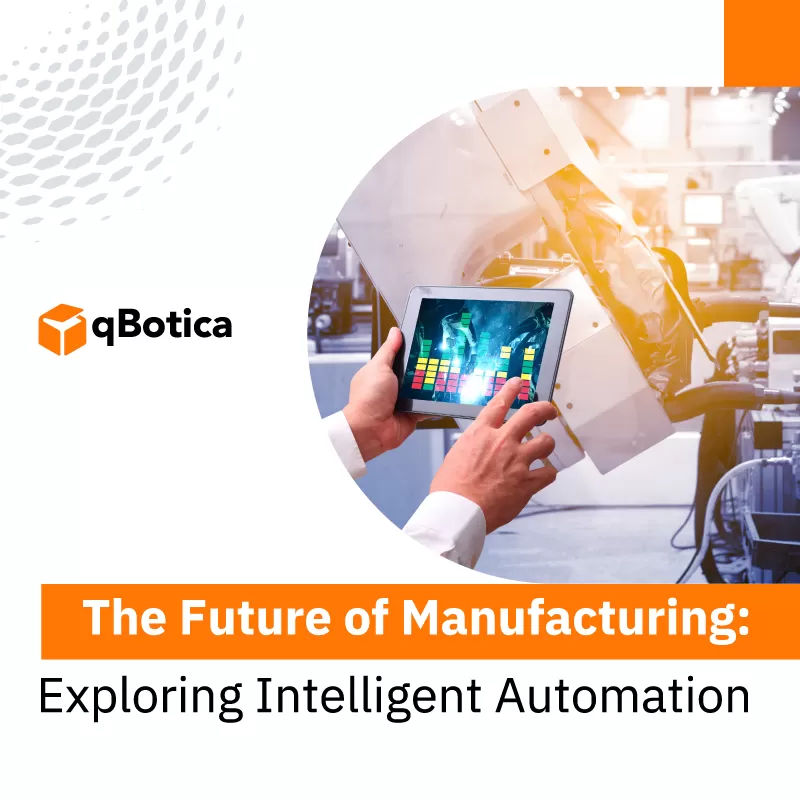
  • The Future of Manufacturing: Exploring Intelligent Automation

    The Future of Manufacturing: Exploring Intelligent Automation

    The world is constantly evolving, and new technologies have been developed to make our lives easier. When it comes to the manufacturing industry, intelligent Automation involves the integration of several elements, such as artificial intelligence (AI), robotics, machine learning, and the Internet of Things (IoT), among other cutting-edge technologies, to streamline and optimize manufacturing processes.

    Thanks to these new technologies, manufacturers can shift their focus to other essential aspects of their business while automating what’s necessary. It can bring several benefits to the business, such as higher productivity and even significant improvements, as well as an improved customer experience.

    Discover how qBotica’s expertise in Intelligent Automation can revolutionize your manufacturing processes. Schedule a meeting with our experts today and unlock the potential of advanced technologies for your business’s success.

    Key Technologies Driving Intelligent Automation

    For starters, Intelligent Automation refers to the use of automation technologies with the purpose of automatizing and optimizing certain tasks and processes in a smart and adaptive manner. This concept involves the use of the following technologies to perform tasks with minimal human intervention:

    1.    Artificial Intelligence (AI)

    Artificial Intelligence is perhaps the most essential aspect of Intelligent Automation. Thanks to machine learning and complex algorithms, businesses can analyze different types of data, including text and numbers, and use the information obtained to predict potential outcomes and make quick but informed decisions. It is like working with a smart computer that can think and make choices without constant human guidance.

    2.    Robotic Process Automation (RPA)

    Robotic process automation refers to the use of collaborative robots to perform repetitive tasks that are typically completed by humans. For instance, the robots could be in charge of filling out forms or perhaps extracting information from documents. RPA goes hand-in-hand with Artificial Intelligence so that it can perform advanced and more complex tasks. In other words, these robots act like virtual assistants who take care of monotonous activities while humans focus on more creative and innovative tasks.

    3.    Internet of Things (IoT) and Connected Devices

    The Internet of Things is not a new concept, but it has recently started to become more relevant due to its integration of it into several areas of our daily lives. It involves connecting common objects and devices we use in our everyday lives to the internet, allowing them to send and receive data.

    When it comes to intelligent Automation, the IoT is an essential element as it allows businesses to improve and enhance various processes. This way, companies can connect devices and sensors to gather information in real time about different aspects of the brand, such as their operations, clientele, or even the environment where the facilities are located. All this information will then be analyzed and processed by Artificial Intelligence to make informed decisions and automate certain tasks.

    Transforming the Workforce with Intelligent Automation

    Intelligent Automation can be implemented in several areas in various departments across a company. When it comes to manufacturing, it can revolutionize traditional processes to increase efficiency and productivity, such as the following:

    Maintenance

    Thanks to Intelligent Automation, analyzing real-time data from sensors and machine logs in an automated manner allows businesses to predict equipment failures or maintenance needs. If companies are capable of identifying these problems in advance, manufacturers can schedule maintenance activities, reduce downtime, and optimize the lifespan of machinery.

    Quality Control

    Intelligent automation systems can use machine vision technology to inspect products for defects, ensuring consistent quality and minimizing the need for manual inspections. This improves accuracy, speeds up the inspection process, and reduces the risk of errors or faulty products reaching the market.

    Inventory Management

    Intelligent Automation can track inventory levels, monitor consumption patterns, and automatically trigger reordering when the stock reaches a predetermined threshold. This optimizes inventory management, reduces stockouts, and minimizes holding costs.

    Supply Chain

    Intelligent Automation can analyze data from various sources, including suppliers, logistics partners, and market demand, to optimize supply chain operations. This includes forecasting demand, managing inventory levels, optimizing logistics routes, and streamlining production schedules.

    Data Analytics and Decision-Making

    Intelligent automation systems can analyze large volumes of data collected from various sources, such as sensors, production systems, and customer feedback. This data analysis enables manufacturers to make data-driven decisions, optimize processes, identify areas for improvement, and enhance overall performance.

    What Does the Future Hold for the Manufacturing Industry?

    The adoption of Intelligent Automation can bring remarkable advancements to the manufacturing industry. Thanks to the integration of technologies like Artificial Intelligence, Robotic Process Automation, and the Internet of Things, companies will be able to revolutionize traditional manufacturing processes and unlock a myriad of benefits.

    The implementation of AI solutions may make it easier for manufacturers to analyze various data types and make informed decisions without the need for human guidance. Furthermore, RPA complements AI as it is intended to automate repetitive tasks, allowing people to focus on more creative and innovative tasks.

    On the other hand, the IoT connects devices, objects, and sensors, making it easier for companies to gather and analyze data. This way, businesses may be able to improve several aspects of their operations, such as maintenance, quality control, or inventory management.

    Intelligent Automation is continually transforming the manufacturing industry, allowing the staff to enjoy various advantages, such as the following:

    • Anticipated maintenance and repair tasks due to the early detection of potential issues
    • Automated quality control for consistent product quality without human participation
    • Data-driven insights for continuous improvement

    It’s important for businesses to assess the potential areas that they could redefine or enhance through Intelligent Automation. This way, it will be possible for them to attack potential weak spots and strengthen the industry, given the highly competitive environment where we’re currently living. This way, human workers may be able to improve their efficiency and productivity by focusing on tasks that are more relevant to the business.

    Conclusion

    This way, embracing Intelligent Automation means looking into the future. It can help businesses unlock new levels of productivity, efficiency, and competitiveness in the rapidly evolving global landscape. The potential of Intelligent Automation may make it possible for manufacturers to shape a future where innovation and Automation can redefine the industry’s possibilities.

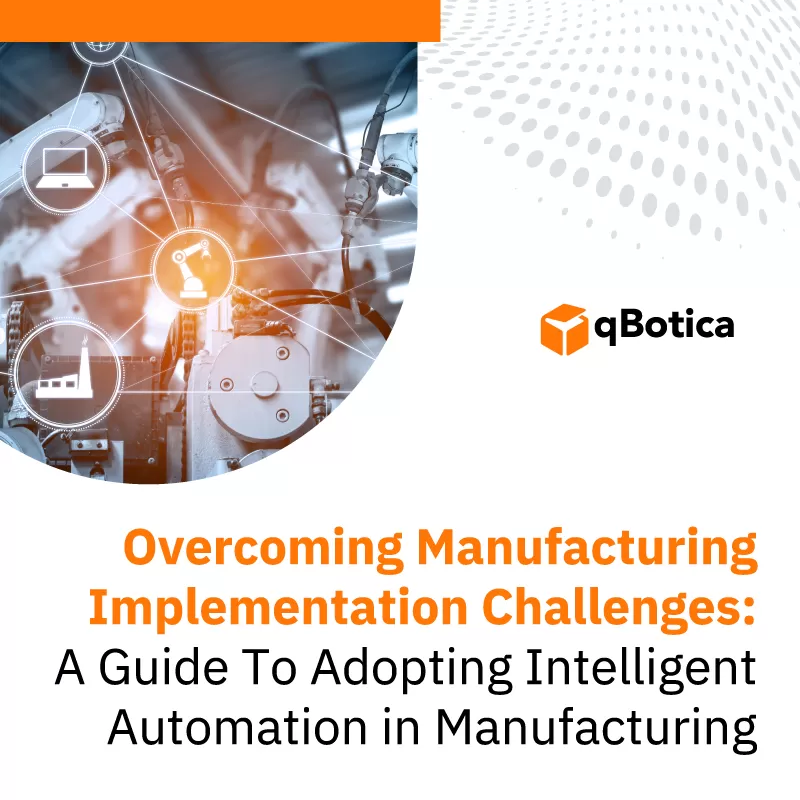
  • Overcoming Manufacturing Implementation Challenges: A Guide to Adopting Intelligent Automation in Manufacturing

    Overcoming Manufacturing Implementation Challenges: A Guide to Adopting Intelligent Automation in Manufacturing

    The implementation process for Intelligent Automation must first start by identifying and addressing the areas that could be optimized, especially those activities that involve high levels of repetitiveness.

    Integrating all the new elements that compose Intelligent Automation can be a complicated task. However, it is essential for businesses to look forward to the future and overcome the potential challenges that may arise during the adoption of such aspects.

    We will dive deep into the different aspects that businesses must take into account when adopting Intelligent Automation in manufacturing. The goal is to conquer obstacles and ensure a smooth transition towards adopting intelligent automation to optimize operations, improve productivity, and drive innovation in this industry.

    What is Intelligent Automation?

    Intelligent Automation is a concept that encompasses a wide range of advanced technologies that are meant to automate and optimize several activities and processes with intelligence and adaptability. Some of these technologies include Artificial Intelligence (AI), machine learning, robotics, and the Internet of Things (IoT).

    Significance of Intelligent Automation in the Manufacturing Industry

    There are different reasons why Intelligent Automation can be important for the manufacturing industry. It revolutionizes and enhances processes, improves operations within a business, allows companies to save costs while also enhancing the quality of their products, and boosts the overall productivity of the whole organization.

    Hence, Intelligent Automation plays a vital role in the manufacturing industry, offering crucial benefits and driving transformative changes.

    Strategic Planning for Successful Implementation

    How can you prepare your business for automation? It’s essential to follow certain steps and assess the potential challenges that could arise during the process. Doing so will ensure that you will have the success you aim for in the long run once implemented.

    1.    Develop a clear implementation roadmap and timeline.

    The first step is to prepare the business for the implementation of the automation program. Doing it the correct way can improve diverse areas of your business, not only those related to manufacturing. That’s why it is crucial to think strategically from the beginning. It will also depend on the specific automation resource that you intend to work with.

    It is important to sit down and evaluate all the potential aspects regarding that particular solution and draw a timeline based on the best way to approach the integration of such resources. Some of the aspects that should be considered include the following:

    •       Staff: Even though the goal is to automatize, the machines should still be supervised. Businesses must establish a committee that looks over the processes, including positions like Head of Automation, Process Analyst, and Technical Architect.
    •       Technology: It’s essential to analyze the situation and explore the different systems that could be implemented in the business. Before adopting new technologies, it is essential to evaluate the limitations the company currently has due to legacy tools or systems and how automation through new technologies can help the business overcome such challenges.

    Last but not least, it is crucial to select platforms that correctly adapt to your business. This way, you can ensure that the new automation tools will be effective, secure, and efficient enough to cover the needs of the company.

    2.    Assessing the current state of operations and identifying areas for automation

    Before implementing new automation solutions, it is crucial for manufacturing businesses to conduct a comprehensive assessment of their current operations. This assessment involves evaluating existing processes, workflows, and tasks to identify areas that are prime candidates for automation. The goal is to determine which tasks can be effectively and efficiently automated, freeing up human workers to concentrate on other departments or activities that require creativity, problem-solving, and decision-making skills.

    By analyzing these tasks, businesses can identify bottlenecks, areas of inefficiency, and opportunities for improvement through automation.

    Once areas for automation are identified, businesses can then determine the most suitable automation technologies to implement, such as robotics, artificial intelligence, machine learning, or a combination of these. It is crucial to evaluate the compatibility of automation solutions with existing systems, infrastructure, and workforce skills to ensure seamless integration and maximize the benefits of automation.

    3.    Setting realistic goals and expectations for Intelligent Automation Adoption

    If a business plans on implementing Intelligent Automation into its system, it is essential for them to establish tangible goals and have clear expectations so that the process of adaptation goes as smoothly as possible.

    Setting goals involves defining the specific objectives that the business aims to achieve through intelligent automation. These goals can be diverse and tailored to the unique needs and challenges of the manufacturing industry. Examples of goals could include improving operational efficiency, reducing production costs, enhancing product quality, increasing productivity, streamlining supply chain processes, or optimizing inventory management.

    The SMART model can be useful for this purpose, as the goals need to be specific, measurable, attainable, relevant, and time-bound. This way, companies can ensure that the plan they are establishing for the integration of Intelligent Automation is actionable and can be effectively tracked and evaluated through the automation journey.

    Potential Challenges for the Implementation of Intelligent Automation

    When implementing intelligent automation in a business, there are several challenges that these companies may face. Some of the most common include the following:

    • Intelligent automation technologies (AI, robotics, data analytics) can be quite complex, making it challenging to integrate them into existing systems and ensure compatibility.
    • Additional technical expertise may be needed to select, implement, and maintain the appropriate automation tools and infrastructure, increasing the resource requirements.
    • The costs of implementing Intelligent Automation can be high, requiring investments in technology, infrastructure, and talent. Calculating the return on investment and ensuring cost-effectiveness is essential.
    • Introducing Intelligent Automation requires a shift in the organizational culture and mindset. It is crucial for businesses to foster a culture that embraces innovation, promotes collaboration, and communicates the benefits of automation.
    • Every organization may face unique hurdles based on its specific context and industry. However, by addressing these challenges through careful planning and strategic decision-making, businesses can navigate the implementation process more effectively and unlock the full potential of Intelligent Automation.

    Ready to overcome these challenges and leverage the power of Intelligent Automation for your business? Contact qBotica’s experts today and discover how our tailored solutions can drive innovation and efficiency in your organization.

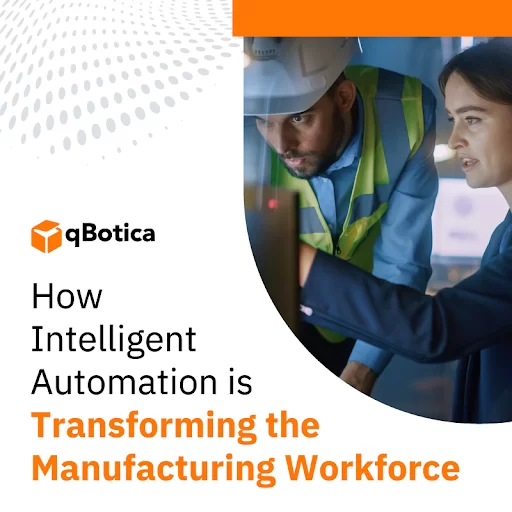
  • How Intelligent Automation is Transforming the Manufacturing Workforce!

    How Intelligent Automation is Transforming the Manufacturing Workforce!

    We all know that the manufacturing industry is undergoing a revolution, and it’s all thanks to intelligent automation.

    Manufacturers are more effective than ever thanks to AI and robotics, and this new technology enables companies to streamline their operations and boost output. Business operations are changing quickly due to the pace of technological advancement.

    We’ll look at how intelligent automation is changing the manufacturing workforce in this blog, as well as what it implies for the future of work.

    What is Intelligent Automation?

    Intelligent automation refers to using AI, robotics, and other technologies to automate tasks previously done by humans. These technologies enable machines to take over mundane, repetitive tasks and free up human workers for more creative or analytical work, and this can improve efficiency while reducing costs.

    In other words, you are hiring a robot to do some of your tasks that you previously did through human resources. This saves a lot of time and helps businesses achieve high efficiency.

    The Benefits of Intelligent Automation for the Manufacturing Workforce

    The manufacturing industry is revolutionizing as intelligent automation technologies such as AI and robotics transform manufacturers’ businesses. Intelligent automation machines take over mundane tasks and free up human workers for more analytical work – resulting in improved efficiency, reduced costs, and an overall better employee experience.

    Here are some of the benefits of intelligent automation precisely explained:

    Increased Output

    By enhancing output, intelligent automation is transforming the manufacturing sector. Robots and machines operate nonstop and around-the-clock, increasing output.

    The research found that businesses that shifted to robotic automation experienced an average of 10% growth in productivity, which resulted in higher income. The rise in output gives producers a competitive advantage in the world market.

    Increased Accuracy

    Intelligent automation reduces errors and waste while increasing output and improving accuracy. Machine learning algorithms powered by artificial intelligence (AI) allow for learning from data, improving task accuracy over time. According to studies, intelligent automation may increase precision and quality control by 40%, leading to significant cost savings and increased customer satisfaction.

    Faster Operations

    Improved turnaround times and quicker processes are further benefits of intelligent automation. High-speed operation enables task completion more quickly and improves responsiveness. Because fewer production cycles need to be completed at once, lead times are shortened and customers are more satisfied. Robots with AI capabilities can foresee issues before they arise, saving manufacturers from expensive delays or business interruptions.

    Intelligent automation also makes it possible for manufacturers to react swiftly to shifting consumer preferences or market trends, helping them to stay one step ahead of the competition.

    Enhanced Customer Satisfaction

    Moreover, intelligent automation leads to enhanced customer satisfaction. Automated machines can quickly process orders and deliver goods on time, leading to the highest customer service.

    Additionally, AI-powered robots can accurately predict customer preferences and trends, allowing manufacturers to customize their products and services according to customer needs. This improves overall customer and brand loyalty.

    Higher Employee Engagement

    Last but not least, intelligent automation has been shown to improve employee engagement and job satisfaction. Taking over mundane tasks gives employees more opportunities to work on challenging and meaningful projects. This leads to improved job satisfaction and greater motivation among employees. It also creates a better working environment, resulting in higher productivity and fewer sick days.

    Applications of Intelligent Automation

    The applications of intelligent automation in the manufacturing industry are vast. Some of the most popular uses include:

    Automated Inspection Systems

    Automation systems with AI capabilities are being used to increase inspection accuracy. Rapid error and defect detection is possible with automated inspection systems, which enhances quality assurance.

    Predictive Maintenance and Analytics

    Moreover, predictive maintenance and analytics are being improved with intelligent automation. By capturing sensor data and forecasting when maintenance should be performed, this system can reduce costs and increase productivity.

    Autonomous Robots

    Moreover, autonomous robots are being used in the manufacturing sector to automate jobs and procedures. The productivity of these robots can be increased by programming them to complete particular tasks more quickly and accurately.

    AI-Powered Supply Chain Management

    Finally, AI-powered supply chain management systems are greatly used to optimize operations in the manufacturing industry. This technology can track inventory levels and predict demand, allowing manufacturers to respond quickly to customer needs.

    FAQs – People Also Ask

    Question #1: How is intelligent automation transforming the manufacturing workforce?

    The manufacturing workforce is transformed by intelligent automation because it boosts accuracy, speed, customer happiness, and employee engagement. Orders can be processed swiftly by automated equipment, cutting down on lead times and raising customer satisfaction.

    Also, it makes it possible for businesses to react swiftly to shifting consumer needs, which boosts productivity and efficiency.

    Question #2: What are the benefits of intelligent automation in the manufacturing industry?

    Increased accuracy, quicker workflow, more customer happiness, and higher employee engagement are all benefits of intelligent automation. Also, it enables businesses to react swiftly to shifting consumer expectations, which boosts productivity and lowers costs.

    Question #3: What are some popular uses of intelligent automation in manufacturing?

    In the manufacturing sector, intelligent automation is frequently used in supply chain management powered by AI, autonomous robots, predictive maintenance, and analytics. These innovations can boost efficiency, lower expenses, and improve accuracy.

    Question #4: What is the role of AI in intelligent automation in the manufacturing industry?

    AI is crucial in intelligent automation, enabling machines to learn from data and improve accuracy with each task. AI-powered robots can anticipate problems before they occur, helping manufacturers avoid costly delays or stoppages in business operations.

    AI-powered supply chain management can track inventory levels and predict demand, allowing manufacturers to respond quickly to customer needs.

    Conclusion

    As a result of improving productivity, accuracy, and speed, intelligent automation alters the manufacturing workforce. Additionally, it improves staff and consumer engagement. Manufacturers can increase the effectiveness and efficiency of their operations by utilizing AI.

    They will be able to maintain their competitive edge and long-term profitability thanks to this. Your opinions on intelligent automation and how you believe it benefits the manufacturing workforce would be greatly appreciated. Post your comments below!