Qbotica

Author: Qbotica Seo

  • The Future of Application Testing: How UiPath Test Cloud and qBotica are Transforming Enterprise Quality Engineering

    Executive Teaser: The New Evolution of Enterprise Testing

    Businesses are now in a period where testing cannot merely prove anything, it must keep on guaranteeing. uiPathTest Cloud used on qBotica, is assisting organisations to align automation, artificial intelligence and performance validation in a single intelligent testing ecosystem. This change is transforming enterprise quality engineering in the following way.

    Lifecycle testing in UiPath Test Cloud: creating, testing, monitoring, and optimizing continuous -all through AI and automation.

    Executive Summary

    In the current digital economy, companies are supposed to provide perfect software more than ever quicker. However, most testing processes are still limited by fixed infrastructure, decoupled tools and manual integration that create bottlenecks into the contemporary release pipelines.

    UiPath Test Cloud

    It is a product of the UiPath Automation Cloud, which reimagines this model by integrating testing into an ecosystem along with an AI-driven ecosystem. It integrates the fields of design, execution, monitoring and performance validation into a single service-quality can become more proactive, rather than reactive, and it is driven by data.

    Companies that have already adopted this model record their observable gains: the accelerated development process, the increased level of automation, and a drastic decrease of the costs of testing and the work done manually. Through the proven enablement experience of qBotica, organizations are accelerating the scale of UiPath Test Cloud into testing business capability that is both strategic and generates faster delivery, compliance, and innovation.

    Combined, UiPath and qBotica are assisting companies in modernizing the test practice, both accelerating timetable to market, enhancing compliance, and facilitating unending innovation on an enterprise-wide scale.

    A Unified Testing Lifecycle

    In essence UiPath Test Cloud takes all testing processes, design, execution and insight, and places them all within one controlled environment. Instead of creating an assortment of structures, the groups can write coded or low-code tests in UiPath Studio or Studio Web with the help of a unified repository of objects that ensures reliability of selectors across the applications.

    Data about tests is centrally stored with UiPath Data Service, which helps teams to parameterize input values or create synthetic datasets with AI to cover more and be repeatable. Tests run on there are elasticantly run in the cloud on an expansive collection of surroundings, such as Web, API, Desktop, Mobile, SAP, Citrix, and Mainframe systems.

    As the results are fed into UiPath Test Manager, real time analytics and SLA dashboards can show the progress, performance and defect links. And since Test Cloud can be directly integrated with the tools like GitHub, Jenkins, and Azure DevOps, testing is a natural continuation of the CI/CDpipeline- it can automatically scale and overcome the limitations of a traditional testing environment.

    This orchestration eliminates tool sprawl, makes governance straightforward and results in a single source of truth of enterprise quality.

    A Cloud-Native Framework: Built to Scale

    UiPath Test Cloud is designed with an elasticity architecture, performance, and scalability to an enterprise. Cloud robots can be used to execute tests which can be dynamically scaled to match the workload demand eliminating the manual infrastructure provisioning. It has over 190 integrations with enterprise technologies, such as SAP, Oracle, Salesforce, Mainframe, and Citrix allowing a team to test all layers of its technology stack within a single platform.

    The AI is used in the process of the lifecycle: Autopilot proposes the choice, comments the test logic, and even assists in refactoring existing scripts. The Change Impact Analysis works automatically to identify high-risk areas when an update is made with the priorities of what to test first. Teams may also perform load, endurance and stress testing with up to 2,000 virtual users – on the same automation assets that drive functional testing.

    These capabilities create a secure, auditable and enterprise ready testing fabric which is a combination of functional preciseness and performance assurance.

    The Rise of Agentic Testing

    Testing is changing not into the traditional automation but into an agentic age, where AI is working autonomously with humans to design, execute, and refine the tests. The AI agents known as agentic testing can be used in combination with traditional test automation as independent agents.

    With Autopilot for Testers, teams can write tests using natural language, where AI can write code, find and use reusable parts and speed up the writing process. The Autonomous Agents will constantly search applications, identify UI or data changes and automatically recover broken tests without human intervention. And with Assisted Manual Execution, the automated process is represented by repetitive manual testing actions, yet by keeping the human oversight and evidence tracking.

    This change makes the process of testing not a mechanical one, but a smart system, which learns, evolves, and becomes better. Companies that have used this model have attained up to 90% automation coverage, 61% faster test creations and an almost 50% reduction in manual work-quality engineering has become a self-improving ecosystem.

    Incorporating Performance as a Core Function.

    Traditional performance testing has been a siloed field, which tends to rely on special tools and infrastructure. UiPath Test Cloud eradicates such a division by injecting performance validation right into the testing cycle.

    The same test assets that are used to verify functionality can now be used to simulate real-world workloads by teams. Multi-channel performance situations, where web, API and desktop processes are combined, may be run in the same interface, with resultant combined metrics of response time, throughput, and resource usage.

    This integration will make sure that the functional accuracy and system resilience are both measured in the same manner bridging the gap between QA and performance engineering. It also gets rid of tools that are duplicate and saves on operational overhead as well as time to insight.

    Measuring the Business Impact.

    The AI-powered, consolidated testing platform has business implications that can be evaluated on the financial and operational levels:

    • 529% ROI over three years
    • $4 million average per organization/annual benefit.
    • 61 percent faster test creation and authoring.
    • 50% decrease in hand testing tracks.
    • The cycles of release are six times higher.
    • 70% shorter processing times
    • 40% fewer escaped defects
    • 96% lessening of automation downtime.
    • 25 percent increase in total IT productivity.

    These findings indicate that the concept of modern testing is no longer a cost center- it is a strategic facilitator of reliability, compliance as well as customer confidence.

    Powering Each Persona in the Testing Ecosystem

    To the Executives and Business Leaders:

    The UiPath Test Cloud provides release pipeline transparency that assists leaders to observe reliability, performance and compliance real time. This visibility improves governance and sets the results of the testing in direct correlation to business KPIs.

    For Enterprise Architects:

    A unified, multi-cloud, and hybrid cloud system eases integration in a standardized framework. Having more than sixty native ALM and DevOps integrations, architects are able to create testing as a shared enterprise service across teams and geographies.

    For Developers:

    The developers are able to create, execute, and test the tests as part of their local CI/CD processes. Self-healing automation reduces maintenance, decreases the tension in the code changes and test preparation.

    As a QA Leader or Test Manager:

    Test Cloud offers centralized regression, data-driven, and performance testing orchestration as well as sophisticated analytics revealing the risk and coverage priorities.

    For Testers and Analysts:

    Low-code development, AI-assisted development, and evidence management in a central location enable testers, instead of performing regular testing, to perform validation that will be of higher value.

    Practical Change in the World of Industry

    In any industry, businesses are achieving quantifiable improvements faster, better, and larger with UiPath Test Cloud.

    A technology organization with operations worldwide was able to save 50% on manual testing and save tens of millions in money every year by integrating the test execution. One insurance company also increased processing by 70%, and a large financial institution consolidated testing on mobile, SaaS and desktop (legacy) applications to achieve regular scalability.

    In the energy market, a single firm achieved 90% coverage of automation and 75% components re-use, which saved it an excess of 80% costs in regression testing.

    These are just some of the ways in which implementing a single testing framework can contribute directly to the speed of operations, risk reduction and software reliability- enabled by such partners as qBotica which assists customers in scaling automation and testing maturity world-wide.

    Standing Apart: Cohesive Competitive Advantage

    In contrast to disjointed on-premises toolchains, UiPath Test Cloud provides a single, cloud-first architecture that scales to the elasticity level balancing security and governance criteria.

    It is compatible with more than 190 technologies, has inbuilt CI/CD connectivity and uses AI-driven self- healing to be stable in frequent releases.

    Data are centrally processed, either by direct integration or by AI-based generation and are traceable and adhere to enterprise requirements, including 21 CFR Part 11.

    All the elements are role-based and auditable, which provides organizations with certainty in the governance and regulatory conformity.

    With UiPath Test Cloud, organisations can test multiple functions, data and performance testing in a single roof, thereby eliminating redundancy and minimising maintenance costs, enabling organisations to focus more on innovating and less on infrastructure.

    From Validation to Continuous Intelligence

    Continuous intelligence is the future of testing a model in which systems do not just validate, but also learn and optimise on-demand. UiPath Test Cloud provides it through developing a continuous feedback loop linking testing to operations, data, and AI-enabled decisions.

    Organizations are also able to unify a disjointed tool set to a single platform, use AI to perform predictive analysis and test optimization, and perform scaling of testing dynamically to support business demand. This change reinvents quality assurance as a persistent layer of intelligence (which strengthens reliability, expands agility and accelerates digital change throughout the enterprise).

    With the adoption of this new wave of agentic AI-guided testing by organizations, the unified ability of UiPath Test Cloud and the enterprise enabling capabilities of qBotica can assist companies in transforming testing into an engine of digital excellence, rather than the reactionary endeavor.

    With UiPath Test Cloud, the future of enterprise quality engineering will be the unification of automation, intelligence, and scale to provide ongoing assurance to current digital ecosystems.


    To learn how UiPath Test Cloud and qBotica can help your organization accelerate digital quality transformation, visit UiPath Test Cloud Documentation or explore more on the UiPath Official Website.
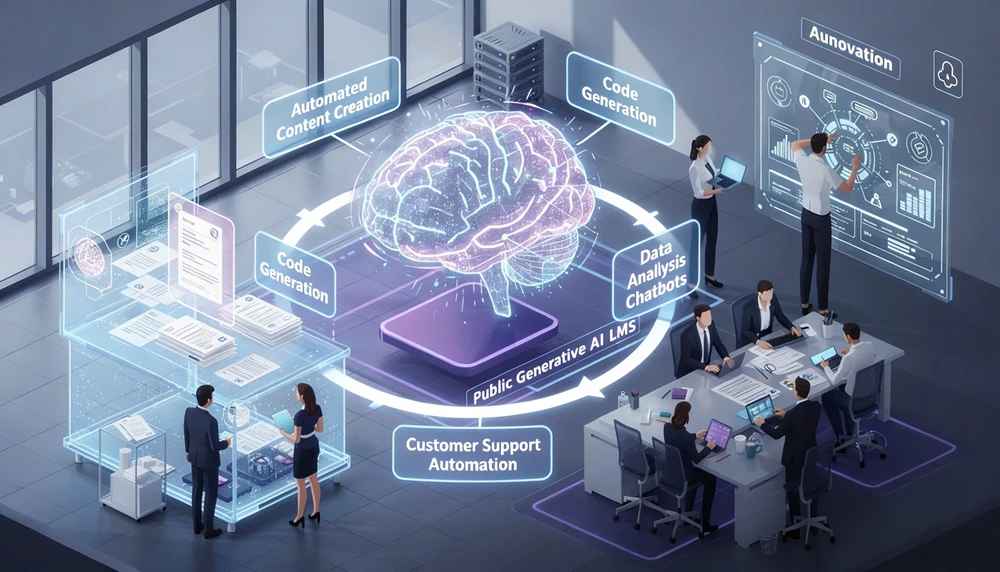
  • Common Use Cases of Generative AI

    Common Use Cases of Generative AI

    Generative AI has transformed various businesses by automating manual administration, increasing efficiency, and simplifying business processes. Taking advantage of the skills of generative AI, human resources are released to work on strategic and innovative initiatives that lead to productivity and innovation in their companies. Public Generative AI technologies such as Large Language Models (LLMs) and their various use cases will be reviewed and examined in the following sections.

    Healthcare

    Generative AI is a key force in the healthcare industry, where it can be used to automate routine and time-intensive activities. It improves efficiency and precision in its operations, enabling medical workers to focus on enhancing patient care and outcomes. Personalized generation of patient care, prescriptions, clinical recommendations, and administration of administrative issues such as scheduling appointments for patients are improved. These are the main improvements which contribute a lot to the telemedicine industry, therefore creating the potential of visiting a doctor in the comfort of your own home. Generative AI models such as Generative Adversarial Networks (GANs) and Variational Autoencoders (VAEs) collaborate with each other to process medical images, identify medical abnormalities, and contribute to the research and development of novel medicines in the future.

    Insurance

    Likewise, the insurance sector uses Generative AI to process claims and automate the process by extracting data provided in forms, verifying claims, and helping in fraud prevention. The usage of Natural Language Processing (NLP) tasks, referred to as Optical Character Recognition (OCR) or Document AI, are both used to read, comprehend, and automate data entry processes. Insurance fraud can be identified through the adoption of pattern recognition on insurance claim information through Large Language Model (LLM) algorithms. Also, LLM-based chatbots aid in customer service, increasing the quality of customer service through the reception of customer requests and to handle policy requests to an extent automatically until the supervision of a human being is necessary.

    Finance and Accounting

    Generative AI is useful in the field of finance to process market trends and propose a portfolio with increased investment policies. Analytics of future trends, pricing of assets, and Generative AI models enable economic indicators by learning using previous financial data in order to determine intricate patterns and associations in the data. Portfolio management models can replicate a number of effects on portfolio performance, economic climates, market situations, and events. At that point, financial professionals are able to develop and refine their investment strategies to maximize risk-adjusted returns, improve portfolio management, and make better investment decisions consequently taking into account the following factors: risk tolerance, anticipated returns, and investment horizons.

    Generative AI possesses the resources to automate tiresome and dull jobs in the accounting industry like: data entry, account reconciliation, and financial report generation. Special AI deep learning functions that are used in transformer models are designed to automate accounting data entry and account audit functions through the extraction of information in different documents offered, loading databases, and resolving inconsistencies to minimize created output errors related to manual input. Preparation of financial statements including balance sheets, income statements, etc., and cash flow statements can also be automated and made more efficient, through financial analysis and templates of financial experts.

    Workflow Automation

    Workflow Automation helps organizations in different sectors to automate and streamline processes. Part of the tremendous advantages is to increase productivity, boost user experiences, and operations of generative AI. Email automation will automate routine administrative functions such as the scheduling of appointments, information processing, businesses, and management. This frees up human resources to work on more strategic issues for the organization. Workflow bottlenecks are discovered, and recommendations are offered to improve general functions of an organization and utilize resources in the best way possible, thereby enhancing productivity. In order to enhance user experience, user tastes and past data are considered to give customized customer suggestions that can be made to improve the overall user experience with a platform of an organization. Thanks to large language models, customers can also interact with chatbots to seek their help by troubleshooting problems and to answer questions that could be raised by the customer.

    Human Resources

    Integration of generative AI in Human Resource Management (HRM) software has changed how the management of employee benefits can be streamlined to take on the time-consuming processes and improve operational efficiency on activities that are based on the handling of paperwork manually, disjointed systems, and disjointed communication into one. Generation of HR documents can be automated with the help of Optical Character Recognition (OCR) and Document AI technology such as employee contracts and on-boarding letters by filling in the proper templates with the proper data and merging the pertinent information about employees with payroll, benefits, and time-tracking systems into the HR database. Chatbots based on generative AI dedicated to HRM systems offer consolidated communication channels with real-time response to employee queries that give uniform answers by responding to questions on company policies, employees’ training processes, and employee perks. Workflow automation is commonly used to assist in quickening HR responsibilities such as approval procedures and leave requests for employees within an organization.

    The ability of generative AI in these industries is only bound to grow as it develops, promoting creativity and productivity.

    -Pradeep Arumugam

  • Agent AI vs Agentic AI: Understanding the Distinction Between AI Terminology and Concepts

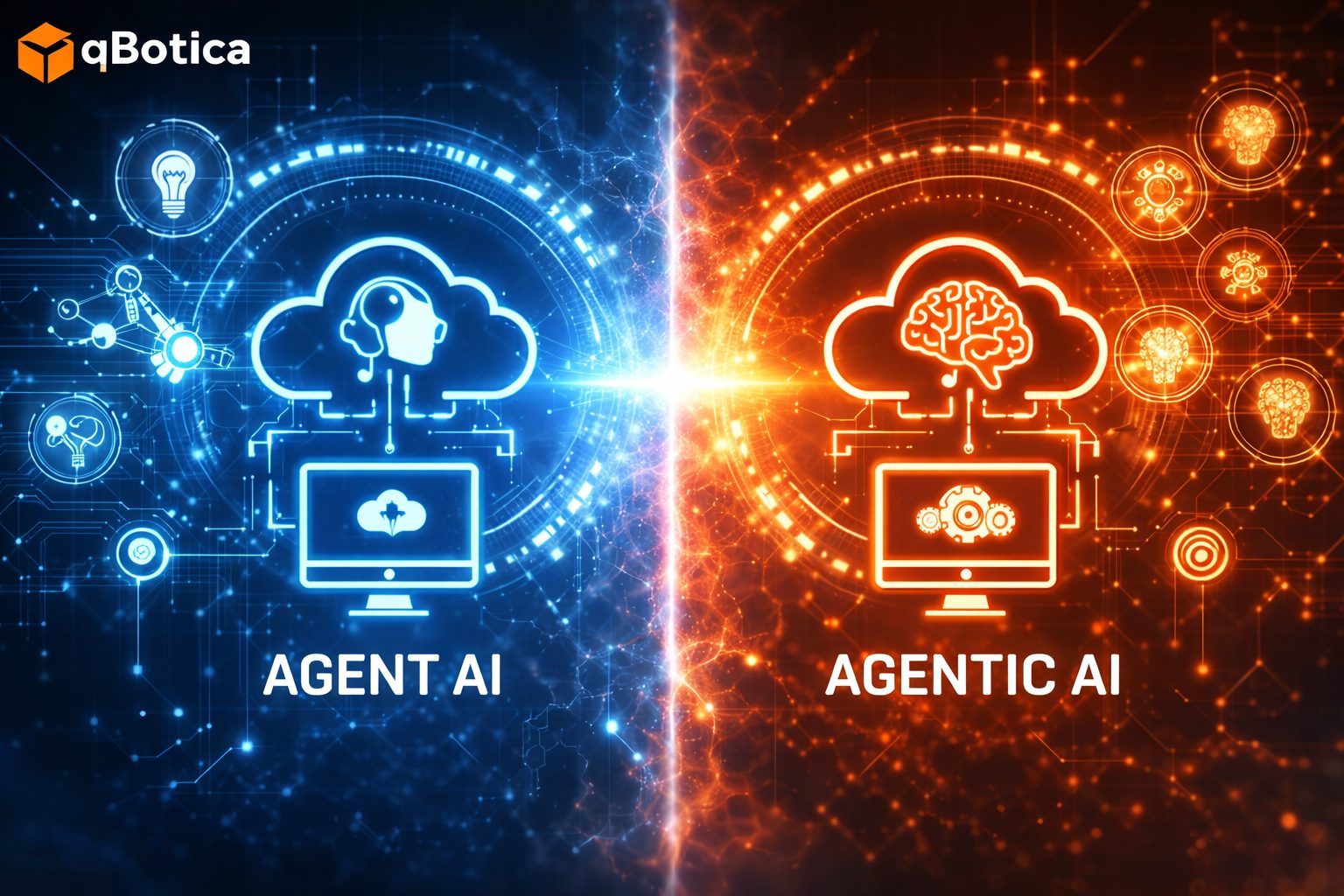
    Agent AI vs Agentic AI: Understanding the Distinction Between AI Terminology and Concepts

    Artificial intelligence terminology is also growing larger by larger bounds, causing confusion among business leaders, solution designers and people using AI in enterprises. One emerging topic of discussion is agent ai vs agentic ai, which is increasingly important as organizations explore intelligent automation strategies and AI transformation initiatives. The controversy of agentic ai vs generative ai is one of the most indeterminate aspects currently, especially as companies consider automation plans and AI transformation models. The two terms can be heard interchangeably, however, they have a lot of differences in terms of meanings, applications, strategic implications and technical structures. Such distinctions are important particularly to businesses that consider autonomous systems, intelligent automation and cognitive decision making frameworks.

    This article offers a practical and industry consistent agentic ai definition and definition of ai agents vs agentic ai, both in terms of conceptual models and practical implementation. It further brings out the situation and stance of qBotica in providing enterprise autonomous AI agents solutions.

    Agent AI vs Agentic AI

    Agent AI vs Agentic AI: Understanding AI Terminology and Concepts

    To start the analysis of agent ai vs agentic ai, it is necessary to know what AI agents are. The term agent AI is used to describe a concept, which is more general and more fundamental: AI systems are agents or assistants that can be used to perform tasks or to interact with users or to manage workflows. These systems can be based on automation platforms, rules, enterprise integration or conversation.

    The term agent AI can be used more broadly to refer to any artificial intelligence system that can act as an agent. These solutions can help in data entry, communication, orchestration, routing or decision making.

    Highly autonomous, goal oriented AI systems (where the decision cycles and optimization are controlled by AI) with very little human involvement are referred to as agentic AI in the modern sense. When people in enterprise teams pose the question, what is agentic ai? the answer would revolve around autonomy and strategic intent these systems are not mere execution of tasks, they are goal oriented.

    Previous intelligent automation systems were under the large umbrella known as Agent AI. However, following the maturation of enterprise automation and the development of intelligent decision layers, industry terminology changed to the label of autonomous system giving rise to agentic ai. This change is a manifestation of more profound abilities: self direction, an understanding of processes and process optimization.

    As enterprise automation becomes more advanced, the industry is moving toward more agentic AI to mean independent enterprise AI decisioning as opposed to mere task agents.

    Major Conceptual Differences and Distinctions

    Agent AI vs Agentic AI: Scope and Specificity Differences

    The initial significant difference between ai agent vs agentic ai is in scope:

    • Stringent is agent AI, which is general purpose in nature.
    • Specific Agentic AI is goal oriented and focused on optimization.
    • Practically, Agent AI can assist conversational agents, agentic ai workflows assistants or programmed decisioning.

    In comparison, agentic systems strive at achieving enterprise outcomes like shorter cycle time, greater precision or lower cost.

    Agent AI vs Agentic AI: Autonomy and Decision-Making

    There is a complete spectrum of autonomy in agent AI, ranging between human operated task assistants to highly sophisticated self controlled software robots. The uppermost part of that spectrum is where agentic AI is situated; this is not created to perform tasks independently, but to make independent choices and strategize.

    Goal Orientation and Intention

    The majority of Agent AI systems act in a specified manner or respond to queries. The agentic AI systems act as independent business agents  analysing, prioritising and realising enterprise level objectives.

    Agent AI vs Agentic AI: Technical Implementation and Architecture at qBotica

    qBotica focuses on the high level automation of the enterprise and the technological environment of the company indicates the division of generative ai vs agentic ai.

    System Design Philosophy

    qBotica Agent AI systems are based on flexible agentic AI architecture, which are flexible in rule based engines, orchestrated platforms and human review cycles. However, agentic AI systems are created with the independent functionality, sophisticated intent processing and autonomous orchestration, which necessitates a specific and complex architectural process when considering how to build agentic AI on agentic ai platforms..

    Decision Making Capabilities

    In cases where the decision making can be performed or assisted by Agent AI, agentic AI uses contextual reasoning, document intelligence, continuous learning and problem solving using cognition. This level of autonomy is key to understanding how does agentic AI works. Such systems are constructed so that they have a high degree of autonomy in making decisions, as opposed to assistance.

    Agent AI vs Agentic AI: Market Positioning and Industry Usage

    With the changing words impacting market discourse, qBotica redefines its messages, product and delivery models based on the emerging autonomous AI needs.

    Terminology Adoption and Trends

    Such trends as terminology adoption are best determined by analyzing both historical and contemporary sources. This analysis is best done through analyzing ancient and modern sources.

    The agent AI is still popular in the automation sector, mostly because of the legacy and conceptual familiarity. However, the AI market in terms of enterprise is moving towards the agentic model based on the high tech features.

    Positioning of Platform qBotica

    qBotica uses the term agentic deliberately and conveys more automation intelligence and autonomous delivery of outcomes. Although the concept of an Agent AI positioning is still the relevant one when it comes to a larger readership of the automation, agentic vocabulary is what sets the most advanced systems of qBotica apart.

    Differences of qBotica in Practical Applications and Use Case

    The agent ai vs agentic ai can be very visible in the practical deployment. Naturally, the categories of agentic ai applications vary depending on functional capability and level of autonomy. A review of agentic ai examples best illustrates this point.

    Agentic AI use cases

    • Bots and communication assistants.
    • Coordination of tasks automation.
    • Automation of workflow.
    • User interaction systems
    • Conversational interfaces

    Such systems uplift efficiency, remove repetitive workloads and provide continuity of processes.

    qBotica AI agent use cases

    • Bi lateral business process management.
    • Workflow routing and prioritization are self managed.
    • Computer decision making and intelligent operations.
    • ABMAgile Customer engagement.
    • Discreet supply chain coordination.

    The agentic systems are self optimizing in performance.

    qBotica’s Business Value and Implementation Considerations

    Commercially, there is a direct relationship between budget, complexity and ROI based on the difference between AI agents and agentic AI. Understanding the benefits of agentic ai is crucial to setting the right investment expectations.

    Investment and ROI Expectations

    The agent AI systems provide sustainable ROI in terms of labor reduction, removal of errors and speed of workflow. The agentic ai advantages produces exponential ROI through the removal of process ownership burdens and through value generation exploration.

    Implementation Complexity

    Implementing agentic AI requires more discovery, architectural modeling, governance design and enterprise readiness. Both of these models are scaled, but the agentic solutions require a higher level of planning and integration maturity.

    Agent AI vs Agentic AI: Selection Criteria and Decision Framework

    The agentic ai vs ai agents query frequently comes out at the early stages of solution design. Clearness on the expectations of intelligence requires a selection of the proper terminology and a solid ai agents definition.

    The use of Agent AI Terminology

    • Task oriented systems can be described when.
    • When it comes to streamline communication.
    • In the workflow assistance conceptualization.
    • When autonomy is limited

    When to Use Agentic AI in the Agent AI vs Agentic AI Framework

    • When the intelligence is higher than the execution of the task.
    • Systems work to achieve results on their own.
    • In cases where optimization is required on an ongoing basis.
    • When autonomy defines value

    The Future of Agent AI vs Agentic AI in Enterprise Automation

    Due to the increasing enterprise AI, the line between agent AI and agentic AI can be unclear. Looking at the future of agentic ai, self architecture will ultimately become the norm, changing the expectations of the enterprise. Two major shifts are likely:

    • General AI artificial intelligence agents will become specialized autonomous agents.
    • Enterprise automation standards will be characterised in agentic systems.
    • The landscape of terminology will not be based on the vice versa.

    Agency AI and Approach to Agent AI at qBotica

    qBotica provides transparency, ai agent framework and technical accuracy throughout the entire spectrum of automation. Regardless of the adoption of either Agent AI or agentic AI systems, qBotica is concerned with:

    • Terminology accuracy
    • Architectural strategy
    • Maturity of intelligent automation.
    • Cognitive operating models
    • Long term automation value

    The outcome: the enterprise customers will get clear expectations, regular updates and accurate system design documents.

    Agent AI vs Agentic AI: Industry Standards and Best Practices

    The internal practices are focused on the alignment between terminology and ability:

    • Effective definition of capabilities.
    • Scoring of transparent autonomy.
    • Regular communication systems.
    • Documentation accuracy
    • Market readiness alignment

    The practices avoid confusion and make the adoption of enterprise automation successful.

    FAQs on Agent AI vs Agentic AI

    Is there any functional difference?

    Yes. Task Agentic AI facilitates tasks, agentic AI accomplishes goals on its own.

    What are the terms that enterprises are supposed to use?

    Speak in terms of the autonomy of operations and not preference or fad.

    What is the difference between the two as offered by qBotica?

    By capability classification, deployment strategy and level of intelligent automation.

    Is the market going to unite at one term?

    Perhaps, but current trends are making a shift towards models that are well defined.

    What has an effect on the choice of terminology?

    System autonomy, level of intelligence, possession of workflow and transformation intentions.

    Find out how qBotica can speed up AI driven change and help your business get real results. Here, you can find out more about qBotica’s smart automation and digital transformation solutions.

    Follow us on LinkedIn and check out our Insights Hub to stay up to date on the latest news and information from qBotica. If you want to know more, please get in touch with the qBotica Marketing Team at

    +1 (623) 252-6597 or

    marketing@qbotica.com

    https://qbdevweb.unitdtechnologies.com/wp-admin